

General News
Behold, the 10 Richest Presidents In the World


With power comes not only fame but immense fortunes. Heads of state or government are supposed to be the servants of the people, but it this appears a Herculean task in this time and age.
Those who serve should have genuine of their motherland at heart and provide leadership to the citizenry.
True leaders are those that are in tune with the pain and plight the people and know what the ordinary man really feels.
Little wonder, there is great admiration for Jose Mujica, the President of Uruguay, who has eschewed all the perks of power to live a simple life among ordinary Uruguayans.
It is in this light that we are taking a look at the top 10 world’s richest presidents and their style of leadership.
1. Vladimir Putin, President of Russia – $40 billion
Vladimir Putin has been the Russian President since 2012, though he also served in the post from 2000 to 2008.
Though his reported income is only $80,000, Putin is said to be a multi-billionaire because of his stakes in various Russian companies.
He has had several houses built ostensibly as official residences of the head of state or government. One in Praskoveevka near the Black Sea is said to cost around a billion dollars.
2. Bhumibol Adulyadej, King of Thailand – $30 billion
Bhumibol Adulyadej is the beloved King of Thailand. He is the longest currently serving head of state and the longest reigning monarch in the history of his country.
He has been the country’s King since 1946. He has made generous contributions to various sectors of Thai society.
He is considered to be the richest royal in the world.
3. Hassanal Bolkiah, Sultan of Brunei – $20 billion
Hassanal Bolkiah’s complete name is Sultan Haji Hassanal Bolkiah Mu’izzaddin Waddaulah ibni Al-Marhum Sultan Haji Omar Ali Saifuddien Sa’adul Khairi Waddien.
He became the Sultan of Brunei after the abdication of his father in 1967. He has one of the largest car collections in the world, with some companies making new cars exclusively for him. He even has a Rolls Royce coated with 24K gold.
4. Abdullah bin Abdulaziz Al Saud, King of Saudi Arabia – $18 billion
Abdullah bin Abdulaziz Al Saud is the third richest monarch in the world. He became King of Saudi Arabia in 2005 after the death of his half brother King Fahd.
As the Saudi King, he is also the Custodian of the Two Holy Mosques. Under his regime, the country has slowly been undertaking reforms, including allowing more rights to women.
He is known for his immediate response to international disasters, like the 2008 earthquake in China and Hurricane Katrina in New Orleans.
5. Khalifa bin Zayed Al Nahyan, President of United Arab Emirates – $15 billion
As the Emir of Abu Dhabi, Khalifa bin Zayed Al Nahyan is also the President of the United Arab Emirates.
He took over as President in 2004 after the death of his father. He is the chairman of the Abu Dhabi Investment Authority.
His family has an estimated wealth of more than $150 billion. He is known for his philanthropic work, making donations to orphanages in Turkmenistan, hospitals in the US and schools in Wales.
6. Mohammed bin Rashid Al Maktoum, Emir of Dubai – $4 billion
As the ruler of Dubai, Mohammed bin Rashid Al Maktoum is also automatically the Prime Minister and Vice President of the United Arab Emirates.
He came to power in 2006, succeeding his older brother Maktoum bin Rashid Al Maktoum. He owns 99.67 percent of Dubai Holding.
He is also responsible for the construction of landmarks like the Palm Islands, Burj Al Arab and the Burj Al Khalifa. His family’s total wealth is estimated to be around $44 billion.
7. Hans-Adam II, Prince of Liechstenstein – $4 billion
His full name can be a mouthful: Johannes Hans Adam Ferdinand Alois Josef Maria Marko d’ Aviano Pius von und zu Liechtenstein.
He owns the LGT banking group. His family also owns an extensive collection of art pieces. These are displayed for public viewing at the Liechtenstein Museum in Vienna. He is considered as the wealthiest monarch in all of Europe.
He holds broad powers as head of state, including the ability to introduce legislation and the power to veto laws passed by the parliament.
8. Hamad bin Khalifa Al Thani, Emir of Qatar – $2.5 billion
The ruler of Qatar comes from the Al Thani dynasty that began its reign in 1850 when Muhammad bin Thani ruled the country.
The family comes from one of the largest tribes in the Arabian Peninsula called the Banu Tamim. The current Emir came to power in 1995 after deposing his father.
He was one of the primary backers of the Al Jazeera news network, even providing a $137 million loan to help the company in its first years of operation.
The Emir is also known as a huge football fan, having made bids to take over clubs like Manchester United and Rangers FC
9. Mohammed VI, King of Morocco – $2.5 billion
Mohammed VI became the King of Morocco in 1999 after the death of his father.
He drew a lot of attention after promising to tackle the triple issues of poverty, corruption and human rights violations.
These have yet to be solved, however, as evidenced by widespread protests in 2011. Corruption issues have also led to the King himself.
He holds significant amount of shares in Omnium Nord Africain, or the ONA Group, that owns diverse investments in retail, financial services, mining and other sectors
10. Sebastian Pinera, President of Chile – $2.4 billion
Sebastian Pinera came to power in 2010 after being elected as the first billionaire to be sworn in as President of Chile.
He owned Chilevision, a terrestrial television channel that broadcasted all over Chile. He also owned 27 percent of LAN Airlines after purchasing the shares of Scandinavian Airlines in the former state-owned firm in 1994.
He also held a 13 percent share in Colo Colo, one of the country’s most popular football clubs. He was also responsible for introducing credit cards to Chile in the 70s.


Nigeria powered Jumia Technologies AG’s strongest growth in 2025, cementing its position as the company’s most important market as rising consumer demand, SME activity and logistics expansion boosted performance across the e-commerce platform.

In the fourth quarter of 2025, Jumia’s Nigeria operations recorded a 50% year-on-year increase in Gross Merchandise Value (GMV) and a 33% rise in orders. The performance highlighted growing adoption of online shopping and Jumia’s increasing relevance to African consumers.
Nigeria’s momentum helped drive 36% year-on-year GMV growth and 34% revenue growth across the group in the quarter, alongside a 26% increase in quarterly active customers. Growth was supported by stronger customer retention and higher order frequency.
Beyond sales growth, Jumia said its Nigeria operations are delivering wider economic impact. The platform supports thousands of local SMEs, enabling them to reach customers nationwide, while continued investment in fulfilment centres and last-mile delivery is creating income opportunities for logistics partners and sales agents.
Efficiency gains were also evident. Fulfilment costs per order declined 12% year-on-year, contributing to a 39% reduction in operating losses and a 47% drop in adjusted EBITDA losses in the fourth quarter. Cash used in operating activities fell sharply to $1.7 million, compared with $26.5 million a year earlier, while liquidity stood at $77.8 million at year-end.
Temidayo Ojo, Chief Executive Officer of Jumia Nigeria, said the results reflect growing trust from consumers and businesses. “Nigeria is central to Jumia’s growth,” Ojo said. “Each order supports local sellers, delivery partners and jobs, while improving access to affordable products for consumers.”
For the full year, Jumia reported 14% GMV growth and 13% revenue growth, with losses narrowing significantly. Looking ahead, the company expects Nigeria to remain a key growth driver as it targets 27–32% GMV growth in 2026 and aims to reach adjusted EBITDA breakeven by the fourth quarter of 2026.
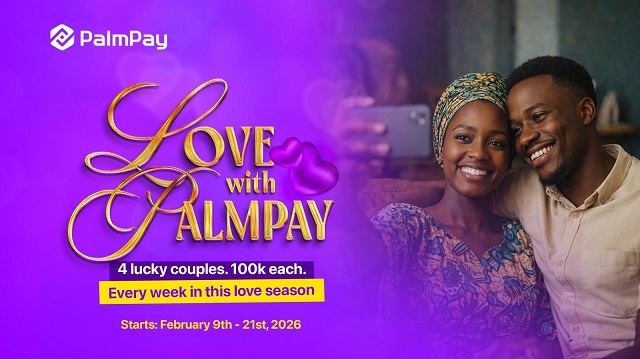
This Valentine’s Day, PalmPay is celebrating love in all its forms with the launch of #LoveWithPalmPay, a campaign highlighting how simple, everyday shared money moments can bring relationships closer.

Valentine’s Day is more than grand gestures; it’s built on the small, meaningful actions that shape relationships, sending timely support, saving together, or managing shared responsibilities. PalmPay encourages users to share 30–60 second real-life stories, either solo or duet style, showing how PalmPay always works and has helped them support or stay connected with someone they love.
The campaign runs from February 9th to 21st across Facebook, Instagram, X (formerly Twitter), and TikTok. Four winners will receive ₦100,000 each week for two weeks, totalling a prize pool of ₦800,000.
Entries can take many forms, including couple videos, solo stories, split-screen duets for long-distance couples, or voiceover narratives with photos or clips, making the campaign inclusive for married couples, parents, and long-term partners.
How to Participate:
- Share an authentic love story about your partner
- Clearly show PalmPay in action (transfers, savings, or other in-app activities)
- Be creative and emotionally engaging
- Post between February 9th – 21st with the hashtag #LoveWithPalmPay
- Share on any of PalmPay’s social media platforms
“Love evolves, and so do relationships,” said Olorunfemi Hanson, Head of Marketing and Communication, PalmPay. “From dating to parenthood, the small money moments we share every day play a big role in keeping us connected. With #LoveWithPalmPay, we want to celebrate those stories and show how PalmPay always works, making everyday love simpler, reliable, and meaningful.”
This Valentine’s Day, PalmPay celebrates love as it truly is real, intentional, and built on shared moments.
PalmPay is a leading digital banking platform driving financial inclusion and economic empowerment in underserved emerging markets. Through its secure, user-friendly, and inclusive suite of financial services, PalmPay empowers individuals and businesses with tools to manage and grow their money.
PalmPay offers a comprehensive range of products, including mobile payments, savings, and micro-insurance via its app and mobile money agent network.
Since launching in Nigeria in 2019 under a Mobile Money Operator license, the platform has grown to over 35 million app users and processes up to 15 million transactions daily. PalmPay has operations in Nigeria, Ghana, Tanzania, and Bangladesh. For more information, visit www.palmpay.com

Central Bank of Nigeria (CBN)and the Nigerian Communications Commission (NCC) have proposed that customers must receive refunds within 30 seconds for failed airtime and data purchases to curb persistent billing complaints in the telecommunications sector.

This was indicated in the Exposure Draft of the Joint CBN–NCC Framework for Resolution of Failed Airtime and Data Purchase Transactions, which was published on the website of the CBN on Monday.
The landmark exposure draft, dated 5 February 2026, seeks to “institutionalise clear accountability” and establish a “coordinated approach to consumer redress” across the financial and telecommunications sectors.
The most significant shift in the proposed framework is the introduction of standardised, automated timelines for resolving failed transactions.
Currently, Nigerians often face long delays when airtime purchases fail at the bank, aggregator, or Mobile Network Operator level.
To solve this, the regulators have proposed a 30-second window for automated reversals. Section 6.0 (ii) of the draft exposure, which dwelt on failed transactions, especially as it relates to unfulfilled airtime/data delivery, proposes a time to refund the purchaser of 30 seconds “if the transaction failed at the bank level… Failed transaction delivery from NCC Authorised Licensees… Failed transaction delivery from MNO to the NCC Authorised Licensee.”
The draft emphasised that stakeholders must “automate reversal processes across all stakeholders” to ensure that refunds require no human intervention from the customer.
The draft exposure also stated that “all parties involved in airtime and data transactions shall take the following actions to ease usage and facilitate consumer satisfaction: a. Stakeholders must immediately connect ONLY to relevant authorised licensees of the NCC and CBN. b. MNOs and banks must only connect to NCC Authorised Licensees/MNO digital channel partners for airtime and data vending… Notifications of failure create final settlement obligations between MNO and NCC-authorised licensees… The NCC and CBN will audit stakeholder compliance jointly or individually at quarterly or other intervals as may be determined.”
From a business and oversight perspective, the regulators are proposing a Central Monitoring Dashboard to be hosted jointly by the CBN and NCC, which will track reversals, Service Level Agreement breaches, and customer complaints in real-time.
“There shall be a Central Monitoring Dashboard hosted by CBN/NCC for tracking reversals, SLA breaches, and customer complaints. This will facilitate the establishment of a real-time national ‘Failed Transactions Dashboard’ with a uniform error code with end-to-end visibility across the value chain’, read the draft exposure.
This is designed to eliminate the “unclear ownership of liability” that often occurs when banks and telcos blame each other for failed recharges. To support this, banks and MNOs will be required to maintain and share daily reports of successful and failed cases.
The proposed framework also addresses the common problem of “lost” money when customers recharge ported phone numbers. The draft mandates that MNOs must validate a phone number against the ported number database before processing any recharge. If the system identifies a number as ported out or invalid, it must “proactively stop recharges” and send a failure code back to the bank to ensure the customer is not debited.
For erroneous recharges sent to the wrong person, the framework sets clear protocols: below N20,000, MNOs will request the recipient’s consent before a reversal, and when it is above N20,000, an affidavit of indemnity or notarised letter is required to process the recovery.
The CBN and NCC in the exposure draft signalled they will take a firm stance on compliance. Both agencies will conduct joint quarterly audits of all stakeholders, including banks, payment service providers, and MNOs, to verify compliance with the new rules. The regulators have warned they will “impose penalties for any breach” of the framework’s provisions.
Banks and other financial institutions have until 10 February 2026 to submit their inputs on the draft before it is finalised. Once implemented, the framework is expected to significantly restore “subscriber trust” in Nigeria’s digital financial ecosystem.

UBA Revamps Agency, Unveils Enhanced Value on RedPay Terminals

FG Seeks Private Sector Partnership to Bridge Broadband Gap

Nigeria Market Powers Jumia’s Momentum as E-commerce Platform Demand Accelerates

Cybersafe Foundation Partners Google to Strengthen Cybersecurity Among CCIs in Africa

Kaspersky Brings more Transparency to Threat Detection with New Hunt Hub

Firm Detected a Fivefold Surge in QR Code Phishing Attacks in the Second Half of 2025

US invests $115m in counter-drone tech for World Cup security

Nigerian Terra Industries Secures $11.8m for Expansion

Nigeria Targeted with 4,622 Cyber-attacks Per Week in December 2025

Firm Detected a Scam Exploiting OpenAI’s Teamwork Features




 General News3 days ago
CBN, NCC Propose Instant Refunds for Failed Airtime, Data

 Telecom3 days ago
Safer Internet Day: Sophos Warns – 42% Attacks Hit Stolen Logins in 2025

 News3 days ago
Ecobank Nigeria to Host Customer Forum on Strengthening Regional Integration for Economic Transformation

 News3 days ago
Lagos to Establish West Africa’s Premier International Financial Centre

 Telecom2 days ago
Inside Nigeria’s Telecom Exploitation Crisis Draining Household Budgets

 General News3 days ago
FG Launches the Happy Woman App Platform

 News3 days ago
Lasaco Assurance Gets Shareholders Approval to Advance Capitalization Plans

 Telecom3 days ago
Airtel Achieves 99 Per cent 4G Coverage across Nigeria