What can wearable gadgets find out about you that you do not know yourself? Would you want such data shared with your employer?
Answering these questions could help to understand the growth potential for commercial wearable devices and offer a glimpse into ways they could change our work environment in the future.
According to the International Data Corporation (IDC) Worldwide Quarterly Wearable Device Tracker, commercial (used by businesses) wearables account for less than 0.5% of about 11 million units shipped worldwide in 2015 Q1.
But this situation can change radically in the near future, once company decision makers and employees alike learn about the benefits of wearable technology.
Vanson Bourne conducted a survey of 300 UK and US IT decision makers that indicates more than 50% of organizations have not considered of wearable technologies, and more than 30% cited that there are no devices that would useful for their business.
In a wider perspective of Internet of Things (IoT) — i.e., machine-to-machine communication — companies are far from being involved in the discussion of new technology perspectives for their business.
According to IDG Enterprise, 41% of companies with more than 1,000 employees and 65% of smaller companies currently have no enterprise plans for IoT.
Needless to say, statistics like this do not bode well for wearables. In addition, other market inhibitors include limited availability of wearable technology solutions, limited application to business needs, and an overall lack of awareness on the part of the general public.
Nevertheless, wearables offer some straightforward benefits that could serve as inducements to enterprise adoption, such as improving workers' health by motivating them to stay active or by providing information that employers will find useful, such as workers’ locations.
What follows are a few examples of how companies can utilize wearable technology and derive business value from these devices.
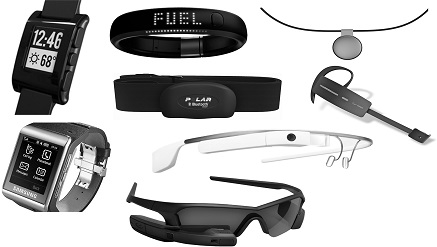
According to IDC, wearable devices are grouped into two categories - basic and smart wearables.
The distinctive feature of basic wearable devices, such as fitness trackers, is that they can perform only functions the device was designed for and cannot run third-party applications.
Smart wearables (for example smart watches or smart glasses), on the other hand, allow users to run third-party applications.
The data generated by basic wearables, such as fitness trackers, can be applied to modern health management programs.
If these devices can improve employees' health by providing additional financial incentives to employees for reaching certain physical activity targets, and allow companies reduce their overall health care spending, enjoy healthier and more productive workforce at the same time, then it is a clear win-win situation.
For example, BP implemented its "Million Step Challenge" program as a prerequisite for a health plan incentive back in April 2013, using Fitbit trackers.
According to the organizers, the wellness program, including the Million Step Challenge, helped to reduce overall health risks by almost 10% and reduce overall health care spend by more than 3%. Since then, BP has renewed the program several times.
Another good example is the U.S. Army, which used 2,200 Fitbit trackers in their first pilot "Performance Triad" course to improve soldiers' health literacy.
The program organizers stated clearly that it was necessary to involve not only solders, but also their families, to build new health habits.
Fitness trackers helped all family members to monitor physical their activity on the fly, which is an essential part of a behavior-changing strategy.
This is one of the reasons why Virgin Pulse, a commercial platform which helps to improve employees' lifestyle habits using wearable devices, also allows to engage several family members for free.
Specific wearables could be designed to focus on particular occupations, for example, for warehouse workers. One wearables startup company, Kinetic, focuses on worker safety, providing instant feedback on lifting practices and thus preventing injuries.
In fact, business-driven health improvement programs could be the only viable instrument to target individuals with the highest health risks, as external programs are likely to be more effective than self-administered ones.
A recent paper published in the Journal of the American Medical Association by researchers at Penn State University suggests that the tracking capabilities alone of wearable devices do not provide sufficient incentive for changing individuals’ behavior.
They also point out that early adopters of wearable technologies are relatively young, and many of them belong to a high-income group.
Thus, the researchers highlight that the greatest health gains could come from the group of individuals who do not use fitness trackers; these people are older, they do not have enough motivation for owing a device, or wearables may simply be too expensive for them.
In order for a wearable to be considered “smart”, it must allow users to run third-party applications. It is precisely this defining function that would make smart wearable devices readily customizable for specific business needs: warehouse labor, long-haul driving, location tracking, and so forth.
Vizux now offers sophisticated M100 Smart Glasses for enterprise markets that are integrated with SAP's warehouse management system.
The vendor claims that these devices can improve workers' performance through hands-free augmented reality solutions: location monitoring, bar-code scanning, video, voice recognition, and a number of other functions.
Another example of an industry-specific wearable smart device is Scania's Black Griffin watch, a special edition of Sony SmartWatch 3, aimed at truck drivers.
The watch is integrated with the Scania Fleet Management System to provide real-time information about Scania trucks.
Emerging of wearable technology gave birth to new business solutions, which facilitate smart notification, communication and location services. Even simple notification devices, combined with location tracking features, could improve communication speed, employee experience, and user satisfaction, once the solutions are properly designed, and become more widely available/affordable.
For example, while many global logistics companies allow customers to track the location of parcels on their websites, now wearable solutions open new opportunities for small and medium size companies.
For example, Domino's Pizza GPS tracker, let customers follow the route of their pizza delivery online, from the oven straight to your door.
This is just the tip of the wearable technology iceberg, as the industry is waiting for new, powerful, and yet affordable solutions that are suitable for both small and large companies.
IDC forecasts that, in the next three years, the shipments of wearables to the business sector will grow faster than the total wearables market on average, growing rapidly from the current share (below 0.5% in Q1 2015) to about 8.0% of the total worldwide wearable shipments in 2017.
Report Predicts Commercial Wearable Devices Sales Boom by 2017
Comms Week22 Jul 20150 Comments
What can wearable gadgets find out about you that you do not know yourself? Would you want such data shared with your employer? Answering these questions could help to understand the growth potential…
C
Published by
Comms Week
Trained and practicing journalist passionate about telecommunications, fintech, cybersecurity, and digital economy reporting.
You May Like
Google Issues Urgent Chrome Update to Block Active Attacks

RockPay Launches, Targets Digital Payments through Social Finance

NDIC Still Paying Depositors of 46 Failed MFBs — Sunday
NITDA Inaugurates Taskforce to Drive Sovereign Cloud Implementation

SEC Proposes N2bn Capital Requirement, N30m Registration Fee for Crypto Firms