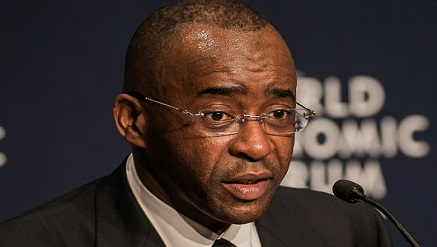
Strive Masiyiwa, CEO and founder of Econet Wireless, the first GSM operator to go live in Nigeria (in 2001) has opened fresh cans of worms up on how the company was killed by Nigerian factors.
Over the years, the company has undergone so many changes of name and management that we can hardly keep up.
Econet Wireless he said paid the stiff price for refusing to play by rotten rules.
In a recent blog post, Masiyiwa, revealed his side of the story behind the company’s downfall in Nigeria.
In his Facebook posts, the Econet boss who is also the richest man in Zimbabwe narrated how the Nigerian politician who is presently serving jail term in UK allegedly demanded a $4.5 million bribe from him.
This is to help in exchange of setting up the operation of Econet in Nigeria, with a threat of being sent out of Nigeria if he does not pay the bribe.
Accusing top politicians from Kenya, Zimbabwe and Liberia of being outrightly corrupt and asking him of bribe, with him being urged to pay about $9 million to top politicians in Nigeria.
Masiyiwa recounted how Lagos and Delta state governments were the only co-investors in Nigeria back then.
He also took his time to recount some spinning revelations and his bitter encounter with a Niger Delta governor.
Masiyiwa made it known in his posts how he was told by UK courts to testify against Niger Delta governor in London which he said he gladly did. He further opined that every corrupt act in Nigeria and Africa is always carried out by at least one foreign accomplice. Read his long but revealing posts below:
”I had the privilege of making Nigeria’s first GSM phone call back in 2001 when I called the regulator to say, “We’re live!” Who would’ve believed then that Nigeria today would have more than 167 million mobile phones?! It all started out as a very exciting new chapter for enterprise in Africa. Shortly after President Obasanjo was elected, the new government announced an incredibly transparent international auction process for three national mobile phone licenses.
”To participate in the bid, you not only had to raise money, but there had to be a member of the bidding consortium who was an experienced GSM operator. Econet Wireless met the requirements because of its experience in Zimbabwe and Botswana. Our Nigerian partners, which included state governments, local banks and high net worth individuals, were financial investors. The largest shareholder had only 10%. That was the written agreement. I managed to assemble a consortium of 22 investors to put up the money needed to bid. Our shareholders were all Nigerian, mostly institutional investors including leading banks and two state governments, Lagos State and Delta State. The license cost us $285m and was the most expensive license ever issued in Africa at the time. This was 2001.
”We considered the investment not only about putting together a network, but also about building a nation. We knew it had the potential to transform Nigeria’s entire business and social architecture. Most of our investors had between 1-10% shareholding.
Econet Wireless Nigeria had only 5% of the shares, but that was fine because it was 5% ownership of a very big pie. As the “technical partner and operator,” Econet was the company with the expertise to build and operate such a business. Our financial investors recognised this, and also allowed us to receive 3% of the turnover as our fees.
This was standard practice in the industry. We were one of the winning bidders and they gave us just six months to set up business and get our network operating. We were under a lot of pressure but our network was live two days before the others! Customers were pouring in. We were number one in the market with an estimated 57% market share. Then came the fateful day when I was told that our company must pay a total of $9m in bribes to senior politicians (in state government) who had facilitated the raising of the money to pay for the license.
”I refused to authorise the illegal payments. Meeting after meeting was held to try to get me to agree, but I would not. The money would not be paid as long as Econet was the operator and I had signing authority. James Ibori, the Governor of Delta State, was demanding $4,5m be paid to him in his personal capacity. He was one of the most powerful men in the country and had a reputation for violence. When he heard that I was refusing to approve payment he issued an ultimatum: “Pay or I will chase you and your people out of the country.” I refused.
”The shareholders met and voted Econet Wireless Nigeria out of management. They cancelled our management contract. James Ibori and his colleagues personally attended the meeting to remove us. After the meeting one of them (a prominent local businessman even today) came up to me and said: “Unfortunately for you, God does not have a vote.” I had to withdraw all my staff and their families: 200 people in all. We left Nigeria. Most of our people had to be retrenched. The loss of the contract almost drove us to bankruptcy as a group. They invited a big international operator to replace us as technical partner and operator. They changed the name of the company from Econet to V-Mobile. Within days of their arrival, the managers of the new operator signed off the payments demanded as bribes.
”Then what happened? A few noble Nigerians had both the integrity and courage to carefully collect all the documentation on the movement of the money, and pass it all on to me. There’s a saying worth remembering in uncovering the trail of destruction that is corruption: “Follow the money”… I bided my time… then I wrote a letter to the United States Department of Justice! It was 2003.”
Corruption, Politicians Killed Econet Wireless- Founder
Comms Week20 Oct 20150 Comments
Strive Masiyiwa, CEO and founder of Econet Wireless, the first GSM operator to go live in Nigeria (in 2001) has opened fresh cans of worms up on how the company was killed by Nigerian factors. Over…
C
Published by
Comms Week
Trained and practicing journalist passionate about telecommunications, fintech, cybersecurity, and digital economy reporting.
You May Like

MTN Nigeria Endorses eWorldForum and Book Launch as GSM Revolution Turns 25

MTN Nigeria's ₦1.62 trillion network Investment builds 100 million subscribers using more data than ever

FG Plans Regulation of Internet Access for Nigerians below 16 Years

The Leadership Reset Powering West Africa’s Customer Experience Revolution

Digital Parks, Master Power Plan New Data Centre Facility in Lagos