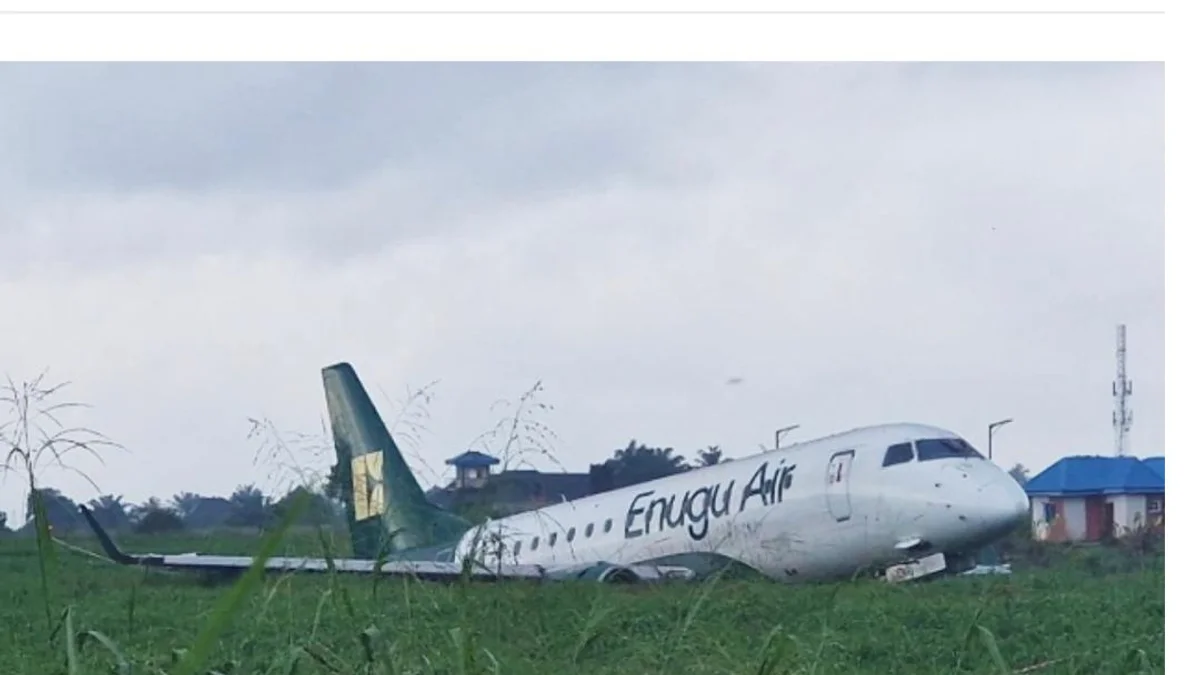
Nigerian Safety Investigation Bureau (NSIB) has identified an inoperative autobrake system as one of the factors that contributed to the runway overrun involving an Enugu Air aircraft at Benin Airport.
An autobrake system is an automated hydraulic braking feature used in commercial and military aircraft to ensure smooth, consistent deceleration during landing or a rejected takeoff (RTO).
A preliminary report disclosed in a statement signed by Funke Arowojobe, director, Public Affairs and Family Assistance, NSIB, on Friday, said that the aircraft had five crew members and 63 passengers on board when Enugu Air Flight 4264, an Embraer E170 operating from Lagos to Benin, ran beyond Runway 05 while landing at the airport.
According to the bureau, the aircraft touched down about 1,641 metres beyond the runway threshold at a speed of approximately 138 knots.
The crew was also dealing with moderate rainfall, poor visibility and a tailwind.
With the autobrake system unavailable, the pilots relied on manual braking, ground spoilers and thrust reversers to slow the aircraft.
However, the aircraft could not stop within the remaining runway distance.
The aircraft subsequently veered off the runway, hitting seven approach lights and two concrete structures.
The impact caused the landing gear to collapse and left the aircraft substantially damaged.
All 68 people on board survived the incident without sustaining injuries.
The NSIB said its investigators were at Oba Akenzua II Airport, Benin, when the incident occurred and responded immediately.
It said the preliminary investigation involved witness accounts, flight recorder data, air traffic control transcripts and an initial examination of the aircraft.
“The content of this preliminary report may still change and does not necessarily bind the conclusions published in the investigation’s final report. The sole objective of this investigation is the prevention of accidents and incidents. It is not the purpose of the investigation to apportion blame or liability,” the bureau said.
The bureau said the preliminary report contained factual information gathered from several sources, including witness statements, flight recorders, air traffic control communications and a preliminary inspection of the aircraft.
However, it stressed that the investigation had not been concluded, noting that further technical examinations were still underway.
The NSIB said, “The preliminary report also contains four immediate safety recommendations, A-2026-039 to A-2026-042, addressed to the Nigerian Civil Aviation Authority (NCAA), the Federal Airports Authority of Nigeria (FAAN) and the Nigerian Meteorological Agency, concerning the runway-end environment, control tower line of sight and the availability of meteorological information.”
The bureau also said it had released a preliminary flight path recreation video based on information available at the current stage of the investigation.
It explained that the move was part of its commitment to transparency and the communication of safety information to the public.
“The preliminary report is available for download on the NSIB website for members of the public and the media,” the bureau stated.
“As part of its commitment to public transparency and the communication of safety information, the NSIB has also released a preliminary flight path recreation video based on data available at this stage of the investigation.”
The bureau cautioned against concluding the preliminary findings, stressing that the information remained subject to further review and analysis.
“The Bureau notes that the information contained in the preliminary report is subject to further review and analysis, and its content may still change,” it stated.
According to the NSIB, the final report would contain the bureau’s conclusions and any additional safety recommendations that might emerge from the completed investigation.
“The final report will present the Bureau’s conclusions and any further safety recommendations arising from the completed investigation,” the statement added.
The bureau also clarified that its investigation was not intended to determine who was responsible for the accident or impose liability.
“In accordance with Annex 13 to the Convention on International Civil Aviation, the sole objective of the investigation is the prevention of accidents and incidents,” it said.
“It is not the purpose of the investigation to apportion blame or liability.”
The accident occurred barely after the aircraft completed its scheduled flight from Lagos to Benin, with all passengers and crew members ultimately escaping injury.
According to the report, the aircraft departed the Murtala Muhammed International Airport, Lagos, at about 2:19 pm for Benin on a scheduled passenger flight and initially completed its take-off, climb, cruise and descent phases normally.
The crew had been cleared for an Instrument Landing System approach to Runway 23 but requested and obtained approval to conduct an RNAV approach to Runway 05.
The report said the crew expressed concern about rain near the airport during the approach, while the tower later advised that the approach path to Runway 23 appeared better.
Despite the advisory, the crew continued with the RNAV approach to Runway 05.
At about 2:48 pm, the tower informed the crew that visibility was about 1,500 metres in moderate rain.
The tower subsequently cleared the aircraft to land on Runway 05 and cautioned the crew that the runway surface was wet.