

Telecom
FG Plans 7,000 New Communication Towers in Rural Areas

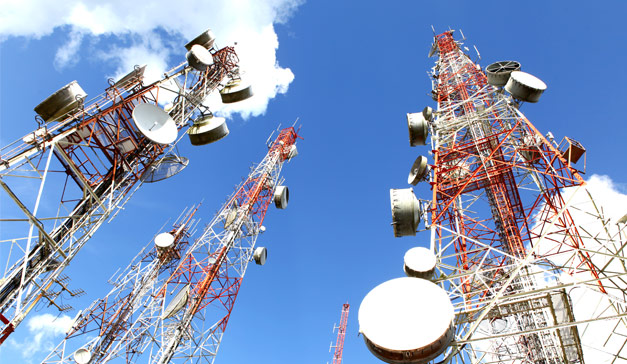
The Federal Government yesterday disclosed plans to build 7,000 new communication towers in rural areas to expand access to telecommunications services and improve digital connectivity across the country.

Dr. Bosun Tijani, minister of Communications, Innovation, and Digital Economy, disclosed this after leading Airtel executives on a visit to President Bola Tinubu at the Presidential Villa in Abuja.
According to Dr. Tijani, the government is committed to ensuring that all Nigerians, especially those in underserved areas, have meaningful access to quality telecommunication services.
The Minister noted that the decision to invest in rural infrastructure aligns with the administration’s broader goal of improving digital inclusion and economic opportunities for all citizens.
Tijani said: “The priority for this government is meaningful access. We don’t want our people to just have access to telecommunication services; we want it to be of high quality. That is why the NCC has been working thoroughly to ensure that we shift the focus not just to quality of service, but to quality of experience.”
The minister explained that the approval for the construction of 7,000 new towers was granted by the Federal Executive Council, FEC, as part of a broader strategy to bridge the digital divide.
He said the investment will complement the ongoing deployment of 90,000 kilometers of fiber-optic cables across the country.
Dr. Tijani also addressed the recent approval of a 50 percent increase in telecom tariffs, clarifying that the decision was necessary to sustain businesses in the sector and prevent job losses.
He revealed that the government conducted a study led by KPMG to determine the optimal tariff adjustment while balancing affordability for consumers and sustainability for telecom operators.
“Some of these decisions are difficult, but it is our responsibility to look out for our citizens, including individuals and corporate entities. If we chose not to allow any tariff increase, we risked losing jobs and seeing companies shut down, which is not the best outcome for the economy,” he explained.
The minister reiterated the government’s commitment to fostering an enabling environment for private sector investment in digital infrastructure while ensuring that public investments support nationwide connectivity.
The construction of the new towers is aimed at significantly enhancing network coverage in remote areas, allowing millions of Nigerians to benefit from improved mobile and internet services.
Also speaking, Chairman of Airtel Africa, Sunil Bharti Mittal, said Airtel Nigeria is the soul of its operations in Africa, with the potential to match India’s advancements in digital innovation, connectivity, and financial inclusion.
Emphasising that Airtel’s success in Nigeria is crucial to its overall success in Africa, Mittal stressed that Nigeria’s strategic importance underscores Airtel’s objective,which is to drive growth and transformation across the African continent.
He said: “Nigeria is the most important part of our Africa strategy. In fact, the entire Africa rests on the back of Nigeria for Airtel.
“And Nigeria is important to us, personally important to me. I watch over one country other than India, personally myself. That is Nigeria. I come back here from time to time, and it’s in our intention to make Nigeria at par with what we are seeing in India in terms of digital innovation, digital connectivity and financial inclusion.
“I can assure all of you here today that we come here with force for good for this country, and you will continue to see us being a very, very responsible corporate citizen contributing to the well being of this country.”
He highlighted the company’s significant investments in Nigeria and its plans for further expansion, including the rollout of 5G services and additional investments of $700 million over the next two years.
Mittal lauded President Tinubu-led government on recent economic reforms, which he said will attract more foreign investment and improve business conditions in Nigeria.
Mittal also spoke on Airtel Africa’s award of scholarship to 10 Nigerian students for full Engineering degrees both at the undergraduate and post graduate levels in top engineering institutions.
He noted that the company expects the Nigerian government to take charge of selecting the 10 students who will be sent to India as part of the fellowship program.
According to Bharti, the Airtel Africa scholarship programme, which is under Satya Bharti School Programme began 15 years ago, has created a large ecosystem of 100,000 school children across various communities in India.
“So, we started 15 years back with the primary school program in India, where the focus was girl child, free education, midday meal, computer in the school uniforms, and we created nearly a large ecosystem of over 100,000 school children going into various villages in India. And that program still continues. We have then stepped it up with scholarships in the universities.
“That programme of Satya bharthi scholar has also started in a big way. And today I can share with you I was very pleased to hand over my letter inviting 10 Nigerian students for a full degree, both undergrad and post grad degrees in engineering in top institutions in India every year.
“And we would expect the Nigerian government to be choosing and selecting those 10 students who sent to India.”
On Airtel’s commitment to the 3 Million Technical Talent programme of the present administration, Mittal said that Airtel aims to support Nigeria in diverting some attention to areas such as Skills and education, while also contributing to the society in a very meaningful way.
“That’s a commitment to be a part of that. And we believe that just like India and many other countries, including in Africa, if we can divert some attention into the area of Skilling and education, I think we’ll contribute To the society in a very meaningful way.”



Google has unveiled a new feature that allows Gmail users to change their existing email addresses without losing data or access to services, marking a major shift in the company’s long-standing policy.

Gmail
According to an update on Google’s account help page, the new option enables account holders to replace their current @gmail.com address with a new one while retaining all associated data, including emails, photos, and integrations with services such as Google Drive, Maps, and YouTube.
The guidance, however, was first spotted on the Hindi version of Google’s support page, suggesting that the rollout may begin in India or Hindi-speaking markets before expanding globally.
The English-language support page still carries the older advisory that Gmail addresses “usually cannot be changed.”
Google explained that under the new policy, users who update their Gmail address will automatically keep their original address as an alias.
This means emails sent to the old address will continue to arrive in the inbox, and the original address will remain valid for signing in to Google services.
Previously, users seeking a new Gmail address had to create an entirely new account and manually transfer their data, a process that often disrupted third-party app integrations. The new feature eliminates that inconvenience, ensuring continuity for users.
The company further clarified that while users can reuse their old Gmail address at any time, accounts that change their address will face certain restrictions.
These include a 12-month waiting period before another new Gmail address can be created, and the inability to delete the newly chosen address once it has been set.
Google assured users that all existing data would remain intact after an address update, including stored photos, messages, and emails.
The gradual rollout of the feature indicates that full global adoption is expected in the coming months, a move likely to be welcomed by millions of users who have long requested the ability to update their Gmail identities without starting afresh.

Nigerian Communications Commission (NCC) has said that Nigeria’s internet usage reached a record 1.24 million terabytes in November 2025.

According to the latest data from the NCC, the figure rose modestly from 1.235 million terabytes in October, reflecting steady growth in digital activity across the country.
Broadband penetration in Nigeria crossed the halfway mark in November 2025, reaching 50.58 per cent, up from 45.61 per cent in January, the telecoms regulator reported.
The figure, however, falls short of the 70 per cent coverage target outlined in the National Broadband Plan 2020–2025, which expires this month.
The country had roughly 109 million broadband subscriptions by November. Growth has been uneven, hindered by infrastructure and regulatory constraints, including frequent fibre-optic vandalism that triggers 30 to 43 network cuts daily, high right-of-way fees, and declining subscriber numbers earlier in the year.
Expansion of mobile networks, particularly 3G and 4G services, alongside limited 5G rollouts in urban centres, affordable smartphones, and competitive data plans, has driven uptake.
Investments in the National Communications Backbone and private-sector initiatives have also improved access, especially in underserved areas.
While Nigeria is gradually improving digital inclusion, achieving the original broadband plan remains challenging due to high infrastructure costs, coverage limitations, and deployment hurdles.
The NCC maintains that continued investment in mobile networks and broadband infrastructure will sustain gradual growth in the sector.
Commenting on the development, some Nigerian analysts attributed the surge to the broader mobile and broadband adoption and the growing appetite for streaming, online learning and other digital services.
According to the analysts, the figures suggest that internet connectivity is no longer a luxury but a necessity for both business and leisure, underscoring the slow but steady expansion of Nigeria’s digital economy.
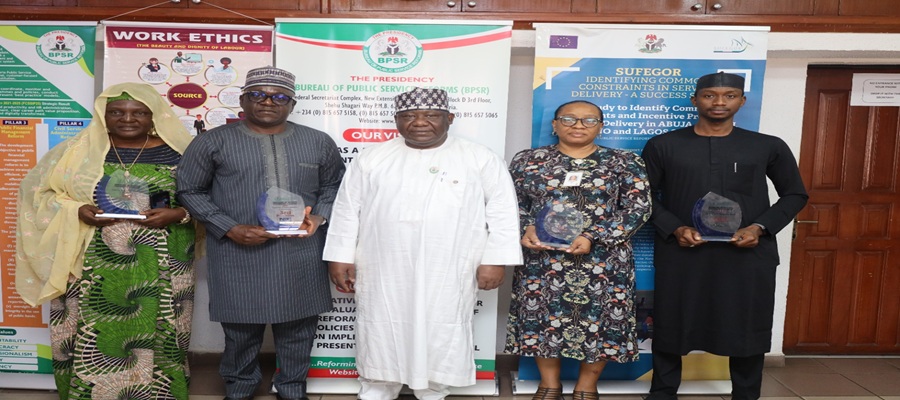
Bureau of Public Service Reforms (BPSR) has named the Nigerian Communications Commission (NCC) among the top three Ministries, Departments and Agencies (MDAs) of the Federal Government with the Best Ranking in Website Performance for 2025.

L-R: Head Special Projects, Nigerian Export Promotion Council (NEPC), Salamatu Andu; Executive Commissioner, Technical Services, Nigerian Communication Commission (NCC), Engr. Abaraham Oshadame; Director General Bureau of Public Service Reforms (BPSR), Head Customer Support Service, Galaxy Backbone, Rosemary Ehize; Secretary to the ES. Nigerian Content Development and Monitoring Board, Tahir Aminu at the BPSR award ceremony for top four MDAs in BPSR Website Performance and Ranking 2025 at the BPSR office on Tuesday, 23rd December, 2025.
This is coming barely three weeks after the telecom regulator was recognized as one of the top five best-performing Federal Government agencies for 2025 by the Presidential Enabling Business Environment Council (PEBEC) – a testament to the Commission’s consistency in investment in technology for ensuring efficient service delivery.
In the BPSR 2024/2025 scorecard ranking of agencies’ websites, the NCC came second in the ranking, trailing behind Galaxy Backbone Limited, which came first while the Nigeria Export Promotion Council (NEPC) clinched the third position, from a pool of 235 MDAs, whose website were evaluated.
BPSR deployed 14 evaluation criteria in include MDA’s website compliance with .gov.ng domain name, appearance and aesthetics (look and feel) of the website, content, relevance to MDAs mandate/government policy and the website’ structure.
Others include website’s responsiveness (device compatibility), security, load time, usability/ease of navigation, availability/uptime, functionality, interactivity, accessibility and capacity building.
The recognition was announced at the official release of Federal Government 2024/2025 Scorecard Ranking for MDAs’ Website held at the Federal Ministry of Finance Auditorium in Abuja on Monday (December 22, 2025) while the award presentation took place at BPSR’s Office on Tuesday (December 23, 2025).
The award, which is an important index metric of the National e-Government Masterplan for determining the Nigeria e-Government Status, was received by the Commission in recognition of its commitment to maintaining a world-class website that enhances service delivery to the citizens.
Receiving the award on behalf of the Executive Vice Chairman of the NCC, Dr. Aminu Maida, the NCC’s Executive Commissioner, Technical Services, Abraham Oshadami, appreciated the BPSR for the recognition, describing the award as “another encouragement for the Commission to be a better public service institution leveraging digital platforms such as our web presence to enhance public service delivery to our various stakeholders, thereby implementing the Federal Government’s Ease of Doing Business policy direction.”
While presenting the award to the NCC, alongside other two agencies, BPSR’s Director-General, Mr. Dasuki Arabi, commended the top three for their proactive decisions in maintaining world-class websites, which are compliant with the Federal Government’s policy direction in effective and efficient service delivery to the citizens.
According to the DG, the 2024/2025 MDA’s websites’ ranking represents a collective effort of federal public institutions in Nigeria to be transparent, accountable and open in governance, as well as a confirmation to align with global best practices in service delivery to the citizens.
Developed about six years ago, Arabi said as a result of the annual ranking, more public institutions have indicated readiness to embrace reforms, and align with the policy direction of the current administration’s Renewed Hope agenda on improve governance for effective service delivery, as introduced by His Excellency President Bola Ahmed Tinubu.
“The ideals of harnessing and deploying technological tools for service delivery has become imperative following the COVID pandemic, and distortions of socio-economic system of nations, culminating in the evolution of competitiveness, cost effectiveness, and agile governance.
“As engine room of governance, it behoves on us in the public service to perform our statutory duties and we must put in place technological innovations and standardized websites to operate services as well as deliver service needs to citizens,” he said.
The Scorecard exercise, he said, is part of the BPSR reform broader function of conducting research on reform implementation efforts and presenting ‘best practice’ models to the entire Public Service, and to among others, improve access to government information, facilitate seamless financial transaction, eliminate corruption and cyber theft, as well as facilitate access to government services.
Speaking on the rigorous nature of the exercise that produced the top three winners, the DG said “in the past few weeks members of the Scorecard Jury drawn from inter-Ministerial Agencies, had worked tirelessly to mill websites of selected MDAs through a rigorous process of enduring criteria for the ranking and the outcome had also passed through a quality assurance mechanism to validate the outcome.”

InsomniaQ Spotlights African Creativity in Lagos

T2 Backs Youth Excellence as NCBC Wins Bosun Tijani Foundation Basketball Tournament

Google Finally Allows Users to Change Gmail Address, Keeps Data and Services Intact

How Moniepoint’s Founders, Tosin Eniolorunda and Felix Ike are Redefining African Tech and Finance

Ecobank Guarantees Seamless Digital Banking Services Throughout the Christmas and Year-End Period

Nigeria Records Highest Weekly Cyberattacks in Africa — Report

Cyber Tsunami Hits Nigeria as Breaches Surge 1,047%, esentry Q3 Report Reveals

Minister Claims Bandits Exploit Poor Network, Bounce Calls Off Multiple Towers

Financial Sector Faced AI, Blockchain and Organised Crime Threats in 2025 – Report

GenAI Adoption Among African workers Outpace Global Peers




 E-Financial2 days ago
Banks quietly move to enforce new ₦50 transfer levy from Jan. 1
 General News2 days ago
Ecobank Guarantees Seamless Digital Banking Services Throughout the Christmas and Year-End Period
 News2 days ago
How Moniepoint’s Founders, Tosin Eniolorunda and Felix Ike are Redefining African Tech and Finance
 Telecom6 hours ago
Google Finally Allows Users to Change Gmail Address, Keeps Data and Services Intact
 General News5 hours ago
T2 Backs Youth Excellence as NCBC Wins Bosun Tijani Foundation Basketball Tournament
 News5 hours ago
InsomniaQ Spotlights African Creativity in Lagos