

News
Buhari Unveils Locally Made Drone

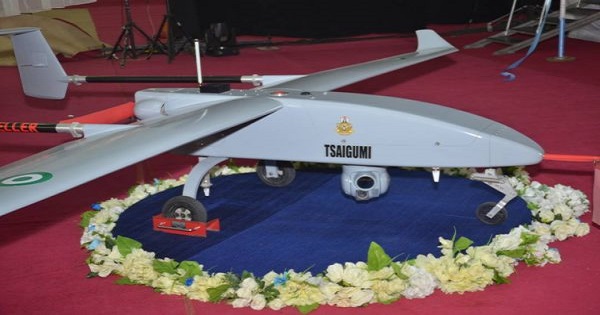
President Muhammadu Buhari on Thursday in Kaduna unveiled the first indigenous operational Unmanned Aerial Vehicle (UAV) nicknamed, Tsaigumi.
The Tsaigumi UAV, which was produced by The Nigerian Air Force (NAF) Aerospace Engineers in collaboration with UAVision of Portugal, would be used for ISR operations in land and sea domains.
It could also be used for policing operations, disaster management, convoy protection, maritime patrol, pipeline and power line monitoring as well as mapping and border patrol duties.
In addition, it could be deployed for the protection of wildlife, weather forecast and telecast.
Additionally, in the maritime domain, the Tsaigumi UAV could be used for search and rescue, coastal monitoring and patrol of Nigeria’s Exclusive Economic Zone.
The UAV, which is capable of day and night operations, has an operational endurance in excess of 10 hours, a service ceiling of 15,000 feet and a mission radius of 100km.
It has a maximum take-off weight of 95kg and its payload is an electro-optic/infra-red camera system.
In his remarks at the induction ceremony, Buhari, who was the Special Guest of Honour, commended NAF under the leadership of Air Marshal Sadique Abubakar for his determination and unwavering commitment to Research and Development (R&D).
He added that the attainment of the technological feat is an indication that Nigeria has the needed potential to surmount other technological needs.
The President noted that UAVs are an essential feature of modern armed forces. He therefore considered it most gratifying that the NAF had gone a step further from simply acquiring them, to developing indigenous technology to produce them.
“Indeed, this outstanding accomplishment holds promise of both military and economic benefit to the nation. From the military perspective, the added capacity for ISR provided by Tsaigumi UAV would undoubtedly boost ongoing and future security operations,” the President added.
BUhari noted that as soon as the NAF UAV project moves into the next stage of mass production, it would create employment opportunities and generate revenue as Nigeria’s first military export product.
While urging the NAF to strive for greater innovation, the President promised that the Federal Government would continue to provide the needed support, for the benefit of the nation.
The President then urged state governments, ministries, departments and agencies to acquire the NAF UAV as required.
In his welcome address, Air Marshal Sadique Abubakar, Chief of the Air Staff (CAS), reiterated the commitment of NAF to R&D so as to develop unprecedented capacity to surmount current and emerging security challenges.
He explained that the newly produced Tsaigumi UAV possesses certain salient physical and performance parameters, which position it as an efficient tool for curbing internal security challenges.
The CAS posited that history and modern experience attest to the role of the military in bringing about innovations that have revolutionised not just warfare capability but human capacity as a whole.
“Indeed, many of the technologies that enhance human life and safety today emerged from R&D; radar, jet engines, satellite tracking, digital photography, Internet and others,” the CAS added.
According to him, today’s feat would have been impossible if not for the unflinching financial support that the Service has continued to receive from the Federal Government. Air Marshal Abubakar added that the NAF would not rest on its oars regarding R&D.
He disclosed that having achieved enhanced ISR capability, the next step for the NAF is to perfect the development of another UAV nicknamed “Ichoku”, which would be the first indigenous Unmanned Combat Aerial Vehicle (UCAV).


Quickteller successfully hosted the maiden edition of InsomniaQ recently in Lagos, delivering a 12-hour non-stop celebration of African music, culture, and creativity.

A statement from the firm on Sunday stated that the event attracted a diverse audience of music lovers, culture enthusiasts, and festive diaspora returnees, marking a strong debut for what organisers described as a potential signature December event.
InsomniaQ featured a dynamic mix of live performances and DJ sets, showcasing Africa’s rich musical diversity and creative depth. From soulful sounds to high-energy performances, the festival offered a thoughtfully curated journey designed to follow the natural rhythm of its audience’s circadian cycle, sustaining energy, connection, and excitement throughout the night.
Beyond the performances, InsomniaQ emerged as a platform for shared cultural expression, creating space for celebration, discovery, and community. The experience reinforced Lagos’ position as the heartbeat of Africa’s December entertainment season and highlighted the growing appetite for premium, culturally grounded experiences.
Commenting on the success of the event, the Executive Vice President, Group Marketing and Communications, Interswitch Group, Cherry Eromosele, described InsomniaQ as an organic extension of Quickteller’s place in everyday moments of connection, culture, and celebration.
“InsomniaQ was created as a space to celebrate African creativity in its full expression, the music, the energy, and the people who make our culture so powerful.
“Seeing that vision come to life, with thousands of people connecting through sound, movement, and shared experience, has been truly rewarding. This debut edition reinforces our belief in creating platforms that bring people together and spotlights the richness of African talent in meaningful ways,” Eromosele said.
The success of InsomniaQ, according to the organisers, reflects a broader commitment within the Interswitch ecosystem to support experiences that extend beyond transactions into everyday life. By championing platforms that blend culture, innovation, and community, Interswitch continues to shape how people connect, celebrate, and experience Africa’s evolving creative economy.
With its strong debut, InsomniaQ has set the tone for future editions and established itself as a new fixture in Africa’s December calendar, celebrating culture, driving connection, and creating memorable experiences.
News
How Moniepoint’s Founders, Tosin Eniolorunda and Felix Ike are Redefining African Tech and Finance


In an era where global tech giants dominate headlines, two Nigerian entrepreneurs are quietly revolutionizing financial services across Africa, proving that world-class innovation can emerge from homegrown talent and local institutions.

Tosin Eniolorunda and Felix Ike, co-founders of Moniepoint Inc, have built one of Africa’s fastest-growing fintech companies, not despite their exclusively Nigerian education, but in many ways, because of it.
Their journey from the lecture halls of Obafemi Awolowo University and the University of Lagos to the TIME100 Most Influential Companies list stands as a powerful testament to the caliber of talent nurtured within Nigerian universities and the transformative potential of locally-rooted vision.
Tosin Eniolorunda’s path exemplifies how Nigerian educational institutions can cultivate entrepreneurial excellence. After earning his degree in Mechanical Engineering from Obafemi Awolowo University, he didn’t follow the well-trodden path abroad but instead chose to build solutions for Nigerian challenges within Nigeria itself. This decision proved prescient.
Understanding the unique financial ecosystem and infrastructure gaps firsthand from the work at TeamApt Ltd where they were building from majority of the country’s banks, Tosin pioneered several industry firsts: introducing instant POS transfers to Nigeria, launching the country’s first virtual account services, and constructing a vertically integrated payments processing switch with full switching and processing licenses.
These feats and technological achievements must be viewed from the prism that these were deeply contextual innovations born from intimate knowledge of local needs, the kind of understanding that comes from being educated and embedded in the communities one serves.
Felix Ike’s contribution complements this vision with technical brilliance equally rooted in Nigerian educational excellence. Graduating with first-class honors in Computer Science from the University of Lagos, Felix brought to Moniepoint the kind of engineering rigor required to build mission-critical financial infrastructure.
As Chief Technology Officer, he has architected systems that are not just functional but scalable, resilient, and secure enough to serve over 10 million businesses and individuals across Nigeria and Africa. His work demonstrates that Nigerian universities are producing software engineering leaders capable of building world-class technology that can compete on the global stage with technology that processes millions of transactions daily and underpins the financial dreams of an entire continent.
Since its founding in 2015, Moniepoint has evolved into Africa’s largest distributor of financial services in Nigeria, with presence across all 774 local government areas. The company’s all-in-one financial ecosystem offering seamless payments, banking, credit, and business management solutions reflects a sophisticated understanding of what African businesses and individuals actually need to thrive.
The accolades have followed: recognition by TIME as one of the 100 Most Influential Companies in 2025, listing among CNBC’s top UK fintech firms, and ranking in the Financial Times’ Africa’s Fastest-Growing Companies for three consecutive years.
The Moniepoint story as an indigenously rooted but globally compliant player challenges prevailing narratives about where innovation must originate and what credentials are necessary for building transformative companies. Tosin and Felix’s success illustrates that Nigerian universities, when their graduates are empowered with vision, opportunity, and determination, can produce founders who don’t just participate in the global economy but reshape it.


Federal Inland Revenue Service (FIRS) has announced that the National Identification Number (NIN) issued by the National Identity Management Commission (NIMC) will automatically serve as the Tax Identification Number (Tax ID) for all Nigerian citizens, while registered businesses will use their Corporate Affairs Commission (CAC) registration numbers.

FIRS
The disclosure was made during a public awareness campaign on the new tax laws posted on X (formerly Twitter) on Monday.
According to the Service, the Nigeria Tax Administration Act (NTAA), which comes into force in January 2026, mandates the use of Tax IDs for certain financial and commercial transactions, including bank account ownership.
FIRS explained that the measure is part of efforts to unify all previously issued Tax Identification Numbers (TINs) by both the federal and state revenue services into a single identifier.
“For individuals, your NIN automatically serves as your Tax ID, while for registered companies, your CAC RC number is used. You do not need a physical card; the Tax ID is a unique number linked directly to your identity,” the Service stated.
The agency noted that the requirement has been in place since the Finance Act of 2019 but has now been strengthened under the NTAA to ensure compliance and ease of administration.
Officials emphasized that the reform would simplify tax processes, reduce duplication, and improve transparency in Nigeria’s tax system.
The Service added that the integration of NIN and CAC numbers into the tax framework would also enhance data accuracy, curb tax evasion, and streamline the monitoring of taxable activities across the country.
Tax experts have described the development as a significant step toward modernizing Nigeria’s revenue administration, noting that it aligns with global best practices where national identity systems are linked to tax compliance.
The FIRS urged Nigerians to ensure that their NINs and CAC registration details are up-to-date, stressing that the identifiers would be required for transactions such as property purchases, contract awards, and access to certain financial services once the NTAA takes effect

FIRS Rebrands as Nigeria Revenue Service, as New Tax Laws Take Effect

Galaxy Backbone Celebrates the Federal Government’s Paperless Civil Service Milestone

Banks to Impose N50 Stamp Duty on Transfers of N10,000 and Above from January 1

How to Use the Correlation of Gold with Other Trading Assets in the Forex Market

How Nigeria’s New Tax Law Could Redefine Risk in the Banking Sector

Nigeria Records Highest Weekly Cyberattacks in Africa — Report

Financial Sector Faced AI, Blockchain and Organised Crime Threats in 2025 – Report

Cyber Tsunami Hits Nigeria as Breaches Surge 1,047%, esentry Q3 Report Reveals

Report Reveals Half of 2025’s Compromised Passwords were Already Leaked

Minister Claims Bandits Exploit Poor Network, Bounce Calls Off Multiple Towers




 Telecom2 days ago
Nnaemeka Ani – The Architect of ‘Code and Courage’

 E-Financial2 days ago
Nigeria’s N58.18trn Budget and Rising Cost of Deficit Governance

 Telecom2 days ago
MTN Nigeria Appreciates Partners, Customers at Lagos Prestige Experience

 Telecom1 day ago
T2 Faces NCC Probe in Benue Over Major Service Outage in 9 LGAs

 Telecom1 day ago
MTN Nigeria Crowns Ayo Benzi Winner of Next Afrobeats Star

 Telecom1 day ago
NCC Grants 45 Days for Telecoms Firms to Fix Unapproved Shareholding Changes

 Telecom1 day ago
NCC Unveils Draft 5-Year Spectrum Roadmap, 60 GHz License-Exempt Guidelines to Boost Broadband, Innovation

 E-Business1 day ago
Jumia CEO says Black Friday Signals Nigeria’s E-Commerce Maturity