

E-Business
VDT Supports Digital Africa 2018 As Official Telecom Partner

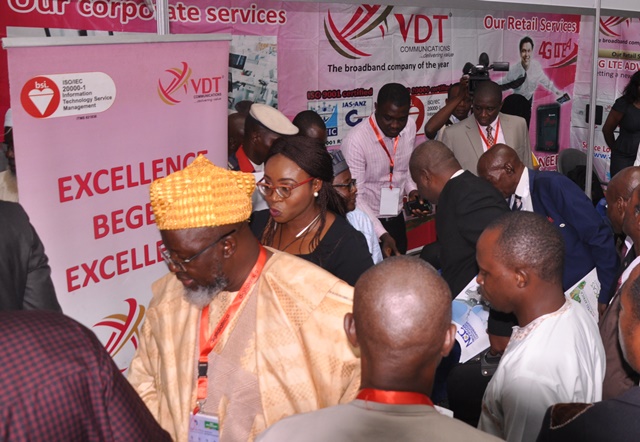
VDT communications, a leading broadband communications service provider in Nigeria sponsored Digital Africa Conference and Exhibition, 2018 as the Official Telecom Partner.
VDT has been sponsoring this conference since inception for six years now. However, year 2018 marks the 3rd year that VDT has sponsored the international technology event as the Official Telecom Partner.
Digital Africa Conference and Exhibition 2018 which held from 5th to 7th June at Shehu Musa Yar’adua Centre in Abuja is on the theme, “Africa’s Tech Renaissance” with the aim of focusing attention on the great achievements in science and technology by ancient Africa, inspiring technology transformation among current players and charting the course for future technology ecosystem in Africa.
VDT Communications’ loyal sponsorship of Digital Africa Conference and Exhibition for 6years now is owing to the desirable ideal of the conference with the ultimate aim of inspiring digital transformation of Africa.
This year’s conference, like the previous ones, featured over 36 international speakers and about 1000 participants from Nigeria, Africa and other parts of the world.
As the Official Telecom Partner of Digital Africa, 2018, in addition to the sponsorship, VDT provided free Wifi for use by all the participants in the conference, thereby demonstrating the premium quality of her services.
The participants at the event applauded the high quality of VDT’s internet service. This attracted a lot of visitors to VDT’s stand.
VDT Communications also exhibited both the traditional and newly developed services including, Digital Leased Circuit, Corporate Internet, Metro Wireless, Metro Fiber, ATM Solutions, Wi-Fi Hotspot and 4G LTE Advanced Retail Internet service.
Barr. Adebayo Shittu, Minister of Communications visited VDT stand during the event and was very impress by the quality and array of VDT service offerings.
The 2018 edition of Digital Africa Conference and Exhibition was bigger and better. The participants experienced premium quality of VDT’s service at the event.



Terra Industries, a Nigerian defence technology startup, has raised $11.75 million to expand its development of defensive systems that protect critical facilities across Africa.

The fundraising round was led by Silicon Valley venture firm 8VC, which was founded by Palantir co-founder Joe Lonsdale.
Other investors in the round include Valour Equity Partners, Lux Capital, SV Angel, and Nova Global, as well as African-focused funds Tofino Capital, Kaleo Ventures, and DFS Lab.
Terra Industries, founded in Abuja by Nathan Nwachuku and Maxwell Maduka, provides multi-domain security solutions for both air and land. Its solutions are intended to detect and respond to threats including terrorism, sabotage, and armed attacks on infrastructure.
The company’s product portfolio includes surveillance drones, ground-based robotic systems, and fixed monitoring towers deployed around sensitive locations.
Co-founder and CEO Nathan Nwachuku said the company has now fully embraced its identity as a defence-focused startup, citing the growing urgency of security challenges across Africa.
He said safeguarding critical infrastructure from terrorist threats has become unavoidable.
Nwachuku argues that protecting Africa’s infrastructure requires a different approach, one that combines local manufacturing, end-to-end system control, and software capable of independently identifying and responding to threats over large areas.
The company aims to position itself as a defence prime, similar to the role played by firms such as Anduril Industries and Palantir in the United States.
Nwachuku also disclosed that the company had earlier raised $800,000 in pre-seed funding.
With the new funding, Terra plans to increase manufacturing capacity within Africa, establish additional defence production facilities, and expand its artificial intelligence and software teams.
While software offices are planned for San Francisco and London, the company said manufacturing operations will remain on the continent.
E-Business
Kaspersky Warns Telecom Threats from 2025 will Carry into 2026 as New Technology Adds New Risk

Kaspersky Security Bulletin reviews what shaped telecom cybersecurity in 2025 and what is likely to persist in 2026. Advanced Persistent Threat (APT) activity, supply-chain compromise, DDoS disruption and SIM-enabled fraud continued to pressure operators in 2025, while newer technology deployments introduce additional operational risk.

In 2025, telecom operators faced four broad threat categories. Targeted intrusions (APTs) continued to focus on gaining stealthy access to operator environments for long-term espionage and leverage through privileged network positioning.
Supply chain vulnerabilities remained an entry point: telecom ecosystems rely on many vendors, contractors and tightly integrated platforms, so weaknesses in widely used software and services can provide a path into operator networks. Finally, DDoS remained a practical availability and capacity problem.
Kaspersky Security Network showed that last year, between November 2024 and October 2025, 12,79% of users in the telecommunications sector encountered web threats and 20,76% faced on-device threats. 9,86% of telecom organisations worldwide experienced ransomware.
At the same time, the telecommunications sector is moving from rapid technological development to broad implementation — and the report argues that this shift creates new opportunities and new operational risks for 2026.
Kaspersky highlights three areas where technology transitions could introduce disruption if rolled out unevenly or without strong controls: AI-assisted network management, where automation can amplify configuration errors or act on misleading data; post-quantum cryptography transitions, where rushed deployment of hybrid and post-quantum approaches could cause interoperability and performance issues across IT, management and interconnect environments; and 5G-to-satellite integration (NTN), where expanding service footprints and partner dependencies introduce new integration points and potential failure modes.
“The threats that dominated 2025 — APT campaigns, supply chain attacks, DDoS floods — aren’t going away. But now they intersect with operational risks from AI automation, quantum-ready cryptography, and satellite integration.
Telecom operators need visibility across both dimensions: maintaining strong defences against known threats while building security into these new technologies from day one. The key is continuous threat intelligence that spans from endpoint to edge to orbit,” said Leonid Bezvershenko, senior security researcher at Kaspersky Global Research & Analysis Team.

Kaspersky analysed phishing and scam campaigns observed from January through September 2025 and found that 88.5% of attacks globally sought credentials for various online accounts.

Another 9.5% targeted personal data such as names, addresses, and dates of birth, while 2% focused on bank card details.
According to data from Kaspersky, over 38 million phishing links were clicked in Africa in the previous year (from November 2024 to October 2025) – all of which were detected and blocked by Kaspersky solutions.
Not everyone uses protective solutions on their devices however, and phishing remains one of the most prevalent cyber threats, with attackers luring users to fake websites where they unwittingly surrender their login credentials, personal information, or bank card details.
Kaspersky research shows that most phishing pages transmit stolen information via email, Telegram bots, or attacker-controlled panels, before it enters underground resale channels.
Data stolen through phishing is rarely used only once: credentials from multiple campaigns are consolidated into data dumps and sold on dark web markets, in some cases for as little as $50. Buyers sort and verify the data to check whether accounts remain active and reusable across different services.
According to Kaspersky Digital Footprint Intelligence, average 2025 prices ranged from $0.90 for global Internet portals to $105 for crypto platforms and $350 for online banking access. Personal documents such as passports or ID cards sold for about $15 on average, with pricing influenced by account age, balance, linked payment methods, and security settings.
As datasets are enriched and combined, attackers can build detailed digital profiles that may later support targeted attacks on executives, finance staff, IT-administrators or individuals with valuable assets or personal documents.
“Our analysis shows that credentials account for nearly 90% of phishing attempts. Once collected, logins, passwords, phone numbers, and personal details are aggregated, checked, and resold, sometimes years after the initial theft.
Combined with new information, even old credentials can enable account takeovers and targeted attacks against both individuals and organisations.
By leveraging open-source intelligence and old breach data, attackers can craft highly personalised scams, turning one-time victims into long-term targets for identity theft, blackmail, or financial fraud,” said Olga Altukhova, senior web content analyst at Kaspersky.

Ecobank Joins Trillion-naira Club for the First Time in 20 Years

PalmPay, Premier Cool to Reward 10,000 Nigerians with ₦100m in “10k for 10k Campaign”

Nigerian Terra Industries Secures $11.8m for Expansion

Kaspersky Warns Telecom Threats from 2025 will Carry into 2026 as New Technology Adds New Risk

SHELT Named in Prestigious 2025 MSSP 250 List for Cybersecurity Excellence

Banks quietly move to enforce new ₦50 transfer levy from Jan. 1

FIRS says NIN, CAC Numbers to Serve as Tax IDs from 2026

Nigeria Takes the Lead in the Global WSIS+20 Digital Agenda

Nigeria Police Arrest Okitipi, Nigerian Allegedly Linked to Microsoft 365 Hack

PalmPay Launches N400 Million World Travel Carnival, Rewarding Users with Free Global Trips




 News3 days ago
SERAP Sues INEC Over Alleged ₦55.9Bn Election Funds Diversion

 General News3 days ago
Ministry of Finance Leads FG-Backed Deal to Deliver Quality Homes and Boost Agriculture in Niger State

 E-Financial3 days ago
NDIC Declares Second Liquidation Dividend for Heritage Bank Depositors

 Telecom3 days ago
FG Plans to Invest $460m World Bank Loan in Fibre Infrastructure

 News3 days ago
AI Founders and Developers to Converge in Lagos for AI in Action 2026 conference

 News3 days ago
FG Inaugurates N40Bn CCTV Control Centre for Third Mainland Bridge

 E-Financial2 days ago
Wema Bank Upgrades ALAT Banking App

 Telecom2 days ago
X Suspends Twitter Account for Rules Violation