

Telecom
Börje Ekholm, Ericsson CEO Urges Europe to Act Fast on 5G or Lose Out

Europe needs urgent and decisive action if it is to benefit from the competitive and innovative capabilities of 5G or it will lose out to the U.S., China, and other regions, Ericsson President and CEO, Börje Ekholm, has warned.
In a keynote address – Europe and 5G: the need for speed – to an audience of international political and business leaders, start-ups, and innovators at the Viva Technology Conference in Paris on May 16, Ekholm called on European governments and regulators to act fast to remove barriers hindering speedy 5G roll out.
Ekholm highlighted Ericsson’s ability to roll out 5G now for customers anywhere in the world by pointing to live commercial 5G networks with lead customers in the U.S., Korea, and Swisscom in Switzerland. He said commercial 5G launches are also close in other regions.
But unlike the US and Asia he said Europe as a whole lacks a concerted regulatory effort to facilitate the speedy realization of 5G digitalization. Failure to quickly address this means the region will be at a competitive disadvantage, he warned.
“It’s time to speed up 5G in Europe,” he said. “We can’t afford to have our European entrepreneurs and enterprises innovate on an old and aging infrastructure. 5G must be seen as a critical national infrastructures – just as vital as trains or ports or airports.”
Ekholm said this mindset already exists in the U.S. Asia, and elsewhere.
“The US and China sees 5G as a critical national infrastructure and the backbone of digitalizing society.”
He said Europe had the same approach when 4G was launched, failing to act on the technology, while the US and Asia pressed ahead, resulting in Europe falling three-to-four years behind.
It was no coincidence, he said, that big 4G winners such as Alibaba, Netflix, and Tencent – emerged from the U.S. and China, and not Europe.
“It’s up to countries to decide if they want to be part of the revolution that 5G is going to bring,” he said.
Other actions
Ekholm said 5G spectrum must be made available in a coordinated fashion and at reasonable prices to catalyze the roll-out of digital infrastructure.
“Today a spectrum auction is deemed a success if it raises the maximum amount of money for the tax income of the government,” he said, “But the reality is that we need to factor in all the other benefits you would get from rapidly building out the telecom infrastructure.”
Ekholm also called for action on the length of spectrum licenses, saying the current approach in Europe results in investment uncertainty among operators in the latter part of a licensing period.
Security
On security, Ekholm stressed Ericson’s commitment to working with others to ensure that security concerns are addressed and answered, in a way that doesn’t defeat the purpose of the technology.
“With 5G, when we have the ability to connect every ‘thing’ security is of course of critical importance,” he said. “End-to-end 5G security was actually factored-in when 5G was designed.”
But as with every system in the history of technology, Ekholm said it is not possible to always guarantee 100 percent security.
“Given the complexity of future architecture, and future networks, the security in 5G will not only depend on the equipment in the networks. It will also depend on the security solutions deployed, and the operating parameters of the network – basically decisions the operator will make.
“We see large enterprises reaching out to us to ask about the resiliency of 5G networks and also IPR theft,” he said. “The question about security is a global question and it’s going to be big.”
“Ultimately, we believe operators will make choices for what kind of customers they will serve and what kind of network and operations they are going to have, and that will drive how the security looks.”
Ekholm said this was why Ericsson doesn’t ´believe that extensive post-development testing is the solution.
“Actually, we believe that post-development testing and source code disclosure risks creating a false sense of security. In modern software development we have continuous deployments. For example, we have new feature roll out every two weeks. So, if we are going through that testing cycle it will just delay the introduction of new features.”
Ekholm closed by addressing how 5G could help to create a more sustainable Europe.
“Ericsson’s purpose is to empower an intelligent, sustainable, and connected world,” he said. “5G will be fundamental in reducing carbon emissions, spurring inclusive growth, but also helping achieve the United Nations Sustainable Development Goals.”
French President Emmanuel Macron; Canadian Prime Minister Justin Trudeau; and former US Secretary of State John Kerry, were among the main stage speakers on Day One of the Viva Technology conference, as well as several major tech CEOs.



Qualcomm Technologies Inc. has announced the successful completion of its third annual Make in Africa (QMIA) Startup Mentorship Program, marked by the virtual Make in Africa Finale 2025. The initiative underscores Qualcomm’s long-term commitment to fostering Africa’s vibrant innovation ecosystem through the broader Qualcomm Africa Innovation Platform.

Highlights:
- The 2025 Qualcomm Make in Africa program supported ten innovative startups from Kenya, Tunisia, Nigeria, Benin and Senegal, each addressing local challenges by developing tech-enabled solutions across critical sectors such as healthcare, sustainable agriculture, climate resilience and mobility.
- This year, the program attracted more than 400 applications from 19 countries, showcasing remarkable talent across the continent.
- Farmer Lifeline, of Kenya, was announced as the 2025 Wireless Reach Social Impact Fund winner, recognizing its impactful use of wireless technology.
- Applications for Qualcomm Make in Africa 2026 are now open. Applicants can visit the Qualcomm website to apply.
As a flagship initiative of Qualcomm, the equity-free program shines a spotlight on the creativity and drive of African founders leveraging advanced technologies such as AI, 4G/5G, robotics, connectivity and IoT to address pressing real-world challenges.
Now in its third year, the program remains steadfast in its mission to accelerate early-stage technology startups by providing tailored mentorship, targeted business coaching, expert engineering consultation and comprehensive intellectual property protection guidance – exemplified by resources such as Qualcomm’s L2Pro Africa training. This holistic support empowers founders to transform their visionary ideas into sustainable, market-ready solutions.
“This year’s cohort has demonstrated incredible ingenuity, transforming complex challenges into scalable, tech-driven solutions that will drive social and economic impact across the continent,” said Elizabeth Migwalla, Vice President International Government Affairs, Qualcomm Incorporated.
“Innovation is the driving force behind Africa’s future, and this year’s startups are a brilliant demonstration of that. The African Telecommunications Union (ATU) is proud to partner with Qualcomm for the Make in Africa 2025 program,” said John Omo, Secretary General of the ATU. “We are working to harmonize spectrum management policies, regional standards, and open data practices, but we know that true progress relies on large-scale support. That’s why we call on governments, universities, investors, and industry to support these initiatives – and any endeavor that places African ingenuity at the forefront.”
The 2025 cohort includes the following groundbreaking startups:
- Aframend (Nigeria): Uses AI to explore African medicinal plants for new drug discovery and aims to turn local remedies into safe, affordable treatments for diseases.
- AmalXR (Tunisia): Offers AI-powered virtual rehabilitation sessions on everyday devices, enabling easy patient and clinician progress tracking.
- Archeos (Benin): Automates fish farming with solar-powered sensors and feeders, providing real-time data on water quality and feeding levels for improved fish health.
- ClimatrixAI (Nigeria): Installs connected weather and flood stations with an AI platform to forecast street-by-street risk, enhancing early warnings and disaster response for local communities.
- Ecobees (Tunisia): Builds smart hive monitors and a digital platform for real-time insights into beehive-health, to protect bees and crops that depend on them.
- Edulytics (Senegal): Applies AI on handheld ultrasound devices for early detection of liver disease, aiming to make this special screening widely accessible.
- Farmer Lifeline (Kenya): Deploys small, solar-powered devices that scan fields for pests and diseases and send alerts straight to farmers’ phones to protect crops.
- Pollen Patrollers (Kenya): A women-led agritech startup using connected hive technology and AI to keep bee colonies healthy.
- Solar Freeze (Kenya): Provides solar-powered cold rooms with remote monitoring enabling farmers to keep fruits and vegetables fresh and increase earnings.
- Pixii Motors (Tunisia): Designs electric scooters with smart batteries that can be swapped in and out at local stations, aiming to revolutionize urban mobility.
Wireless Reach Social Impact Fund Winner
Kenyan innovator, Farmer Lifeline, was announced as the winner of the 2025 Wireless Reach Social Impact Fund. The fund, sponsored by Qualcomm® Wireless Reach™ Initiative, champions the innovative use of wireless connectivity to address pressing community. As the winner, Farmer Lifeline will receive dedicated funding and tailored technical support to scale its groundbreaking solution.
“Farmer Lifeline stood out with its innovative small solar-powered devices that scan fields to detect pests and diseases. This technology enables local farmers to effectively protect their crops, significantly increase yields, and improve food security”, stated Erica Ciaraldi, Vice President, Wireless Reach, Qualcomm Incorporated.
“Their visionary approach and dedication to agricultural resilience have positioned them as leaders in their field. They are driving meaningful change for smallholder farmers and inspiring others across the continent. This fund will empower them to scale their impact further, enabling broader reach and deeper influence across Africa and the world.”
In recognition of the groundbreaking innovations demonstrated by all finalists, each will receive stipends designed to accelerate their growth, support strategic development and safeguard their intellectual property. This comprehensive support underscores Qualcomm’s commitment to fostering innovation and ensuring these visionary projects can thrive sustainably.
Looking ahead: Launch of Qualcomm Make in Africa Startup Mentorship Program 2026
Building on the significant success of previous years, Qualcomm is excited to launch the fourth year of the program in 2026.
Applications for the 2026 Qualcomm Make in Africa cohort can be found at the Qualcomm website.


Fynd, an AI-native retail technology platform backed by Reliance Retail Ventures Limited, today announced its official expansion into South Africa, onboarding Surtee Group – one of the region’s most established luxury and fashion retailers – as its first strategic customer in the market. This milestone marks a pivotal moment for African retail, as legacy brands begin embracing digital transformation to meet the demands of a rapidly evolving consumer landscape.

Fynd
Fynd’s entry into Africa reflects its commitment to enabling digital transformation in high-growth retail markets worldwide. The move also comes at a turning point when South Africa’s e-commerce sector is projected to exceed R130 billion ($7.48 billion) in 2025, capturing nearly 10% of total retail sales – a fourfold increase since 2020.
According to Statista, South Africa is expected to have 11.7 million e-commerce users in 2025, with projections reaching 21.5 million by 2029. This growth is being driven by rising internet penetration, mobile-first shopping behaviour, and increasing trust in digital platforms. To meet rising consumer expectations, businesses are investing in AI and unified commerce platforms. Fynd’s scalable, AI-native stack is built to support this shift, enabling agility, personalisation, and operational efficiency.
“South Africa’s retail landscape is evolving fast,” said Ronak Modi, Chief Business Officer – Global at Fynd. “Consumers expect seamless, personalised experiences across every channel, and retailers need agile, intelligent infrastructure to keep up. Our platform is built to unify disconnected systems, speed up fulfilment, and elevate customer engagement; all without adding operational complexity.”
“South Africa is an exciting addition to our global footprint. The market is digitally ambitious, brand-forward, and ready for intelligent commerce infrastructure. Our goal is to help local retailers unify siloed systems, personalise engagement, and accelerate fulfilment without adding complexity.”
Surtee Group operates 94 boutiques and 2 e-commerce sites, comprising the multi-branded stores Levisons and the mono-brand boutiques, namely, Giorgio Armani, Michael Kors, Lacoste, Hugo Boss, VERSACE, TOD’S, Salvatore Ferragamo, Versace Jeans Couture, Emporio Armani, Burberry, Jimmy Choo, Luminance, Paul Smith, Coach, and Armani Exchange. They will implement Fynd’s unified commerce stack, including Storefronts, Order Management System (OMS), Warehouse Management System (WMS), and Clienteling tools to connect in-store and online operations, streamline inventory visibility, and launch brand-specific ecommerce storefronts across its brand portfolio.
While online retail continues to surge, offline sales still represent the vast majority of revenue for retailers in the country. Fynd will enable Surtee Group to unify its offline inventory online, power ship-from-store capabilities, and improve both margins and sell-throughs. Additionally, products like Clienteling will empower in-store teams to engage customers better and drive incremental sales through personalised recommendations and seamless omnichannel experiences.
Fynd’s entry into the market is designed to meet this demand. Its AI-native platform enables real-time stock visibility, ship-from-store capabilities, dark store orchestration, and intelligent customer engagement all within a single scalable solution.
As part of its digital transformation roadmap, Surtee Group aims to consolidate its leadership in luxury and fashion retail while expanding into e-commerce and improving omnichannel agility.
“We were looking for a partner who understood both the technical and strategic dimensions of unified commerce,” said a Surtee Group spokesperson. “Fynd stood out for their proven scalability, consultative approach, and deep experience with global fashion brands, many of which align with our portfolio. Their unified stack enables us to modernise operations while building a connected, brand-first customer experience.”
Fynd has already scaled across India, the GCC, and Southeast Asia, and now adds Africa to its regional presence. With Surtee Group leading the transformation, Fynd is positioned to play a key role in powering unified commerce adoption across South Africa’s growing digital economy.
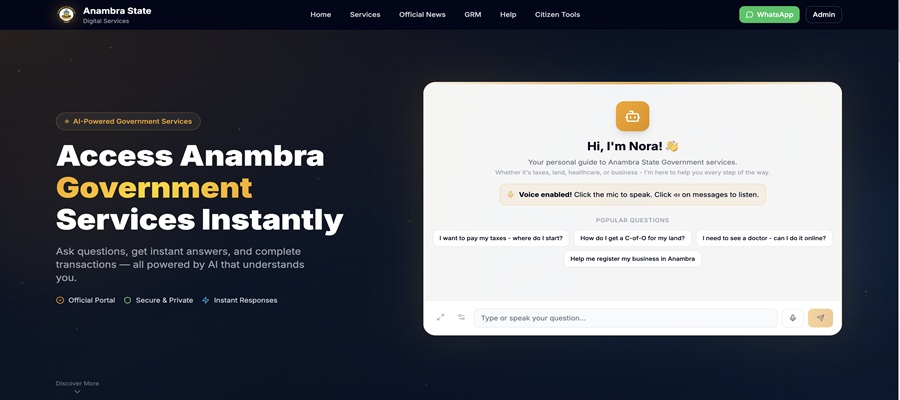
Anambra State has taken another decisive step in digital governance with the BETA launch of SmartGov (https://smart.anambrastate.gov.ng), its digital government services platform designed to simplify how citizens access its over 31 public services anytime and anywhere.

Anambra Rolls Out SmartGov
SmartGov is powered by Artificial Intelligence (AI), enabling citizens to interact with government through natural conversations rather than complex procedures or paperwork. At the core of the platform is NORA, an intelligent digital assistant trained on Anambra State government services, processes, and directories.
This launch further cements Anambra’s leadership in digital transformation, coming on the heels of its recognition at the recently held National Council on Communications, Innovation and Digital Economy (NCCIDE), where the State won four major national awards, including Best Overall Performing State in Digital Technology Development and Best State in Human Capital Development.
SmartGov serves as a single digital gateway to official government information, services, and platforms across the State.
Using AI, the platform understands citizens’ questions and guides them accurately to the right service, requirement, or process.
Through a simple three-step interaction, citizens can:
1. Ask questions about any government service in plain language
2. Receive intelligent AI-driven guidance that directs them to the correct procedure, requirements, or platform
3. Get answers or complete transactions online, via WhatsApp, or through voice-enabled access
The platform currently covers eight major service categories, including Taxes and Revenue, Land and Property, Business Services, Health, Education, Security and Complaints, Transport and Vehicles, and Culture and Tourism.
With 24-hour availability and multilingual support in English and Igbo, SmartGov removes traditional barriers such as office hours, location, and unnecessary bureaucracy, making government services more inclusive and accessible.
From business-related inquiries to renewing vehicle papers, paying taxes, or locating the nearest health facility, SmartGov guides users clearly and seamlessly through each step of the process, ensuring accuracy and consistency across government interactions.
The BETA launch also showcases Anambra’s technical innovation by bringing together AI, voice-enabled access, and WhatsApp connectivity into one unified platform, all supported by a continuously updated government service directory.
This development positions Anambra as a national reference point for citizen-focused eGovernment, building on strong policy direction, sustained digital infrastructure investments, and a deliberate focus on human capital development.
Describing the platform and its functionality, Chukwuemeka Fred Agbata (CFA), MD/CEO of the Anambra State ICT Agency, said SmartGov was built with citizens at the center.
“SmartGov is more than a service directory. It is an intelligent gateway that makes government interactions simple, fast, and reliable.”
He added that Mr Governor, Prof. Chukwuma Charles Soludo, CFR, has consistently emphasized technology as the backbone of governance through the Everything Technology, Technology Everywhere vision.
“SmartGov is a practical expression of this vision. By embedding AI into everyday government services, Anambra State is making governance more transparent, accessible, and efficient for Ndi Anambra.”
As part of the BETA phase, SmartGov also has a dedicated feedback channel to support continuous improvement. Citizens are enjoined to submit feedback via https://smart.anambrastate.gov.ng/feedback
In addition to existing channels such as the Grievance Redress Mechanism (GRM) and official email platforms, NORA, the AI digital assistant, is also available to guide users through the feedback process where required.
“As we refine SmartGov during this BETA phase, we invite Ndi Anambra to explore the platform, use it actively, and share feedback to help us make it even better,” CFA concluded.
SmartGov is now live at https://smart.anambrastate.gov.ng, ushering in a new era of AI-enabled, citizen-centric governance in Anambra State and advancing Mr Governor’s Smart Mega City vision, where innovation is expected, not optional.

PalmPay Launches N400 Million World Travel Carnival, Rewarding Users with Free Global Trips

Nigeria Takes the Lead in the Global WSIS+20 Digital Agenda

Qualcomm Completes Third Edition of Make in Africa Startup Mentorship Program

FirstCap Acts as Joint Issuing House on Veritasi Homes & Properties Plc’s ₦30 Billion Bond Programme

Fynd Expands Global Footprint, Adds Africa With Surtee Group Partnership

Nigeria Records Highest Weekly Cyberattacks in Africa — Report

Hackers Breach Phones of Dangote and Otedola, Demand Ransom

Cyber Tsunami Hits Nigeria as Breaches Surge 1,047%, esentry Q3 Report Reveals

MTN Nigeria Has Invested Over ₦32.23 Billion in National Priorities Through Its Foundation

Group Deepens Digital Rights Advocacy in Ghana Through Judicial Training and Policy Dialogue




 News3 days ago
SiBAN New Executive Council to Champion Vision for Nigeria’s Digital Economy

 E-Financial3 days ago
Tax Reform or Financial Exclusion? The Trouble with Mandatory TINs

 Telecom3 days ago
NCC Blames NOGASA for Abuja Outage

 General News3 days ago
NITDA DG Calls for Innovation-Led Economic Rebirth @ Kano Startup Weekend

 E-Business2 days ago
Check Point Reveals Nigeria as Second Most Targeted African Country for Cyberattacks in November

 Telecom2 days ago
Airtel Africa Partners Starlink to Launch Direct-to-cell Service in 14 Markets

 News2 days ago
REA, NBS Partner to Deliver Comprehensive Energy Data for Nigeria

 News3 days ago
APC National Chairman Appoints Mr. Abimbola Tooki as Special Adviser on Media