

Telecom
ICAF Says NCC, Operators Need Stakeholders’ Support for Improved QoS

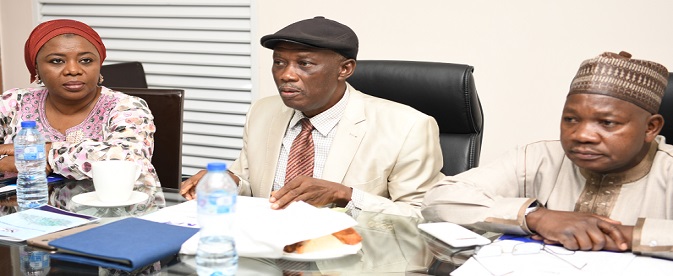
Industry Consumer Advisory Forum (ICAF) has advocated the need for stakeholders at the federal, state and local levels, both in public and private sectors, to work with the Nigerian Communications Commission (NCC) and Mobile Network Operators (MNOs) to collectively contribute towards improving the Quality of Service (QoS) delivery by MNOs in the country.

L-R: Hafsat Lawal, Head, Consumer Protection and Policy Development, Nigerian Communications Commission (NCC); Igho Majemite, Chairman, Industry Consuemr Advisory Forum (ICAF) and Aliyu Ibrahim, Head, Consumer Protection and Advocacy, NCC, during the ICAF first quarter meeting in Abuja.
The advocacy group stated this during a presentation made at its first quarter 2020 meeting held in Abuja.
At every meeting of ICAF, a corporate member is required to make a presentation about a topical issue in the sector.
At this meeting, the Association of Licensed Telecoms Operators of Nigeria (ALTON) made the presentation focused on challenges of quality of service delivery in telecoms sector.
In the presentation, ICAF noted that the challenge of poor QoS in the telecom industry is an issue that requires collaborative efforts of the National Assembly as well as state and local governments, to tackle.
Explaining further, ICAF stated that the collaboration is both urgent and necessary because telecoms has long migrated from being a mere enabler of communication, to an industry that has become widely acknowledged as being the most important enabler of socio-economic activities in contemporary society.
The advocacy body said as with every other sector of the economy, the telecommunications sector has its own peculiar challenges that impact on the ability of telecoms operators to deliver seamless services to customers.
ICAF listed the challenges to include infrastructure damage, bombed sites due to insurgent activities, illegal site lock-outs, unstable power supply and prolonged power outage, denial of statutory permits for infrastructure roll-out, high cost of Right of Way (RoW), and use of substandard devices by the consumers, among others.
Elaborating further, ICAF presentation indexed a situation where telecommunications operators continue to suffer various forms of infrastructure damage across the country, and noted that such a challenge usually leads to sudden outages or poor QoS.
ICAF recalled that at the onset of the insurgency in the North-East region, operators were also at the receiving end of the destruction that was visited on the infrastructure in the region. He cited Adamawa, Borno and Yobe states as areas where hundreds of BTS sites were either bombed or affected due to dependence on a bombed site. Such vandalism resulted in loss of coverage in so many places including Dikwa, Gamboru, Monguno, Bama, Konduga and Damaturu.
“Operators have been able to restore a lot of these sites, while restoration at other facilities are still pending due to security concerns. In some cases those that were restored have been bombed again, but efforts are currently ongoing in collaboration with agencies in the security services and state governments, to secure sites,” ICAF noted in the presentation. It also assured participants that “with these efforts it is hoped that there will be noticeable improvement in coverage, leading to reduced dropped calls in the affected areas.”
The presentation further explained that the failure of some governmental authorities and their subsidiary agencies to grant the statutory approvals required by operators to build more sites is another problem. ICAF affirmed that “as the existing infrastructure get to full capacity, operators need to build more facilities to accommodate excess call, SMS, data and Unstructured Supplementary Service Data (USSD) traffic. Unfortunately, in the past seven years, the FCT Administration, in particular, has not granted approvals for telecommunications sites to be built in the Territory.”
On vandalism and theft, the ICAF presentation observed that this has been a recurring experience of the operators as unknown hoodlums increasingly break into sites, kill or injure the guard on duty and cart away valuable equipment such as the power generating sets, base transceiver station (BTS) equipment and air conditioners among other facilities. It said these criminal activities immediately lead to network outages in the area covered by facilities that suffered vandalism.
ICAF, however, noted that no operator desires to have poor service delivery because of the increased competition that has been engendered by the telecoms regulator.
According to ICAF, “we are in a highly competitive market, where we have multiple players and we should understand that there is no operator that wants to have downtime on its network as that can lead to loss of subscribers to rival operators. The NCC has heightened this with the introduction of the Mobile Number Portability, which makes it easier for a subscriber that is not satisfied with his or current network in terms of service delivery to migrate to other preferred network.”
The presentation further said: “This means if there is any challenge that is affecting any operator’s ability to deliver better experience to its numerous customers, the logical thing is for that operator to take steps to address the challenge so that it will be able to retain its customers. But most of these challenges are far beyond what operators can control. The NCC has been doing a lot to get the buy-in of all relevant stakeholders to address some these challenges, but not much inroad has been recorded because not all stakeholders in the ecosystem are fully supporting the regulator’s efforts at addressing these issues in order to ensure that telecom consumers get top-notched services.”
Proffering solutions to the challenges, ICAF said while the regulator has been taking QoS measurements and sanctioning the erring operators, it must also be acknowledged that it has been making efforts toward addressing all the identified challenges faced by the operators in order to improve service delivery on the networks to telecoms consumers.
“However, if we all agree that telecoms is central to our socio-economic development, then the NCC’s efforts need to be supported by all stakeholders, especially the National Assembly through the passage of the Critical National Infrastructure (CNI) Bill and; we at ICAF also urge the state governors to be considerate about policy measures in order to encourage massive deployment of telecoms infrastructure in their states, as being championed by the NCC,” the advocacy group recommended in the presentation.


Modern messengers, such as WhatsApp, Telegram, Signal and others, are often used for illicit purposes. Kaspersky Digital Footprint Intelligence has conducted an in-depth monitoring of over 800 blocked cybercriminal Telegram channels between 2021 and 2024.

While a range of illegal activities continues to be hosted on the platform, its environment has become noticeably more challenging for sustained underground operations.
Telegram’s bot framework and other built-in features make for a low-effort ecosystem for the underworld.
A single bot can simultaneously manage queries, process cryptocurrency payments, and instantly deliver stolen bank cards, info-stealer logs, phishing kits, or DDoS attacks to hundreds of buyers per day, often without operator involvement.
Unlimited, non-expiring file storage eliminates the need for external hosting when distributing multi-gigabyte database dumps or stolen corporate documents. This frictionless automation naturally favours high-volume, low-price, low-skill offerings, such as leaked bank cards or other data, hosting malware, etc.
High-value, trust-dependent deals (for instance, zero-day vulnerability information) still remain on reputation-gated dark-web forums.
Kaspersky researchers found two clear trends related to illegal activities on Telegram. The average lifespan of shadow channels has increased, with the proportion of channels surviving over nine months more than tripling in 2023-2024 compared to 2021–2022. At the same time, Telegram’s blocking activity has risen significantly.
Monthly takedown figures recorded since October 2024 – even at their lowest – are comparable to the peak levels seen throughout 2023, and the overall pace continued to accelerate in 2025. This impedes malicious activities.
Other disadvantages of Telegram for cybercriminals include the lack of default end-to-end (E2E) encryption for chats, the inability to use their own servers for communication (due to the messenger’s centralised infrastructure), and closed server-side code, which makes it impossible to verify its functionality.
As a result, several established underground communities, including the nearly 9,000-member BFRepo group and the Angel Drainer malware-as-a-service operation, have already begun shifting primary activity to other platforms or proprietary messengers, citing repeated disruptions of their activities on Telegram.
“Fraudsters find Telegram a convenient tool for many malicious activities, but the risk-reward balance is clearly shifting. Channels are managing to stay online longer than a couple of years ago, yet the dramatically higher volume of blocks means operators can no longer count on long-term stability.
“When a storefront or service disappears overnight – and sometimes reappears only to be removed again weeks later – building a reliable business becomes much harder. We’re starting to see the early stages of migration as a direct consequence,” comments Vladislav Belousov, Digital Footprint Analyst at Kaspersky.

Galaxy Backbone Limited (GBB), the Federal Government’s leading ICT infrastructure and shared services provider, will mark its 20th anniversary in June 2026 with a grand celebration that reflects two decades of innovation, resilience, and national impact.

Since its inception in 2006, Galaxy Backbone has been at the heart of Nigeria’s digital transformation journey; building the technological foundation that supports modern government operations and public service delivery. What began as a bold vision to connect government has grown into a critical national platform that drives efficiency, transparency, collaboration and innovation across the public sector.
Over the last 20 years, GBB has helped redefine how government works. By providing secure connectivity, enterprise-grade data centre services, cloud platforms, and digital collaboration tools, Galaxy Backbone has enabled Ministries, Departments and Agencies (MDAs) to move from fragmented, paper-based processes to more integrated, technology-driven systems.
This transformation has improved government-to-government coordination, strengthened engagement with businesses, and enhanced the delivery of services to citizens. Today, the digital infrastructure powered by Galaxy Backbone supports thousands of government users, hundreds of institutions, and critical national platforms that Nigerians rely on daily.
A key part of this journey has been the Federal Government of Nigeria’s investment, managed by GBB in robust national infrastructure, high-capacity and world class data centres, fibre-optic connectivity across multiple states, secure hosting services, and shared platforms that have helped government operate more efficiently and responsively. These contributions have played a pivotal role in Nigeria’s progress toward a more digital, agile and citizen-centered public service.
Galaxy Backbone’s impact has earned both national and global recognition. In 2025, the organisation was ranked first overall in the Federal Government Website Performance Scorecard, reflecting its commitment to excellence in digital service delivery. Internationally, GBB, a couple of years ago, received the prestigious United Nations Public Service Award, a testament to its leadership in promoting a whole-of-government approach to digital transformation.
As GBB celebrates two decades of service, this milestone is more than an organisational anniversary; it is a celebration of Nigeria’s digital evolution. It is an opportunity to appreciate how collaboration between government, industry partners, technology providers, and dedicated public servants has helped build a stronger, more connected nation.
The June 2026 anniversary celebration will bring together stakeholders from across the public and private sectors to reflect on the journey so far, acknowledge the partnerships that have shaped this success, and chart an ambitious course for the future. It will highlight how collective effort, shared vision, and innovation have positioned Galaxy Backbone as a strategic national asset.
Looking ahead, Galaxy Backbone remains committed to deepening digital transformation across the country; expanding infrastructure, strengthening cybersecurity, enhancing service delivery, and supporting the Federal Government’s drive for a smarter, more efficient and digitally empowered Nigeria.
At 20 years, Galaxy Backbone stands proud of its past, confident in its present, and inspired by the limitless possibilities ahead.


Galaxy Backbone Limited (GBB), Nigeria’s leading federal ICT infrastructure provider, has announced its 20th-anniversary celebration for June 2026, marking two decades since unifying government’s fragmented digital landscape into a secure national platform.

Galaxy Backbone
The announcement by Head of Media and Corporate Communications Chidi Okpala follows GBB’s top ranking in the 2025 Federal Government Website Performance Scorecard by the Bureau of Public Service Reforms, cementing its leadership in digital service delivery and transparency.
Managing Director Professor Ibrahim Adepoju Adeyanju described the milestone as celebrating Nigeria’s shift from paper-based silos to a cloud-first, integrated government. Achievements include the UN Public Service Award for 1-GOV.net, high-speed fiber deployment for G2G and G2B interactions, IPPIS payroll rollout, and pandemic-era digital support.
The June event will gather public-private stakeholders, global tech partners, and policymakers to unveil GBB’s next-decade roadmap emphasising cybersecurity, AI in public service, and rural connectivity.
GBB positions itself at the forefront of Nigeria’s 2030 digital nation drive, with 20 years of innovation signaling a smarter, connected future.

SEC Hikes Minimum Capital Requirements for Market Operators After a Decade

Study Shows Blocks in Telegram are Pushing the Underground Out

Galaxy Backbone Marks Two Decades of Powering Nigeria’s Digital Evolution

NGX Unveils Net-Zero Plan for Greener Capital Market

Galaxy Backbone Marks 20 Years, Tops FG Website Scorecard

Banks quietly move to enforce new ₦50 transfer levy from Jan. 1

FIRS says NIN, CAC Numbers to Serve as Tax IDs from 2026

FIRS Declares NIN, CAC Numbers as Tax IDs from 2026

US Begins Partial Visa Ban on Nigerians January 1

Galaxy Backbone Tops FG’s Website Performance Ranking




 E-Financial3 days ago
Paystack Expands Beyond Payments into Banking

 E-Financial3 days ago
SEC Partners Police in Nationwide Crackdown on Ponzi Schemes, Crypto Frauds

 General News3 days ago
EFCC to Use Space Technology to Boost Asset Tracking, Investigations

 E-Business3 days ago
Nigeria Targeted with 4,622 Cyber-attacks Per Week in December 2025

 E-Financial3 days ago
FG Halts Tax Guidelines Amid Uncertainty Over Final Laws – Oyedele

 E-Financial3 days ago
Paystack Buys Microfinance Bank, Enters Nigeria Banking Arena

 News3 days ago
FG Directs Banks, Fintechs to Remit VAT on Service Fees
 E-Financial2 days ago
SEC Hikes Minimum Capital Requirements for Market Operators After a Decade