

Telecom
As Nigeria Celebrates Seven Years of GSM

This month of August marks seven years since the country began the liberalization of telecommunications industry through adoption of Global System for Mobile communications (GSM) technology.
The Nigerian telecommunications industry has experienced significant growth in the last seven years, following the successful take-off of the digital mobile telephone services, using GSM technology. From less than 500,000 active fixed telephone lines as at mid 2001, to a population of over 120 million, the total number of connected fixed and mobile telephone lines increased to about 53 million both active and inactive lines this June.
However the entrance of the GSM technology has brought about such a revolutionary transformation that millions of Nigerians with no access to telecommunications now clutch mobile phones in their millions. It is a common sight these days to see traders, fish sellers, hawkers, motorcycle riders among others using mobile phones. The staggering number of subscribers on the three major GSM networks of MTN, Globacom and Zain as Nigeria celebrates 7 years of operations, is a testimony to the hunger of Nigerians for communications.
It is clear that Nigeria cannot celebrate the advances recorded in the communications sphere without acknowledging the contributions of Ernest Ndukwe, the executive vice chairman of the Nigerian Communications Commission (NCC). Ndukwe has over the years emerged as the face of GSM in Nigeria through his transparent handling of the regulatory affairs of the telecoms sector.
Since February of 2001 when he supervised the auctioning of GSM licences in the country, he has conducted the affairs of the regulatory functions of the commission in such a way that other countries in Africa now come to Nigeria to understudy the regulatory processes that has seen the sector emerge as the largest and fastest growing in Africa and the 3rd fastest growing in the world.
Several research firms across the globe have commended the Nigerian government and Ndukwe, one of the most sought-after telecom resource persons in the telecommunications industry in Africa for an effective transparent and foreign investment attracting regimes in the continent. In spite of the recent downturn in the quality of service dished out by operators characterized by drop calls, undelivered text messages, Ndukwe’s starling qualities as a regulator of note is still intact.
However, beyond the celebration of seven years of GSM, the NCC had taken several measures to tackle the issues of quality of service. One of the ways the NCC has shown that it was serious in tackling issues of quality of service was in the area of the enforcing its regulatory powers to stop operators from further promos that has been a major cause of network congestion witnessed in recent times. By this action the NCC sent a message that no operator is above the law and that they must conform to measures that will save the sector from further deterioration due to their poor service delivery. The commission has also procured equipments that will enable it monitor congestion and service quality of the various networks in the country.
It also ensured that operators paid their subscribers N175 compensation for poor quality of service experienced in January this year, even as some operators protested by taking the commission to court. It stood its ground and made this happened.
Benefits
In the last seven years, since the GSM revolution hit the nation, a lot of benefits have been enjoyed by the Nigerian subscriber who was hitherto at the mercy of the almost nonexistent epileptic services rendered by the Nigerian Telecommunications Nitel. Since then, the monopoly of non effective service rendered by Nitel has been broken and communication across regions enhanced by GSM thus encouraging the socio economic growth of the nation, enhancing business and social relationships. The fact is that effective communication is crucial and cannot be overemphasized. With a teledensity presently below 35 % and a subscriber base of 53 million as at the end of June, one could say that a feat has been achieved by the GSM revolution in connecting Nigerians to a critical service given the fact that before the advent of GSM, teledensity was less than 4% and only about five hundred thousand Nigerians had access to telephony services in a nation of over a hundred million people.
Then having a telephone was a class thing and only the rich could afford the luxury and the muscle to withstand the stress of Nitel technicians who used to hold subscribers to ransom at every little opportunity. Then it was a common sight to see the technicians asking for ladder and cables and all sorts to fix a line anytime a problem arises, it was indeed a nightmare. One could easily recall the stress of keeping vigil at the offices of Nitel in a bid to make calls and be confronted with the common problem of no tone come back tomorrow and so on. But thanks to President Obasanjo and the coming of GSM all that is now history.
The GSM revolution in the country has indeed contributed over 80 percent of $12 billion private investment in the sector as well as account for $10 billion foreign direct investment. It has also stimulated local investment and increased job opportunities. It is a common scene in urban areas of young men and women sitting under an umbrella provided for them by GSM operators making calls for people at token. This umbrella call centre initiative is today providing food to greater percentage of unemployed Nigerians, aside this are others who are trading in recharge cards and other products of GSM operators.
The benefit of GSM technology is enormous and still increasing as it gets expanded, we may not easily forget that Nigerians are now turning GSM engineers, these are our young countrymen and women who eke their living through repair of mobile handsets. The popular Otigba computer village is no longer computer village in its sense as the sale of mobile handset has almost taken over business at the market.
The revolution has also indirectly stimulated development and vibrancy of some sectors of the economy, such sectors are leveraging on the technology deployed by GSM operators to provide services to their customers, A case in point is the banking sector, where banks are offering mobile banking which give customer the opportunity to monitor and carry out transactions on the move through their mobile phones. Most Automated Teller Machines (ATM) deployed by banks is working with the help of GSM General Package Radio Service (GPRS) deployed by operators.
There has been an increased turnover for advertising and marking communications services basically because of the GSM operators that uses the channel often times to reach their subscribers as campaign for more subscribers.
Challenges
In spite of the benefits Nigerians are enjoying from the advent of GSM technology, the operators are not finding it a world of roses in rendering services. The much talked about poor quality of service is a function of weak infrastructure base, operators have been powering their equipment with generators which are not the case in most environment. This is attributed to inefficient public power system. Nigeria CommunicationsWeek investigations reveal that the three major operators in this space, MTN, Glomobile and Zain are powering their over 14,000 base transceiver stations with 28,000 generators. They are also providing security for their equipment which has not deterred unscrupulous Nigerians from stealing these generators and diesel. At last count in December last year Zain, Glomobile and MTN lost a total of 290 generators and over a million litres of diesel, this is indeed a huge lost to bear by operators.
There is also the problem of area boys. One of the operators has had to shutdown one of its sites in Lagos due to incessant demand of huge settlements by Area Boys. In the Niger-Delta area, one of the operators reported that over 30 of its sites have become inaccessible due to militant youths, who have refused them to refuel or maintain the sites except they parted with huge sums of money. It is unfair on the GSM operators, who unlike the oil companies are not taking any natural resource but building telecommunications infrastructure around the country.
Operators are also face with multiple taxation imposed on their equipment by different tiers of government, Abuja capital development authority had impose N3 million annual fee on each base station in the metropolis. More so, Association of Licensed Telecommunications Operators of Nigeria (Alton), the umbrella body of the telecom operators, are in court with Lagos state government over the later imposition of N500,000 fee per base station in the state.
The regulatory body also needs to ensure that competition is enshrined in all market segment of the sector as well as maintain favourable regulatory and investment climate, required for the protection of consumers. This is necessary in view of anti competitive behavour of some GSM operators.
The next phase of the Telecommunications growth will come from the rural areas. With a paltry 40 percent of the country being covered with telecommunications services, it is obvious that a huge gap needs to be tapped and already the focus for now by stakeholders and investors is on the rural area and how ICT services can be deployed to the rural communities. Investors are falling over themselves to come to Nigeria and do business mostly as a result of the fact that in spite of the infrastructural problems posed by lack of power, roads among other, Nigeria has a high return on investments rate. It is a fertile ground for any investor to recoup their investments, because of its population. Before now, the country has witnessed higher investments in the urban areas as opposed to lower investments in the rural areas by telecoms operators. In order to bridge this gap, telecommunications and internet services need to be deployed to the rural areas.
The NCC under Ndukwe should not relent in its efforts of playing its regulatory functions in an effective manner. Nigeria has a lot to gain and cannot afford to loose sight of the fact that an effective regulatory environment has to a large extent helped in steering the ship of the nation’s telecoms revolution.
As Nigeria celebrate this seventh year of Global System for Mobile communications (GSM), subscribers await the introduction of number portability which is believed will in no small measure help in address the quality of service issues.
NCC need to be commended for rising up to the challenges of regulation, especially with SIM registration, call centre initiative, consumer parliament and its current effort at ensuring that physically challenged group in the society are fairly treated by operators.



Google has unveiled a new feature that allows Gmail users to change their existing email addresses without losing data or access to services, marking a major shift in the company’s long-standing policy.

Gmail
According to an update on Google’s account help page, the new option enables account holders to replace their current @gmail.com address with a new one while retaining all associated data, including emails, photos, and integrations with services such as Google Drive, Maps, and YouTube.
The guidance, however, was first spotted on the Hindi version of Google’s support page, suggesting that the rollout may begin in India or Hindi-speaking markets before expanding globally.
The English-language support page still carries the older advisory that Gmail addresses “usually cannot be changed.”
Google explained that under the new policy, users who update their Gmail address will automatically keep their original address as an alias.
This means emails sent to the old address will continue to arrive in the inbox, and the original address will remain valid for signing in to Google services.
Previously, users seeking a new Gmail address had to create an entirely new account and manually transfer their data, a process that often disrupted third-party app integrations. The new feature eliminates that inconvenience, ensuring continuity for users.
The company further clarified that while users can reuse their old Gmail address at any time, accounts that change their address will face certain restrictions.
These include a 12-month waiting period before another new Gmail address can be created, and the inability to delete the newly chosen address once it has been set.
Google assured users that all existing data would remain intact after an address update, including stored photos, messages, and emails.
The gradual rollout of the feature indicates that full global adoption is expected in the coming months, a move likely to be welcomed by millions of users who have long requested the ability to update their Gmail identities without starting afresh.

Nigerian Communications Commission (NCC) has said that Nigeria’s internet usage reached a record 1.24 million terabytes in November 2025.

According to the latest data from the NCC, the figure rose modestly from 1.235 million terabytes in October, reflecting steady growth in digital activity across the country.
Broadband penetration in Nigeria crossed the halfway mark in November 2025, reaching 50.58 per cent, up from 45.61 per cent in January, the telecoms regulator reported.
The figure, however, falls short of the 70 per cent coverage target outlined in the National Broadband Plan 2020–2025, which expires this month.
The country had roughly 109 million broadband subscriptions by November. Growth has been uneven, hindered by infrastructure and regulatory constraints, including frequent fibre-optic vandalism that triggers 30 to 43 network cuts daily, high right-of-way fees, and declining subscriber numbers earlier in the year.
Expansion of mobile networks, particularly 3G and 4G services, alongside limited 5G rollouts in urban centres, affordable smartphones, and competitive data plans, has driven uptake.
Investments in the National Communications Backbone and private-sector initiatives have also improved access, especially in underserved areas.
While Nigeria is gradually improving digital inclusion, achieving the original broadband plan remains challenging due to high infrastructure costs, coverage limitations, and deployment hurdles.
The NCC maintains that continued investment in mobile networks and broadband infrastructure will sustain gradual growth in the sector.
Commenting on the development, some Nigerian analysts attributed the surge to the broader mobile and broadband adoption and the growing appetite for streaming, online learning and other digital services.
According to the analysts, the figures suggest that internet connectivity is no longer a luxury but a necessity for both business and leisure, underscoring the slow but steady expansion of Nigeria’s digital economy.
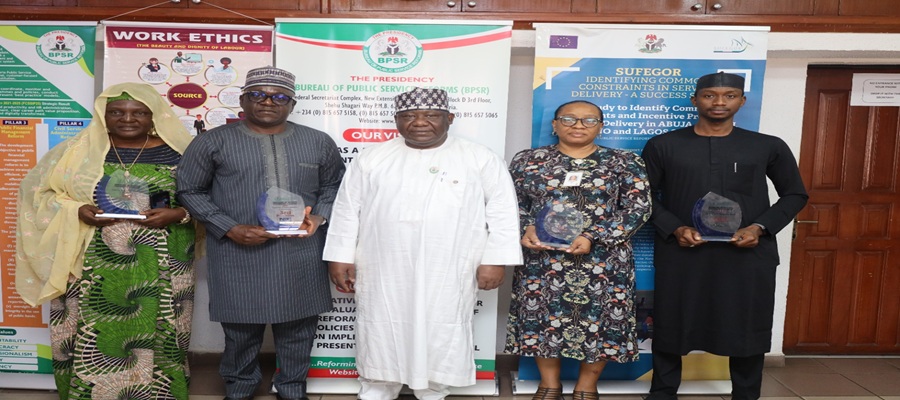
Bureau of Public Service Reforms (BPSR) has named the Nigerian Communications Commission (NCC) among the top three Ministries, Departments and Agencies (MDAs) of the Federal Government with the Best Ranking in Website Performance for 2025.

L-R: Head Special Projects, Nigerian Export Promotion Council (NEPC), Salamatu Andu; Executive Commissioner, Technical Services, Nigerian Communication Commission (NCC), Engr. Abaraham Oshadame; Director General Bureau of Public Service Reforms (BPSR), Head Customer Support Service, Galaxy Backbone, Rosemary Ehize; Secretary to the ES. Nigerian Content Development and Monitoring Board, Tahir Aminu at the BPSR award ceremony for top four MDAs in BPSR Website Performance and Ranking 2025 at the BPSR office on Tuesday, 23rd December, 2025.
This is coming barely three weeks after the telecom regulator was recognized as one of the top five best-performing Federal Government agencies for 2025 by the Presidential Enabling Business Environment Council (PEBEC) – a testament to the Commission’s consistency in investment in technology for ensuring efficient service delivery.
In the BPSR 2024/2025 scorecard ranking of agencies’ websites, the NCC came second in the ranking, trailing behind Galaxy Backbone Limited, which came first while the Nigeria Export Promotion Council (NEPC) clinched the third position, from a pool of 235 MDAs, whose website were evaluated.
BPSR deployed 14 evaluation criteria in include MDA’s website compliance with .gov.ng domain name, appearance and aesthetics (look and feel) of the website, content, relevance to MDAs mandate/government policy and the website’ structure.
Others include website’s responsiveness (device compatibility), security, load time, usability/ease of navigation, availability/uptime, functionality, interactivity, accessibility and capacity building.
The recognition was announced at the official release of Federal Government 2024/2025 Scorecard Ranking for MDAs’ Website held at the Federal Ministry of Finance Auditorium in Abuja on Monday (December 22, 2025) while the award presentation took place at BPSR’s Office on Tuesday (December 23, 2025).
The award, which is an important index metric of the National e-Government Masterplan for determining the Nigeria e-Government Status, was received by the Commission in recognition of its commitment to maintaining a world-class website that enhances service delivery to the citizens.
Receiving the award on behalf of the Executive Vice Chairman of the NCC, Dr. Aminu Maida, the NCC’s Executive Commissioner, Technical Services, Abraham Oshadami, appreciated the BPSR for the recognition, describing the award as “another encouragement for the Commission to be a better public service institution leveraging digital platforms such as our web presence to enhance public service delivery to our various stakeholders, thereby implementing the Federal Government’s Ease of Doing Business policy direction.”
While presenting the award to the NCC, alongside other two agencies, BPSR’s Director-General, Mr. Dasuki Arabi, commended the top three for their proactive decisions in maintaining world-class websites, which are compliant with the Federal Government’s policy direction in effective and efficient service delivery to the citizens.
According to the DG, the 2024/2025 MDA’s websites’ ranking represents a collective effort of federal public institutions in Nigeria to be transparent, accountable and open in governance, as well as a confirmation to align with global best practices in service delivery to the citizens.
Developed about six years ago, Arabi said as a result of the annual ranking, more public institutions have indicated readiness to embrace reforms, and align with the policy direction of the current administration’s Renewed Hope agenda on improve governance for effective service delivery, as introduced by His Excellency President Bola Ahmed Tinubu.
“The ideals of harnessing and deploying technological tools for service delivery has become imperative following the COVID pandemic, and distortions of socio-economic system of nations, culminating in the evolution of competitiveness, cost effectiveness, and agile governance.
“As engine room of governance, it behoves on us in the public service to perform our statutory duties and we must put in place technological innovations and standardized websites to operate services as well as deliver service needs to citizens,” he said.
The Scorecard exercise, he said, is part of the BPSR reform broader function of conducting research on reform implementation efforts and presenting ‘best practice’ models to the entire Public Service, and to among others, improve access to government information, facilitate seamless financial transaction, eliminate corruption and cyber theft, as well as facilitate access to government services.
Speaking on the rigorous nature of the exercise that produced the top three winners, the DG said “in the past few weeks members of the Scorecard Jury drawn from inter-Ministerial Agencies, had worked tirelessly to mill websites of selected MDAs through a rigorous process of enduring criteria for the ranking and the outcome had also passed through a quality assurance mechanism to validate the outcome.”

InsomniaQ Spotlights African Creativity in Lagos

T2 Backs Youth Excellence as NCBC Wins Bosun Tijani Foundation Basketball Tournament

Google Finally Allows Users to Change Gmail Address, Keeps Data and Services Intact

How Moniepoint’s Founders, Tosin Eniolorunda and Felix Ike are Redefining African Tech and Finance

Ecobank Guarantees Seamless Digital Banking Services Throughout the Christmas and Year-End Period

Nigeria Records Highest Weekly Cyberattacks in Africa — Report

Cyber Tsunami Hits Nigeria as Breaches Surge 1,047%, esentry Q3 Report Reveals

Minister Claims Bandits Exploit Poor Network, Bounce Calls Off Multiple Towers

Financial Sector Faced AI, Blockchain and Organised Crime Threats in 2025 – Report

GenAI Adoption Among African workers Outpace Global Peers




 E-Financial2 days ago
Banks quietly move to enforce new ₦50 transfer levy from Jan. 1
 General News2 days ago
Ecobank Guarantees Seamless Digital Banking Services Throughout the Christmas and Year-End Period
 News2 days ago
How Moniepoint’s Founders, Tosin Eniolorunda and Felix Ike are Redefining African Tech and Finance
 Telecom5 hours ago
Google Finally Allows Users to Change Gmail Address, Keeps Data and Services Intact
 General News5 hours ago
T2 Backs Youth Excellence as NCBC Wins Bosun Tijani Foundation Basketball Tournament
 News4 hours ago
InsomniaQ Spotlights African Creativity in Lagos