

E-Financial
Bankers Committee Kicks Against Interest Rate Reduction


The Bankers’ Committee yesterday said that it might be difficult for the Central Bank of Nigeria (CBN) to achieve a lower interest for the country owing to the current level of macro economic environment.
The committee at the end of its 316th meeting held at the headquarters of the CBN specifically noted that for the country to achieve a reduction in interest rate, issues such as the high costs at which banks source for fund, the high inflation rate, as well as the exchange rate needed to be addressed in a fundamental manner.
Present at the meeting was the Governor of the CBN, Mr. Godwin Emefiele, the four Deputy Governors of the apex bank, all the Chief Executives of Deposit Money Banks, and the Managing Director of the Nigerian Deposit Insurance Corporation, Alh Umaru Ibrahim among others.
Emefiele had, while unveiling his agenda for the banking sector, stated that he would pursue a gradual reduction in key interest rates and maintain exchange rate stability to aggressively shore up foreign exchange reserves.
He had said while a reduction in deposit rates would encourage investment attitudes in savers, a reduction in lending rates would make credit cheaper for potential investors.
However, addressing journalists shortly after the bankers committee meeting, Mr. Segun Agbaje, Managing Director, Guaranty Trust Bank, said while the structure of the economy remained fundamentally fixed, there is need to address factors such as exchange rates and import substitution in order to drive down interest rates.
He, however, added that the committee would continue to support the initiative of the new apex bank boss to drive down interest rate within the medium to long term.
He said, “The interest rate environment that we have today is suitable when you take the other factors such as inflation, and price stability, and the lower interest rate going to the medium term is desirable.
“So, if you look at the policy thrust of this current governor of the central bank to bring down interest rate, but it is not going to happen tomorrow.
“You are going to balance what you see today and keep the interest rate and then gradually move to what you think as the desired state which is a reduction in interest rate.”
When asked about the impediments to achieving a lower interest rate, the GT bank boss said, “There are many impediments to lower interest rates. First you have to look at the rate of inflation, you have to look at what type of exchange rates you want, you have to look at what the cost of funds of the banks are, you have to look at what the cost of providing infrastructure, you have to look at cost of providing personnel.
“All these come into what becomes what is cost of funding before you determine what the margin is. Even your macro economic factors as a country also affect what interest rates are charged.
“There are so many variables that determine interest rate. Whether you live in lower interest rate environment we do not want interest rate that is below the rate of inflation because that discourages savings.”
Phillips Odouza, GMD of United Bank for Africa, who also spoke at the media briefing said that since the commencement of the biometric registration of bank customers, about 10,000 customers have been captured .
He said the project was vital for the banking sector as it will assist in consumer lending by providing credit to people that were hitherto excluded from the banking system.


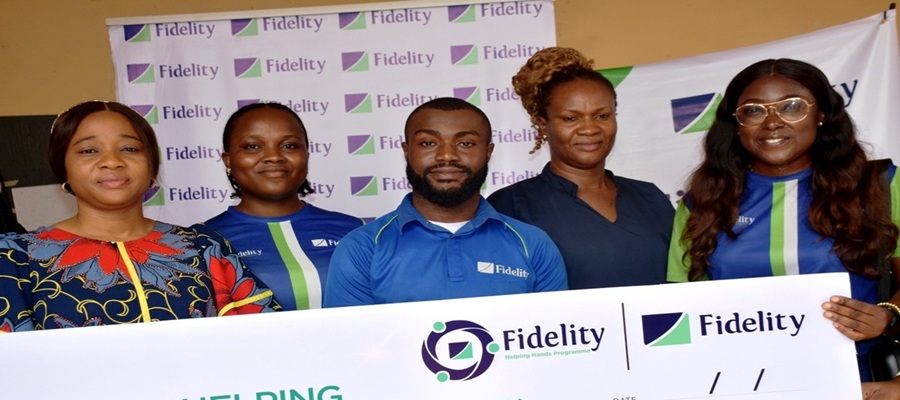
Fidelity Bank Plc has brought relief to indigent patients at the Enugu State University Teaching Hospital (ESUTH) Parklane, by offsetting medical bills and providing financial support to children battling chronic health conditions alongside donations of ante-natal kits to pregnant women.

L-R: Public Relations Officer, Enugu State University Teaching Hospital (ESUTH), Amarachi Amusi; Team Member, Optimizers Inductees Class of 2025, Precious Uchechi-Uneke; Class Governor, Optimizers Inductees Class of 2025, Chinedu Hilary-Elijah (both of Fidelity Bank Plc); Matron, Children’s Ward ESUTH, Esther Nnaji; and Team Lead, Corporate Social Responsibility (CSR), Fidelity Bank Plc, Victoria Abuka; during the Fidelity Helping Hands Program (FHHP) outreach to ESUTH recently.
The intervention, which was carried out under the bank’s Corporate Social Responsibility (CSR) initiative known as Fidelity Helping Hands Programme (FHHP), was funded and executed by newly inducted employees of the bank, the Optimizers Inductees Class, as their community impact project, with matching financial support from the bank.
Commenting on the outreach, Divisional Head, Brand and Communications Division, Fidelity Bank Plc, Dr Meksley Nwagboh, highlighted that the initiative underscores the bank’s commitment to improving lives through targeted social interventions across its four CSR pillars.
“This project reflects the spirit of who we are as a bank. Beyond providing financial services, we are committed to touching lives within the communities where we operate. Today, we are donating ante-natal kits to pregnant women and also supporting indigent patients who have remained in the hospital due to unpaid bills. Some of the children also require long-term medical care, so we have given additional financial support to aid their continued treatment,” Dr Nwagboh said.
Whilst wishing the beneficiaries quick recovery and good health, Nwagboh described the intervention as both significant and timely, enabling many families to reunite and celebrate the festive season without the burden of outstanding hospital debts.
Receiving the donation, the Chief Matron of the Children’s Ward, Esther Nnaji, commended Fidelity Bank for the timely intervention, describing it as a lifeline for families grappling with rising healthcare costs.
“There are so many families here in desperate need. Some of the children are battling cancer, sickle cell disease and other chronic conditions. Fidelity Bank’s support will go a long way in relieving their pain. Because of what you have done, some of these children will now be able to see their siblings again,” she said.
Several beneficiaries expressed deep gratitude to Fidelity Bank for easing their financial burdens. Mrs. Adaeze Ilo, whose baby’s bill was cleared, said the support came at a moment of despair.
“After spending months in the hospital, we had no idea how to raise the money,” she said. “Fidelity Bank came through for us when we needed it the most. We are deeply grateful.”
Another relieved parent, Jane Anthony, whose son’s bill was cleared, said her family had already accepted that they would spend Christmas in the hospital.
“God used Fidelity Bank to send us home to enjoy Christmas. My heart is full.” she said.
The recent outreach to Enugu State University Teaching Hospital further highlights Fidelity Bank’s continued commitment to supporting vulnerable groups and strengthening community well-being across Nigeria through community-driven CSR efforts.
Ranked among the best banks in Nigeria, Fidelity Bank Plc is a full-fledged Commercial Deposit Money Bank serving over 9.1 million customers through digital banking channels, its 255 business offices in Nigeria and United Kingdom subsidiary, FidBank UK Limited.
The Bank is a recipient of multiple local and international Awards, including the 2024 Excellence in Digital Transformation & MSME Banking Award by BusinessDay Banks and Financial Institutions (BAFI) Awards; the 2024 Most Innovative Mobile Banking Application award for its Fidelity Mobile App by Global Business Outlook, and the 2024 Most Innovative Investment Banking Service Provider award by Global Brands Magazine. Additionally, the Bank was recognized as the Best Bank for SMEs in Nigeria by the Euromoney Awards for Excellence and as the Export Financing Bank of the Year by the BusinessDay Banks and Financial Institutions (BAFI) Awards.


Nigeria’s banking regulators have moved to shut down two mortgage lenders after prolonged financial distress, as authorities intensify efforts to enforce capital discipline and restore confidence in the country’s housing finance system.

The Central Bank of Nigeria (CBN) has withdrew the operating licenses of Aso Savings and Loans Plc and Union Homes Savings and Loans Plc, setting in motion a liquidation process that will see insured depositors paid by the Nigeria Deposit Insurance Corporation (NDIC).
The revocation marks a decisive intervention by the central bank, which said the lenders repeatedly failed to meet regulatory standards despite supervisory actions.
In a statement signed by Hakama Sidi Ali, acting director of corporate communications, the CBN said the decision was taken under the Banks and Other Financial Institutions Act, BOFIA 2020, and the revised guidelines for mortgage banks, as it seeks to re-position the sub-sector and entrench compliance.
“As part of its efforts to re-position the mortgage sub-sector and promote a culture of compliance with relevant laws and regulations, the Central Bank of Nigeria has revoked the licenses of Aso Savings and Loans Plc and Union Homes Savings and Loans Plc,” the statement said.
The central bank said the two institutions breached several provisions of BOFIA 2020 and regulatory guidelines, citing weak capital, balance-sheet strain and persistent non-compliance.
According to the CBN, the lenders failed to meet the minimum paid-up share capital requirement for their licence category and did not have sufficient assets to meet their liabilities.
The lenders were also “critically undercapitalised with a capital adequacy ratio below the prudential minimum ratio as prescribed by the CBN,” the regulator said, adding that both institutions failed to comply with several directives imposed by the central bank over time.
The action highlights the CBN’s broader push to tighten oversight of Nigeria’s financial system after years of regulatory forbearance, particularly in niche segments such as mortgage banking that have been weighed down by funding constraints, rising credit risk and weak profitability.
While the sector accounts for a small share of total banking assets, it is viewed as key to expanding access to long-term housing finance in Africa’s most populous economy.
The CBN said it remains focused on safeguarding systemic stability. “The CBN remains committed to its core mandate of ensuring financial system stability,” the statement said.
Following the withdrawal of the licenses, the NDIC was appointed liquidator of the two lenders and has begun the process of winding them up, including reimbursing eligible depositors.
In a separate statement on Tuesday, the Corporation said it had commenced liquidation in line with the NDIC Act 2023 and started verification and payment of insured deposits to customers of the defunct banks.
Depositors are entitled to receive up to ₦2 million per depositor, with payments to be made using Bank Verification Numbers (BVN) to identify alternate bank accounts for automatic credit.
Customers with balances above the insured limit will receive the initial ₦2 million, while the remaining sums will be paid as liquidation dividends after the realisation of assets and recovery of outstanding loans, the NDIC said. The corporation added that it would begin selling the banks’ assets and intensify debt recovery efforts to accelerate payments of uninsured balances.
The NDIC advised depositors to submit claims either online or physically at branches of the closed banks during the verification period, with valid identification and proof of account ownership. Creditors were also asked to file claims, with payments to follow after all depositors have been fully settled, in line with statutory provisions.
Staff and shareholders of the defunct banks will only be paid after depositors and creditors, from proceeds realised during liquidation, the NDIC said, while urging borrowers to repay outstanding loans and assuring the public that other licensed banks remain safe and sound.

Central Bank of Nigeria (CBN) has revoked the operating licences of Aso Savings and Loans Plc and Union Homes Savings and Loans Plc, citing persistent regulatory breaches that undermined the safety and soundness of the institutions.

CBN
In a statement issued on Tuesday, the Acting Director of Corporate Communications, Mrs. Hakama Sidi Ali, said the decision was part of renewed efforts to sanitise the mortgage sub-sector and enforce strict compliance with banking regulations.
According to her, the affected institutions violated several provisions of the Banks and Other Financial Institutions Act (BOFIA) 2020 and the Revised Guidelines for Mortgage Banks in Nigeria.
“The institutions failed to meet minimum paid-up share capital requirements, were critically undercapitalised, and did not comply with multiple regulatory directives. They also lacked sufficient assets to cover liabilities,” Sidi Ali said.
She explained that the revocation was intended to strengthen confidence in the mortgage sector and ensure that only institutions capable of operating safely and soundly are allowed to continue business.
The apex bank stressed that it remains resolute in enforcing regulatory standards across all segments of the financial system.
“The Central Bank of Nigeria remains committed to its core mandate of ensuring financial system stability,” Sidi Ali added.
Nigeria CommunicationsWeek reports that the move follows repeated warnings from the CBN in recent years, urging mortgage operators to improve capitalisation, governance, and compliance with statutory requirements.
Industry analysts say the action is expected to reinforce discipline within the mortgage banking segment and restore public trust in the sub-sector, which has struggled with weak capitalisation and governance challenges.

NITDA Partners OGP to Drive Presidential Digital Goals

MTN Graduates 20 Fellows, Expands Media Innovation Programme

Fidelity Bank Boosts Maternal, Child Healthcare @ESUTH

PalmPay Launches N400 Million World Travel Carnival, Rewarding Users with Free Global Trips

Nigeria Takes the Lead in the Global WSIS+20 Digital Agenda

Nigeria Records Highest Weekly Cyberattacks in Africa — Report

Hackers Breach Phones of Dangote and Otedola, Demand Ransom

Cyber Tsunami Hits Nigeria as Breaches Surge 1,047%, esentry Q3 Report Reveals

MTN Nigeria Has Invested Over ₦32.23 Billion in National Priorities Through Its Foundation

Group Deepens Digital Rights Advocacy in Ghana Through Judicial Training and Policy Dialogue




 E-Business2 days ago
Check Point Reveals Nigeria as Second Most Targeted African Country for Cyberattacks in November

 Telecom2 days ago
Airtel Africa Partners Starlink to Launch Direct-to-cell Service in 14 Markets

 News2 days ago
REA, NBS Partner to Deliver Comprehensive Energy Data for Nigeria

 E-Financial2 days ago
CBN Revokes Licenses of Two Mortgage Banks, NDIC Begins Liquidation

 E-Financial2 days ago
CBN Revokes Licences of Aso, Union Homes Mortgage Banks Over Regulatory Breaches

 E-Business2 days ago
Microsoft Empowers 350,000 more Nigerians with AI Skills

 Broadcasting2 days ago
MultiChoice Talent Factory Calls for Entries Into Fully Funded Film Training Programme

 General News1 day ago
FirstCap Acts as Joint Issuing House on Veritasi Homes & Properties Plc’s ₦30 Billion Bond Programme