Blurb: With more than 40 percent of Africa’s population living in urban areas, Africa is embracing urbanization and the opportunities and challenges that come with it. Smarter cities are more capable of attracting FDI. For a country and its cells, “Cities”, there is also Maslow-like hierarchy of digital needs. Security assurance is the basic needs.
ICT has an important role to play in attracting capital and investment by increasing efficiency and cutting costs, not only for a country but also at a city-level. However, how closely is ICT and investment correlated to each other and what is the implications for Africa, home to most of the hundreds of millions of new city dwellers expected by 2050?
A report launched recently by UN Habitat (‘The State of African Cities 2018: The geography of African Investment’) explains how African cities can replicate those of East Asia and attract foreign direct investment (FDI) in order to develop sustainably.
The report shows Africa needs to seize a more prominent position in the world economy by enhancing its accessibility, connectivity, markets and urban attractiveness. It finds “reliable mobile networks and internet access attract knowledge-based FDI”.
As a leading company in the ICT industry, Huawei fully agrees with many of the report findings include that firstly, improving ICT infrastructure is critical to attracting FDI, whilst secondly, the ICT industry itself is also a crucial sector for FDI. For the latter finding, the report highlights that ICT sector FDI offers the highest growth rates and highest number of direct jobs along with manufacturing, and that the two are closely linked.
Connectivity provided by communications network and internet has become as important as water and electricity. The State of African Cities Report notes inward FDI into Africa correlates positively with large urban populations (markets), mobile phone subscriptions, internet bandwidth and full electricity supply, “These factors combined with high-quality ICT and lower transaction costs enhance FDI attraction for multinationals.” This parallels Huawei’s own experiences in Africa over the last twenty years.
A better ICT environment can better attract knowledge-based FDI. It starts with having reliable mobile networks and internet access. Internet access itself is not enough though. Huawei believes that in Africa connectivity brought by the network of communication towers and fibre is like the “soil”, which provides the fertile ground for important value-adding crops, which in this case are services including Safe City, E-government, E-education, E-health, E-agriculture and so on that enhance public social services delivery and better allocation of resources. We must keep improving the soil fertility, or the quality, access and speed of the connectivity, so the “crops” can grow successfully improving the ease of doing business and livelihoods.
With more than 40 percent of Africa’s population living in urban areas, Africa is embracing urbanization and the opportunities and challenges that come with it. On the one hand, African countries are gaining agglomeration and economy of scale benefits, but on the other hand they must manage "big city diseases" e.g. congestion, pollution, and even some non-traditional security threats such as financial security and terrorism.
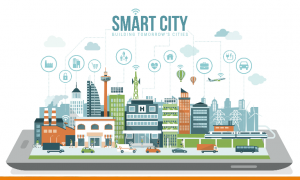
The “smart city” concept is a new critical phenomenon in urban development, especially when cities want to expand their global reach. Smarter cities, according to the report’s studies, are more capable of attracting FDI from more and further destinations. City administrations can therefore set up Smart Procurement Agencies and Competition Commissions, for branding their city as an attractive “smart” investment destination.
How to make a city smarter?
First, construction of smart cities is a giant system that interacts across systems and is a “system of systems”. It requires coordination of cross-domain coordination through the top-level design, including setting goals, priorities, and implementation paths. The top-level design is also essential rather than optional given that cities are paying more attention to civic experiences, technological frameworks, new technology references, and construction models, In addition to projects and investments.
Second, taking a two-step approach starting with Safe City and then moving to Smart City. According to Maslow’s hierarchy of needs, safety and security together with food and water are basic needs for all human beings. For a country and its cells, “Cities”, there is also Maslow-like hierarchy of digital needs. Similarly, security assurance is the basic needs for a country or a city. It lays a solid foundation for a competitive nation and a dynamic city.
Third, to grow the nerve system inside and outside the body. Huawei sees a city as a living organism, which is powered by a nervous system comprises a “brain” (the control center) and “nerves” (the network and sensors). Leveraging leading new ICT such as cloud computing, IoT and AI, Huawei is committed to creating a strong nervous system that powers Smart Cities. More importantly, as the report finds, to establish a national, regional and international network of dedicated smart cities that collaborate and share beneficial information and data.
The report is well-timed and chimes with Huawei’s own experiences from our work across the world, including in African countries. With Huawei’s vision to bring digital to every person, home and organization for a fully connected, intelligent world, we fully support the recommendations in the report that local policy makers should embrace the digital revolution, develop ICT skills and invest more in regional infrastructure, both physical and ICT, to make our cities safer, our lives better and our future smarter.