

General News
ComTech Ministry to Launch Gender Initiatives to Empower Women


Federal Ministry of Communication Technology has finalized plans to launch gender based initiatives that will empower Nigerian women and girls from Monday the 4th of November.
Mrs Omobola Johnson, minister of Communications Technology, said that the initiatives are the SmartWoman Nigeria initiative, 1000 Girls in ICT Training programme and the ICT Girls Clubs geared at educating, empowering, developing and making women and girls in Nigeria ICT savvy and self- reliant.
Two of the initiatives, the Smart Women Nigeria and the 1000 Girls ICT training programme will be launched on November 4 in Lagos, while the ICT Girls Clubs will be launched in January 2014. The Ministry is collaborating with some partners to launch the initiative.
The SmartWoman Nigeria platform developed by US based social enterprise ChangeCorp will be launched in collaboration with WIMBIZ.
The initiative seeks to promote the development of women in Nigeria by harnessing the power of mobile communication tools provided by Information and Communication Technologies (ICTs).
The SmartWoman initiative which featured at the first meeting of the Broadband Commission for Digital Development Working Group on Gender in Mexico City (of which the Minister of Communication Technology, Mrs Omobola Johnson is a member) is targeted at low- to middle-income urban and high-income rural women business owners. It offers learning in communication skills, banking, financial, health, and family work/life balance issues.
The second Gender initiative to be launched by the Ministry also on the 4th is the ICT training for 1000 Girls in collaboration with Hauwei.
The training project will inculcate 1000 girls with crucial ICT skills necessary for empowerment and development of the girls.
The programme is a three day programme that will train 1000 unemployed Nigerian girls within a year in specific ICT skills that will enhance their employment opportunities.
The girls will be trained in Telecommunication Networks, Transmission Network and GSM, LTE, WCDMA and other ICT skills.
The first phase of the training programme will commence on the 4th of November 2013.
Upon completion of this first phase, the top 200 students based on performance during phase 1 will be given further training to become Huawei Certified Network Associates
The third initiative, the ICT Girls Club is perceived as a viable platform to create an enabling environment to encourage young girls to embrace ICTs.
The aim of these Clubs is to help to bridge the existing digital divide between boys and girls and remove the barriers that discourage girls from embracing ICTs.
The goal is to ensure that more girls embrace and adopt careers in ICTs. The Clubs will teach animation, website development, blogging, software development, graphics design, games, computer programming etc.
The Ministry in partnership with two recognized NGOs (Women in Technology in Nigeria WITIN and Women Empowerment Centre WTEC) will set up the clubs in selected schools across the 6 geo political zones in Nigeria in January 2014.
The Federal Government of Nigeria in a bid to further empower Nigerian women and girls developed an innovative approach to gender empowerment through the Ministry of Communication Technology, Agriculture, Water Resources, Health and Works.
To empower women and Girls, five Ministries signed MOUs with the Ministry of Women Affairs and Finance to develop the potential and earning power of women and deliver on specific services that will impact positively on the lives of Nigerian women.
The Ministry of Communication Technology, a key partner in the MoU signed through the specific technology initiatives listed above is empowering women and girls to embrace ICTs to actualize their potentials and contribute to the economic development of Nigeria.
ICTs have the transforming power to accelerate the development of women by helping them to be more efficient and effective in their jobs, careers, and business and to generate new employment opportunities. It also has the potential to significantly contribute to increasing the social welfare of women.


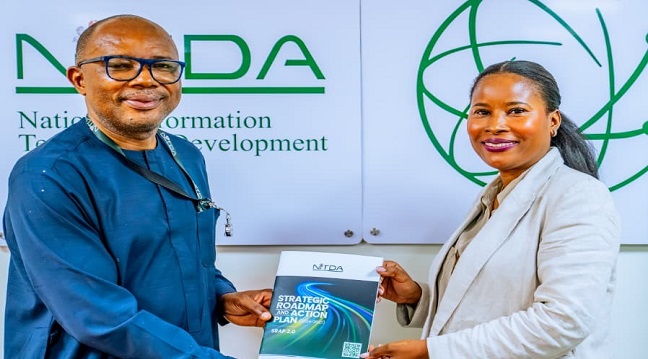
The National Information Technology Development Agency (NITDA) and Agence des Systèmes d’Information et du Numérique (ASIN), the Information Systems and Digital Agency of the Republic of Benin, have moved to strengthen bilateral cooperation on digital transformation, digital public infrastructure, and innovation-driven governance.

The commitment was reaffirmed during a courtesy visit by the Beninese delegation to NITDA’s corporate headquarters in Abuja, where discussions centred on deepening bilateral cooperation, sharing best practices, and advancing digital development across the region.
Speaking during the engagement, the Director General of NITDA, Kashifu Inuwa, represented by the Director of Stakeholder Management and Partnerships, Dr. Aristotle Onumo, said regional collaboration remains critical to advancing Africa’s digital economy and building resilient digital ecosystems capable of supporting sustainable growth.
He noted that NITDA is committed to driving Nigeria’s digital transformation through the development of policies, standards, and strategic frameworks designed to modernise governance and improve service delivery across the public sector.
According to him, the agency has developed several foundational frameworks, including the Enterprise Governance Framework, Digital Transformation Framework, and Software Quality Assurance Framework, to guide Ministries, Departments, and Agencies (MDAs) in their digital transformation journeys.
“Our goal is to move government institutions beyond basic digitalisation to full digital transformation, and ultimately, to build an intelligent, data-driven government powered by emerging technologies such as artificial intelligence,” he said.
Inuwa also disclosed that since 2018, NITDA has reviewed over ₦1.5 trillion worth of government IT projects to ensure compliance, technical alignment, and value for money.
He said the intervention has helped the Federal Government save more than ₦300 billion by eliminating duplication, promoting shared services, and improving the success rate of digital projects across ministries, departments, and agencies.
On digital public infrastructure, he revealed that Nigeria has transitioned from fragmented agency-to-agency data exchanges to a more integrated and citizen-centred digital ecosystem through the Nigerian Data Exchange (NGDX) platform.
He explained that the platform provides a federated and centralised framework for seamless data exchange among government institutions while preserving the autonomy of individual information systems.
According to him, the proposed e-Government and Digital Economy Bill will provide the legal backing needed to strengthen the platform and institutionalise digital collaboration across government.
The DG further highlighted NITDA’s Strategic Roadmap and Action Plan (SRAP 2.0) 2024–2027, which aligns with the Federal Government’s Renewed Hope Agenda and focuses on critical areas such as digital literacy, research and development, cybersecurity, innovation, inclusive access, and strategic partnerships.
Earlier, the Head of International Partnerships at ASIN, Tildy Erlong, said the delegation’s visit followed a recent Smart Africa workshop in Abuja and was aimed at strengthening institutional ties and learning from Nigeria’s digital transformation experience.
She described ASIN as the operational agency under Benin Republic’s digital ministry, responsible for implementing strategic digital development projects across the country in collaboration with key institutions, including the national identity agency, ANIP, and the cybersecurity agency, CENIN.
Erlong highlighted Benin’s achievements in digital public infrastructure, noting that about 98 per cent of the country’s population—approximately 13.6 million citizens—has been enrolled on its digital identity platform.
She added that more than 60 government agencies and service institutions are connected through Benin’s XROAD interoperability platform, enabling the delivery of over 250 digital services to citizens.
According to her, Benin is also prioritising digital inclusion, open-source systems, and the deployment of artificial intelligence to improve service delivery in sectors such as healthcare, education, and justice.

As part of its Children’s Day celebration, PalmPay, through its Young Stars initiative, has rewarded 60 outstanding students, inspiring young learners across public schools.

The initiative goes beyond rewarding high-performing students, it is also about building confidence, widening ambition, and reminding children that their future can be bigger than their present circumstances.
For Mohammed Jubril, one of the beneficiaries, the recognition has already changed how he thinks about what is possible.
Inspired by the support he has received, Mohammed shares a bold dream for the future: “I want to become a governor one day so I can help more children like me get access to education and opportunities.”
His words capture the deeper impact of the Young Stars programme. For many of the children recognised. The award is not just a reward for past performance. It is a signal that their efforts matter, their dreams are valid, and their future is worth investing in.
During the engagement sessions at the event, the pupils also excitedly shared their aspirations, speaking with enthusiasm about the careers they hope to pursue in the future. From doctors and teachers to engineers, pilots, and entrepreneurs, the children expressed big dreams and a strong sense of purpose, reflecting how early encouragement and recognition can help shape ambition and confidence.
For many students in public schools, access to educational support often determines not just academic outcomes, but how far they allow themselves to dream. Through the Young Stars Initiative, PalmPay is helping to change that narrative by affirming that excellence deserves recognition, and potential deserves investment.
For Mohammed’s family, the impact is both practical and deeply emotional. His father describes the recognition as a moment of renewed confidence for his son and a reminder that hard work can open doors to real opportunity.
As the initiative continues to reach more pupils across Lagos public schools, it leaves behind a powerful message; when children are supported, they don’t just perform better, they dream bigger.

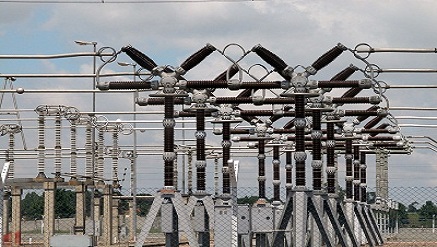
Electricity Distribution Companies (DisCos) in Nigeria generated a total of N597.55 billion in revenue during the first quarter of 2026 despite persistent power supply challenges and consumer complaints over service delivery.

The figures are contained in the latest commercial performance factsheets released by the Nigerian Electricity Regulatory Commission (NERC).
According to the data, the 11 electricity distribution companies collectively recorded N204.74 billion in revenue in January, N196.68 billion in February and N196.13 billion in March, bringing total collections for the three-month period to N597.55 billion.
The report showed that the companies maintained an average monthly revenue collection of about N199.18 billion during the period.
NERC’s data revealed varying levels of commercial performance among the distribution companies, with differences in billing efficiency, collection efficiency and revenue recovery rates.
In January, the DisCos billed customers N268.20 billion and recovered N204.74 billion, leaving N63.46 billion in unpaid bills.
The sector recorded a billing efficiency of 79.72 per cent and a collection efficiency of 76.34 per cent during the month.
In February, total billings stood at N242.29 billion, while collections amounted to N196.68 billion, resulting in an outstanding balance of N45.61 billion.
Billing efficiency improved to 87.44 per cent, while collection efficiency rose to 81.17 per cent.
For March, total billings reached N246.43 billion, with revenue collections of N196.13 billion, leaving a shortfall of N50.30 billion.
Billing and collection efficiencies for the month were recorded at 83.89 per cent and 79.59 per cent respectively.
The report also highlighted significant volumes of unbilled energy across the quarter, indicating ongoing operational and commercial challenges within the electricity distribution segment.
Among the top-performing firms were Eko Electricity Distribution Company and Ikeja Electric, which consistently posted stronger revenue recovery rates.
Eko DisCo notably achieved a recovery efficiency of over 100 per cent in February, according to the report.
However, some operators continued to face collection challenges.
Kaduna Electricity Distribution Company recorded one of the lowest recovery efficiencies during the review period, posting 41.20 per cent in February.
The NERC commercial performance report tracks key indicators including energy received, energy billed, total billings, revenue collections and recovery efficiency to assess the operational and financial health of electricity distribution companies.
The revenue performance comes against the backdrop of continued complaints from electricity consumers over high tariffs, estimated billing, inadequate metering and frequent power outages.
Nigeria also experienced significant power supply disruptions during the first quarter, largely attributed to gas supply constraints affecting electricity generation.
Industry data indicated that electricity generation at some points declined from about 4,000 megawatts to below 2,000 megawatts due to shortages in gas supply to thermal power plants.
Operational data from the Nigerian Independent System Operator showed that thermal plants require about 1.63 billion standard cubic feet of gas daily to operate optimally.
However, actual gas supply as of Feb. 23, 2026, stood at approximately 692 million standard cubic feet per day, representing less than 43 per cent of required demand.
The shortfall forced several generating plants to reduce output or shut down operations, prompting the Transmission Company of Nigeria (TCN) to implement load-shedding measures across the national grid.
Industry stakeholders have continued to advocate improved metering, stronger measures against energy theft and enhanced customer service to improve sector efficiency and revenue collection.

NITDA, Benin’s Digital Agency Strengthen Ties on Digital Transformation

IFC, NGX Group Unveil Nigeria Gender Programme

FG Targets Alleged N3tn Capital Flight, Opens Airtime Credit Market to Nigerian Fintechs

NITDA Backs NiRA’s Ambitious 2026 Plan to Drive Massive .ng Domain Adoption

TikTok Tax Scam Exposed: Two Arrested Over Alleged £153 Million Fraud Scheme

CPN Begins Crackdown on Quack IT Professionals, Vows Tougher Action against Cybercrime

FG to Launch Nationwide Free Digital TV Platform June 17

Jumia Nigeria Records Strong Q1 2026 Growth as Technology-Led Strategy Drives Market Expansion

MTN, Airtel, Glo Under Pressure as FG Demands Better Service Delivery

CBN Extends PoS Geo-Fencing Enforcement Deadline to August 2026




 Telecom2 days ago
Glo to Improve Customers’ Digital Lifestyle with “More Data, More Value” Package

 News2 days ago
London Strengthens Global Investment Ties with Africa @ First Ever London-Africa Business Summit

 Telecom2 days ago
Chinese Bank Supports Nigeria Towers Project

 Telecom2 days ago
Moniepoint CEO Pushes New Credit Revolution for Millions of Nigerian Small Businesses

 E-Business2 days ago
FG Seeks Inclusive, Human-centred Artificial Intelligence Policies

 Broadcasting2 days ago
NASENI Trains 50 Women in Kano on Renewable Energy Technologies Under She-Powers Initiative

 Telecom2 days ago
ESET Enhances Cybersecurity Awareness Among Lagos State MDAs Through Capacity-Building Programme

 Telecom2 days ago
ALTON Warns Fibre Vandalism, Multiple Taxation Threaten Telecom Service Quality and Growth