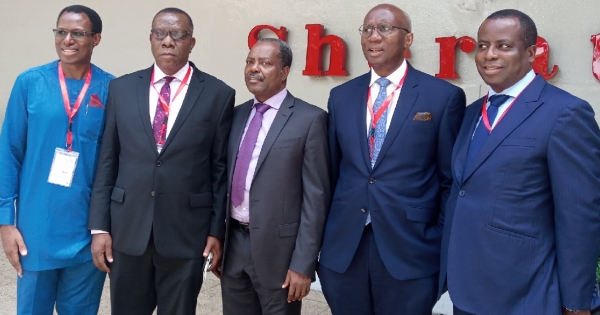
Prof. Umar Garba Danbatta, executive vice chairman, Nigerian Communications Commission, NCC, has said that the introduction of e-government applications has been beneficial to the process of governance.
He noted significant areas such as public procurement, where electronic applications have expanded government access to potential suppliers and increased the number of offers received in a timely manner.
Danbatta stated this at the Nigeria e-government conference organized by Digiserve Network Services which was held in Lagos last week, according to him, “in Nigeria, the deliberate decision to deploy ICT for public service delivery is, in part, traceable to the formulation of the Nigerian National Telecommunications Policy in 2000. The policy seeks to make Nigeria an ICT-driven country in Africa and a key player in the information society and also use IT for education; creation of wealth; poverty eradication; job creation; governance; health; and agriculture.
“Through the policy, the Federal Government expressly announced the initiative of the government to deepen its digital and online presence to enhance its operation of the government in providing public services in a transparent, effective and efficient means.
The EVC represented by Dr. Henry Nkemadu, Director, Public Affairs, NCC added that with government at Federal, State and Local Government levels in Nigeria facing a number of issues ranging from huge unemployment, corruption, crime, low internally-generated revenue (IGR) and poor government service delivery in some quarters, effective application of ICT to governance would help to remarkably increase IGR bring efficiency and convenience to government services delivery process, curb corruption practices and create lot of high skilled labour in the country.
“A retrospective look at how we have fared as a nation since 2000, when the Nigeria National Telecommunications Policy established the need for e-government drive, showed that many Ministries, Departments and Agencies (MDAs) at Federal and especially State levels have moved a number of their services online.
“There has been appreciable increase in the number of MDAs, especially at Federal and State levels with functional websites with information about specific programmes or services benefiting women and children, persons with disabilities, older persons, indigenous people, and people living in poverty, businesses and so on.
“At Federal Level, for instance, the Treasury Single Account (TSA), the Integrated Personnel Payroll Information System (IPPIS) as well as other e-services have been put in place while efforts are being made to substantially reduce paper workplace in government offices.
“Today, it is clear to government at all levels that one of the ways to reverse cases of huge unemployment, corruption, crime, low internally-generated revenue (IGR) and leakages in government revenue, among other issues is to use ICT to drive government’s internal processes and service delivery to its citizens and other stakeholders with capacity to enhance efficiency and convenience in the delivery of government services and create high skilled workforce in the country”.
Danbatta however, highlighted some of the challenges that Nigerian e-government drive are faced with which range from lack of adequate Information Technology (IT) infrastructure; epileptic power/electricity supply; reduced budgetary allocation for ICT, lack of trained and qualified personnel and the resistance to change attitude by public servants and other related issues.
“At the centre of e-government adoption is the Internet, which is an important infrastructure that must be available to both the government and the end-user citizens, businesses or other stakeholders to ensure effective interaction with the government. In this regard, the Nigerian Communications Commission (NCC) has continued to push various initiatives to deepen access to the Internet and by extension, broadband services in the country.
“The Commission exceeded its target for Broadband Penetration in 2018 and will continue its drive towards universal access as detailed in the framework of its 8 Point Agenda. As at August 2019, 2G subscriptions stood 122.9 million, corresponding to 64.42 per cent of the population.
"Also, there were 49.7 million 3G subscriptions equivalent to 26.03 per cent of the population with 17.3 million 4G subscriptions representing 9.07 per cent of the population. Broadband penetration on 3G and 4G, which are categorised as broadband networks, therefore stood at 35.10 per cent in August, 2019.
“The Commission is actively exploring the utilisation of television white space (TVWS) technology to expand affordable broadband services to rural areas, while we have issued Infrastructure Company (InfraCo) Licences to some organisations to deploy fibre across the geopolitical zones with Access Points in all the 774 local government areas of the Federation,” he stated.
He noted that in line with the Next Level agenda of the current administration, the Commission hopes to increase the number of fibre deployment in Nigeria to 127,000 kilometre from its current 42,000 kilometer of fibre connectivity in the country. “Through the InfraCo initiatives, therefore, the Commission expects additional 30,000 kilometre of fibre to be added. This is aside the results expected from major Mobile network Operators (MNOs), who also earmark resources, on a yearly basis, to expand their fibre deployment.
“The NCC is also working with the Ministry of Communications and other necessary stakeholders towards addressing the perennial industry challenges such as the Right of Way (RoW) issues, multiple taxation and regulation, vandalism/fibre cuts, theft of telecoms equipment, insecurity, power problem, among others – all of which are critical industry issues- impeding fast broadband infrastructure deployment in the country, which has impacted the level of access to government, businesses and individuals to enjoy e-government services.
“You may be aware that, in the second quarter of 2019, the Federal Government, building on the 2000 Telecommunications Policy, officially launched the ‘Nigeria e-Government Master Plan 2020’. The Master Plan, which is the brainchild of the Federal Ministry of Communications, is aimed at achieving the Federal Government’s vision and objective of Economic Recovery Growth Plan (ERGP), for a virile economy. I will encourage this gathering of experts both from public and private sectors to also examine what this Plan means for the country within the broad spectrum of e-government drive,” he said.