Connect with us

E-Financial

Efina Survey Reveals 39.6Mn Adults in Nigeria Still Financially Excluded

Published

on

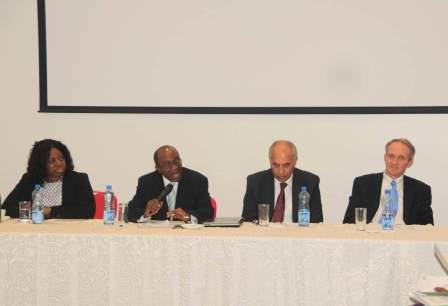
(L-r): Ms. Modupe Ladipo, chief executive officer, EFINA, Godwin Emefiele, governor Central Bank of Nigeria, Tariq Mohar, deputy CEO, Tameer Microfinance Bank, Pakistan and David Porteous, CEO, Bankable Frontier Associates at EFInA financial inclusion conference 2014 that held recently in Lagos.
Kindly share this post

Findings from the Enhancing Financial Innovation & Access (EFInA) Access to Financial Services in Nigeria 2014 survey revealed that the number of Nigerian adults nationwide who are banked increased from 28.6 million (32.5% of the adult population) in 2012 to 33.9 million (36.3% of the adult population) in 2014.

However, 36.9 million adults, representing 39.5% of the adult population, are financially excluded, meaning that they have no access to financial services.

According to Ms. Modupe Ladipo,chief executive officer of EFInA, “The good news is that, since EFInA started measuring financial access in 2008, the number of Nigerian adults with access to formal financial services (such as bank accounts, insurance, pensions, mobile money or microfinance bank products) has increased by 25 million.

“That is larger than the entire population of many African countries. However, given Nigeria’s population growth, the number of financially excluded adults still remains high. To reduce financial exclusion, financial services providers will need to be more effective in reaching those in the most excluded groups, including youth, women, Northern Nigerians, and those living in rural areas.”

The nationally-representative EFInA Access to Financial Services in Nigeria 2014 survey also showed that mobile money awareness and usage remains low; 11.9 million adults (12.7% of the adult population) are aware of mobile money, and only 800,000 Nigerian adults (0.8% of the adult population) currently use mobile money.

Uptake of insurance is also low, with 1 million adults (1.1% of the adult population) using insurance, although 14.3 million adults said that they would be interested in microinsurance products.

The survey also found that 2.6 million adults (2.8% of the adult population) currently have a microfinance bank account; however an additional 31.5 million adults said that they would like to have a microfinance bank account.

This information was announced during EFInA’s Financial Inclusion Conference held on December 2, 2014 in Lagos. 

EFInA hosted the Financial Inclusion Conference to share new research findings, provide insights from local and international experts about deepening financial inclusion, and celebrate financial inclusion achievements in Nigeria by announcing the winners of the 2014 Financial Inclusion Awards.

The Keynote Address at EFInA’s Financial Inclusion Conference was given by Mr. Godwin Emefiele, Governor of the Central Bank of Nigeria, who recognised the accomplishments that have been made to date in promoting financial inclusion in Nigeria.

He underscored the importance of continuously monitoring progress towards achieving the targets of the National Financial Inclusion Strategy, saying that “the EFInA Access to Financial Services in Nigeria 2014 survey will offer new information that can be used to gauge our progress thus far.”

Emefiele also emphasised the need for tenacity in pursuing financial inclusion goals, saying, “Financial inclusion is a long journey, and it is important that we continue to take this seriously. The Central Bank of Nigeria is committed to this journey.”

Ms. Arunma Oteh, director general of the Securities and Exchange Commission (SEC), shared insights about how the capital market can promote financial inclusion in Nigeria, by contributing to economic growth in the country and creating opportunities for each and every Nigerian to build wealth.

Ms. Oteh highlighted recent successes by the Nigerian capital market to increase financial inclusion, including an increase in the range and affordability of mutual funds, deployment of non-interest finance products, and initiatives undertaken by the SEC and capital market operators to promote financial literacy.

She stated that, “If we focus on financial inclusion holistically, people will feel like they are part of this society, like they can earn a living.” 

The EFInA Financial Inclusion Conference featured a presentation by Mr. Tariq Mohar, Deputy CEO of Tameer Microfinance Bank in Pakistan.

Mr. Mohar shared information about how Tameer successfully became the largest microfinance bank in Pakistan, with 1.2 million customers, in less than 10 years, through use of innovative solutions such as the Easypaisa mobile money service and ‘Bank on Wheels,’ a fleet of secure roving vehicles that can handle a range of transactions.

Mohar shared how Tameer Microfinance Bank has worked to develop a financial ecosystem, to ensure that customers at the base of the pyramid can have access to savings, credit, payment mechanisms and insurance.

The Conference also featured presentations by Mr. David Porteous, CEO of Bankable Frontier Associates, who stated that three key elements are essential for sustainable long term financial inclusion – customer value proposition, viable business case for financial services providers, and a healthy ecosystem.

Ms. Anjali Banthia, Specialist in Product Marketing, Research & Financial Education for Women’s World Banking, shared practical advice and examples about developing financial services for women.

The Conference concluded with EFInA presenting Financial Inclusion Awards to organisations that have made significant contributions toward deepening financial inclusion in Nigeria.

Award winners in each category were: Financial services provider that has deepened financial inclusion; Microfinance Bank:  ACCION Microfinance Bank; Financial services provider that has deepened financial inclusion – Deposit Money Bank:  GT Bank; Best mobile money operator:  Pridar Systems Limited (Firstmonie); Regulator that has championed financial inclusion:  Central Bank of Nigeria and Best research firm:  Nielsen Nigeria

Efina is a financial sector development organisation that promotes financial inclusion in Nigeria.

Established in late 2007, its vision is to be the leader in facilitating the emergence of an all-inclusive and growth-promoting financial system. 

EFInA is funded by the UK Government’s Department for International Development (DFID) and the Bill & Melinda Gates Foundation.

(L-r): Ms. Modupe Ladipo, chief executive officer, EFINA, Godwin Emefiele, governor Central Bank of Nigeria, Tariq Mohar, deputy CEO, Tameer Microfinance Bank, Pakistan and David Porteous, CEO, Bankable Frontier Associates at EFInA financial inclusion conference 2014 that held recently in Lagos.


Kindly share this post

Nigeria CommunicationsWeek believes that technology makes life more exciting and helps improve the lives of people around Nigeria and indeed the world. So since 2007, we have devoted our energy to independent reportage of technology and how they affect lives.

E-Financial

AfDB Group Mobilises Global Private Capital to Close Africa’s Financing Gap

Published

on

Kindly share this post

Building on the successful conclusion of the 17th replenishment of the African Development Fund (ADF-17), which mobilised $11 billion for Africa’s most vulnerable countries, the African Development Bank Group and the Government of the United Kingdom convened global investors and private sector leaders in London to accelerate a new phase of private capital mobilisation for Africa’s development.

The inaugural Africa Private Capital Mobilisation Day, held on 17 December at Lancaster House, brought together more than 150 senior decision-makers from private equity firms, sovereign wealth funds, pension funds, insurers, philanthropies, and development finance institutions and export credit agencies—marking a decisive shift from dialogue to execution.

The high-level event was hosted by the African Development Bank Group in partnership with UK government institutions, the Foreign Commonwealth and Development Office, UK Export Finance and British International Investment, reflecting a shared ambition to scale private capital flows into African economies.

Speaking at the opening, African Development Bank Group President Dr Sidi Ould Tah described the event as a natural continuation of the ADF-17 replenishment process and a decisive step toward addressing Africa’s estimated $402 billion annual development financing gap.

“We will build on recent engagements with development finance institutions, export credit agencies, pension funds, sovereign wealth funds, insurers, and philanthropic partners to advance concrete initiatives under our vision for a New African Financial Architecture,” said Dr Ould Tah.

The Africa Private Capital Mobilisation Day aligns with President Ould Tah’s Four Cardinal Points vision, which focuses on unlocking Africa’s capital potential, strengthening financial sovereignty, transforming demographic growth into a dividend, and delivering resilient infrastructure and value chains.

UK Minister for Development, Jenny Chapman said, “We are delighted that President Ould Tah decided to hold the first Private Capital Mobilisation Day here in London, recognising the critical role of the City of London in mobilising investment for Africa. The UK’s shifting role—from donor to investor—will support countries who want to grow their economies and ultimately ultimately exit the need for aid.”

The programme featured focused discussions on reshaping perceptions of risk in Africa, designing innovative financial platforms, and mobilising capital in fragile and frontier markets.

New analysis on the Global Emerging Markets Risk Database delivered by the Center for Global Development presented new evidence showing that long-term lending to African borrowers has historically been significantly less risky than commonly perceived.

Sector-focused discussions underscored the strategic role of healthcare and aviation in strengthening Africa’s economic resilience, productivity and integration. Participants were introduced to two flagship initiatives championed by the Bank Group and its partners:

– The Africa Medicines and Equipment Facility, developed in partnership with the Gates Foundation, will provide African countries with predictable, timely, and affordable financing to secure essential medicines and medical equipment.

– The Integrated Aviation Transformation Programme for Africa—supported by a dedicated blended-finance facility—aims to modernise and expand Africa’s aviation ecosystem—from airports and airlines to enabling services critical to trade, tourism, and regional integration.

In parallel, President Ould Tah convened a closed-door roundtable with senior executives from approximately 30 leading institutional investors to explore the launch of an Africa-focused Private Sector Innovation Lab. The proposed platform would serve as a dedicated space to co-create new financing instruments, partnership models, and risk-sharing solutions tailored to African markets.

The outcomes of the Africa Private Capital Mobilisation Day are captured in the London Communiqué, setting out clear commitments by the African Development Bank Group and its partners to scale private capital mobilisation for Africa.

Further work will go into setting out priority actions and implementation pathways to scale private capital mobilisation for Africa, turning ambition into scalable capital and risk mitigation solutions.


Kindly share this post
Continue Reading

E-Financial

FIRS says NIN, CAC Numbers to Serve as Tax IDs from 2026

Published

on

Kindly share this post

The Federal Inland Revenue Service (FIRS) has announced that the National Identification Number (NIN) will automatically serve as the Tax Identification Number (TIN) for individual Nigerians beginning in 2026.

The clarification was issued on Monday through a public awareness campaign on the new tax laws shared by the Service on X.

According to the FIRS, registered businesses will also no longer need a separate Tax Identification Number, as their Corporate Affairs Commission (CAC) registration numbers will now function as their official tax identifiers under the revised tax framework.

The announcement follows public concerns over aspects of the new tax laws that require a Tax ID for certain transactions, including the operation and ownership of bank accounts.

Providing further explanation, the FIRS said the Nigeria Tax Administration Act (NTAA), scheduled to take effect in January 2026, mandates the use of a Tax ID for specified transactions. It, however, noted that the requirement is not entirely new, stressing that it has been in existence since the Finance Act of 2019 but has now been strengthened.

“The Tax ID unifies all Tax Identification Numbers previously issued by the FIRS and State Internal Revenue Services into a single identifier,” the Service said.

“For individuals, your NIN automatically serves as your Tax ID, while for registered companies, your CAC RC number is used. You do not need a physical card, as the Tax ID is a unique number linked directly to your identity.”

The FIRS explained that the new system is intended to simplify identification processes, eliminate duplication, close gaps that enable tax evasion, and promote fairness by ensuring that all individuals earning taxable income contribute accordingly.

The agency also urged Nigerians to ignore misinformation surrounding the reform, assuring the public that the new tax framework is designed to improve efficiency and transparency in tax administration.

Meanwhile, the Chairman of the Presidential Committee on Fiscal Policy and Tax Reforms, Taiwo Oyedele, disclosed that banks will be required to request a TIN from all taxable Nigerians as part of the federal government’s new tax administration framework, which will take effect on January 1, 2026.


Kindly share this post
Continue Reading

E-Financial

Fidelity Bank Bolsters Ikoyi Fire Station with Hoses, Pumps for Safer Communities

Published

on

Kindly share this post

Fidelity Bank Plc has reinforced its commitment to community safety and sustainable ecological practices through the donation of essential firefighting and preventive equipment including hoses and gasoline water pumps to the Ikoyi Fire Service Station in Lagos.

Fidelity Bank Bolsters Ikoyi Fire Station with Hoses, Pumps for Safer Communities

L-R: Lagos State Controller, Federal Fire Service, CF (Controller of Fire), Adebayo Funke; Tolulope Rojaiye, Marketing Business Partner, Fidelity Bank Plc; Assistant Superintendent of Fire, Ishola Folorunsho Olufemi; and Station Commander, Onikan Fire Station, Lagos, Okeke Ferdinand; during the donation of firefighting equipment to the Federal Fire Service at Ikoyi, Lagos, recently.

The donation was made under the Fidelity Helping Hands Program (FHHP) by the True Serve team, reaffirming the Bank’s commitment to the environment and community safety. Through the FHHP, members of staff identify areas of critical community needs, raise funds, and then receive matching monetary support from the bank to execute the projects.

Commenting on the reason behind the donation, Divisional Head, Brand and Communications Division, Fidelity Bank Plc, Dr Meksley Nwagboh, emphasized that the donation reflects the bank’s dedication to strengthening emergency response capabilities and promoting public safety within the communities it serves.

According to him, “Fidelity Bank remains committed to supporting initiatives that contribute to the protection of our environment, lives and property. We see community safety as a shared responsibility and continuously extend support to both corporate bodies and individuals.”

Dr Nwagboh further noted that, “We believe that preventive measures are far more effective than reactionary responses. This donation is part of our efforts to drive sustainable practices by providing the necessary tools. Our goal is to ensure that people live meaningful, safe, and empowered lives.”

In her comments, Lagos State Controller, Federal Fire Service and Controller of Fire (CF), Funke Adebayo commended Fidelity Bank for the timely support, while cautioning residents to exercise heightened vigilance during the festive period, especially with the dry weather conditions.

“We appreciate Fidelity Bank for this timely donation. We are in a harsh weather period where fire incidents can escalate quickly. Parents must educate and caution children against the use of fireworks during celebrations. Fire should never be treated carelessly,” Adebayo said.

She noted that the Fire Service has embarked on sensitization visits to various corporate organizations, warning against unsafe practices that could lead to preventable fire outbreaks.

On his part, Area Commander, Onikan Fire Station and Chief Superintendent of Fire (CSF)Oswere Michael expressed appreciation to Fidelity Bank for supporting their operations. He encouraged families, business owners, and community members to prioritize fire safety at all times.

“Everyone has a role to play in preventing fire incidents at home and in the workplace. This support from Fidelity Bank will go a long way in enhancing our capacity to protect the community,” CSF Oswere added.

Ranked among the best banks in Nigeria, Fidelity Bank Plc is a full-fledged Commercial Deposit Money Bank serving over 9.1 million customers through digital banking channels, its 255 business offices in Nigeria and United Kingdom subsidiary, FidBank UK Limited.

The Bank is a recipient of multiple local and international Awards, including the 2024 Excellence in Digital Transformation & MSME Banking Award by BusinessDay Banks and Financial Institutions (BAFI) Awards; the 2024 Most Innovative Mobile Banking Application award for its Fidelity Mobile App by Global Business Outlook, and the 2024 Most Innovative Investment Banking Service Provider award by Global Brands Magazine. Additionally, the Bank was recognized as the Best Bank for SMEs in Nigeria by the Euromoney Awards for Excellence and as the Export Financing Bank of the Year by the BusinessDay Banks and Financial Institutions (BAFI) Awards.


Kindly share this post
Continue Reading

Trending