Connect with us

E-Financial

FairMoney MFB Reaffirms Commitment to Drive Financial Inclusion through Digital Banking 

Published

on

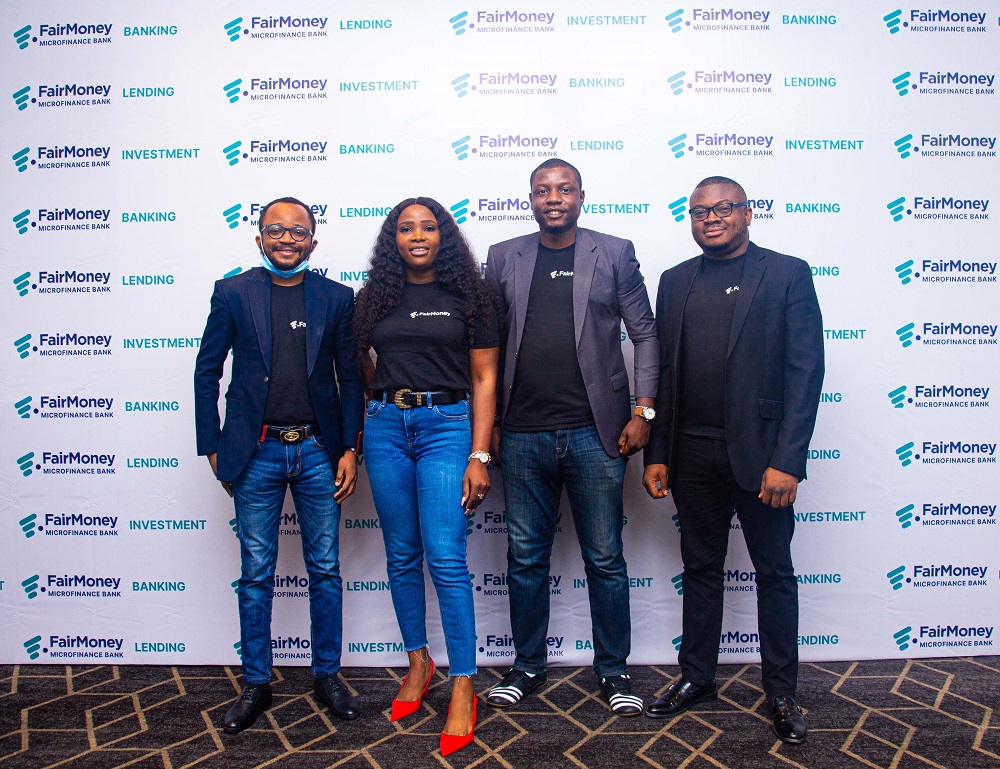
L – R: Kingsley Ishiguzo; Head of Operations, FairMoney MFB; Nengi Akinola; Head, Marketing & Branding, FairMoney MFB; David Nwosu, Head, Retail Banking, FairMoney MFB and Henry Obiekea, VP, Capital markets, FairMoney MFB at the FairMoney MFB media parley, recently.
Kindly share this post

FairMoney Microfinance Bank, Nigeria’s leading digital bank, has reiterated its commitment to provide topnotch digital banking services that would drive financial inclusion for the mass Nigerian market.

L – R: Kingsley Ishiguzo; Head of Operations, FairMoney MFB; Nengi Akinola; Head, Marketing & Branding, FairMoney MFB; David Nwosu, Head, Retail Banking, FairMoney MFB and Henry Obiekea, VP, Capital markets, FairMoney MFB at the FairMoney MFB media parley, recently.

The company stated this on Friday during a media parley with journalists at Radisson Hotel, Ikeja, in Lagos.

Stemmed from a burning desire to bridge the lag between developing African countries – Nigeria inclusive, and the new age of banking enjoyed in developed countries, FairMoney was founded with an overarching vision to be the leading digital bank driving financial inclusion for the average Nigerian.

With a strategy premised on catering to the majority, FairMoney was birthed to cater to the predominant needs of the Nigerian market – small & medium scale enterprises, through quick & seamless loans. Following this strategy over the past 4 years of operation, FairMoney MFB has grown its customer base to over 5 million users, and 2 million bank accounts by relentlessly positioning as the New Bank for the masses.

According to Laurin Hainy, Co-Founder/CEO, FairMoney, “FairMoney is positioned to support our customers across their various financial service needs even as we work to maintain our current position as the leading digital bank in Nigeria.

“Our mission has always been to serve the needs of as many Nigerians as possible. Our approach to doing this involves providing millions of Nigerians with loans and capital to meet their immediate needs and in some cases, to grow their businesses, and so far, we have disbursed over N117billion loans since inception,” he said.

“Our goal ultimately is to use technology to bank the 60 million Nigerians currently excluded from the financial ecosystem. We have also introduced secure and innovative technology processes to improve our lending operations, as well as a strong privacy protection policy, and a comprehensive loan collection policy which has been successfully deployed in the last 4 years,” Laurin added.

With millions benefiting from it’s numerous financial services & features, FairMoney has finely niched a reputation as a leading driver for financial inclusion in Nigeria through its strong lending service offerings which avails customers the opportunity to secure loans without collateral in as little as 5 minutes, free debit cards & free inter-bank transfers to continually support SMEs & MSMEs by alleviating common expenses issued by traditional banks through account maintenance charges.

Amongst the many offerings of FairMoney is the digitization of general banking procedures through the app by making bill payments accessible without needing to visit banking halls & introducing consumer empowering initiatives like the recently concluded FairMoney Transact & Win Black Friday engagement which had lucky winners go home with 10 smartphones, 5 generators & a delivery motorcycle; not to mention the ongoing ’12 Days of Fair giveaways’ Christmas giveaways all in the bid to offer equal opportunities for all and stay true to their promise of Fair banking for all.

Speaking at the Media Parley, Nengi Akinola – Head Marketing & Branding reiterated FairMoney’s commitment to supporting Nigerians.

“To us at FairMoney, the goal is to see a world where everyone has equal financial opportunities and support to reach their financial goals, however great or wide it may be. We will continue to build on our offerings, so that we can continue to meet the growing needs of the average Nigeria customers” she said.

“We can’t wait to share all the interesting new features we’re bringing to the FairMoney app in the new year” Nengi added.


Kindly share this post

Ugo Onwuaso is an ICT enthusiast. He believes technology should be used for general good. He holds a Master of Public Administration (MPA) degree from the Lagos state University. Dear Reader, Your support matters. But we believe that technology makes life more exciting and helps improve the lives of people around Nigeria and indeed the world. That is why, we have devoted our energy to independent reportage of technology and finance and how they affect lives. Our incisive and analytical view of how technology news affects the daily life help individuals and organizations make up their minds. Quality journalism costs money. Today, we're asking that you support us to do more. Kindly support our effort to deliver technology and finance journalism to everyone in the world. Donate as little as N1,000. Bank transfers can be made to: UBA Plc 1017156876 Communication Week Media Ltd

E-Financial

Access Holdings Shareholders Approved to Raise N40bn Capital Through Private Placement

Published

on

Kindly share this post

Access Holdings Plc has received the approval of its shareholders to raise additional capital of up to N40 billion or such other amount or their equivalent in foreign currencies, via private placement.

The shareholders gave the approval as part of the special resolutions at Access Holdings Plc Extraordinary General Meeting (EGM) held on Thursday December 18.

In a notice to the Nigerian Exchange Limited (NGX), Access Holdings said the new ordinary shares created in connection with the private placement, will be allotted at a price of N20.25 to one or more investors in such tranches and on such terms and conditions as shall be determined by the Board.

Access Holdings Plc Board of Directors is authorised to consider, negotiate, approve, and finalise the list of potential private placement investors; determine the structure, valuation, modalities, and timeline for the private placement.

The Board was also authorised to consider, negotiate, approve and finalise the list of potential private placement investors; determine the structure, valuation, modalities and timeline for the private placement.

The shareholders also approved for the issued share capital of Access Holdings Plc to be increased from N26 658 billion to N27.646 billion by the creation and addition of 1,975,308,641 ordinary shares of 50 kobo each ranking pari-passu with the existing ordinary shares of the Company.


Kindly share this post
Continue Reading

E-Financial

Customs Slam 3 Percent Surcharge on Banks over Delayed Revenue Remittance

Published

on

Kindly share this post

Nigeria Customs Service (NCS) has imposed a three per cent surcharge on Deposit Money Banks (DMBs) over delays in the remittance of Customs revenue by designated banks.

Customs Slam 3 Percent Surcharge on Banks over Delayed Revenue Remittance

The development was disclosed by Abdullahi Maiwada, national public relations officer of the Service,  in a statement titled “Nigeria Customs Service Commences Enforcement of Penalties Against Designated Banks for Delayed Remittance of Customs Revenue.”

The agency stated that delays in remitting collected Customs revenue constitute a breach of remittance obligations and negatively impact the efficiency, transparency and integrity of government revenue administration.

Maiwada explained that any Designated Bank that fails to remit collected Customs revenue within the prescribed period will be liable to penalty interest, adding that affected banks will receive formal notifications detailing the delayed amount, applicable penalty and the timeline for settlement.

“The NCS has noted instances of delayed remittance of Customs revenue by some Designated Banks following reconciliation of collections processed through the B’Odogwu platform. Such delays constitute a breach of remittance obligations and negatively impact the efficiency, transparency and integrity of government revenue administration.

“In line with the provisions of the Service Level Agreement (SLA) executed between the Nigeria Customs Service and Designated Banks, the Service hereby notifies stakeholders of the commencement of enforcement actions against banks found to be in default of agreed remittance timelines.

“Accordingly, any Designated Bank that fails to remit collected Customs revenue within the prescribed period shall be liable to penalty interest calculated at three per cent above the prevailing Nigerian Interbank Offered Rate for the duration of the delay. Affected banks will receive formal notifications indicating the delayed amount, applicable penalty and the timeline for settlement.”

Maiwada further advised Designated Banks to strengthen their internal controls, ensure strict adherence to remittance timelines and comply fully with the provisions of the SLA.

He reiterated that the Service remains committed to enforcing accountability, safeguarding government revenue and promoting a transparent and predictable financial system in support of national economic development.

“The Service further notes that persistent or repeated non-compliance with the terms of the SLA may attract additional sanctions, including regulatory and administrative measures, as provided under the Agreement and relevant laws guiding Customs revenue collection.

“The NCS reiterates that prompt, accurate and complete remittance of Customs revenue is a fundamental obligation of Designated Banks. Any payment of collected revenue into unauthorised accounts, whether deliberate or erroneous, will be treated as a serious violation and addressed in accordance with the SLA and applicable legal frameworks.

“Designated Banks are therefore advised to strengthen internal controls, ensure strict adherence to remittance timelines and comply fully with the provisions of the SLA. The Service remains committed to enforcing accountability, safeguarding government revenue and promoting a transparent and predictable financial system in support of national economic development,” he added.


Kindly share this post
Continue Reading

E-Financial

World Bank to Approve $500m Loan for Nigeria Today

Published

on

Kindly share this post

The World Bank is set to approve a $500m loan to Nigeria on Friday (today) as part of efforts to expand access to finance for micro, small and medium enterprises across the country, according to Punch.

World Bank to Approve $500m Loan for Nigeria Today

The proposed facility, titled the Fostering Inclusive Finance for MSMEs in Nigeria (FINCLUDE) Project, aims to mobilise private capital and promote innovative financial products for small businesses, according to information obtained from the World Bank.

Negotiations on the loan are ongoing, and approval by the World Bank Group’s board is expected on Friday.

The approval, expected on December 19, 2025, will see the World Bank commit $500m to the project out of an estimated total cost of $2.39bn.

Of the World Bank financing, $400m will be provided by the International Bank for Reconstruction and Development, while $100m will come from the International Development Association.

The Federal Government will be the borrower under the arrangement, with the Development Bank of Nigeria serving as the implementing agency with overall responsibility for managing the funds.

The remaining $1.89bn required for the project is expected to be provided by commercial lenders as unguaranteed financing.

According to the World Bank, the FINCLUDE project will leverage the platforms of the Development Bank of Nigeria and its subsidiary, Impact Credit Guarantee Limited, to deepen credit access for MSMEs.

“The proposed FINCLUDE Project leverages the platforms of the Development Bank of Nigeria and its subsidiary, the Impact Credit Guarantee Limited, to drive inclusive MSME finance,” a document from the World Bank read.

“Through these catalytic institutions, the project will deploy a package of complementary, inclusive, and innovative instruments tailored to the diverse needs of MSMEs in Nigeria.”

The World Bank described DBN as “a partner well known to the World Bank with high implementation capacity and a proven track record in designing and executing complex, innovative projects,” noting that its role would be central to the success of the intervention.

The project is structured around three main components. These include the provision of inclusive and innovative MSME finance products, the de-risking and mobilisation of private capital through partial credit guarantees, and technical assistance aimed at modernising and digitising Nigeria’s MSME finance ecosystem.

Under the first component, the World Bank said the project would provide Tier 2 subordinated capital to eligible financial institutions and support the establishment of an MSME investment fund to deliver equity and long-term debt financing to small businesses.

The bank said this approach would help “crowd-in private capital, test market innovations and promote financial sustainability” within the MSME segment.

Also, the project will offer targeted technical assistance to strengthen the capacity of financial institutions, improve regulatory oversight and modernise the MSME finance value chain linking DBN, lenders and entrepreneurs.

In its appraisal report, the World Bank highlighted Nigeria’s ongoing economic reforms, describing the country as being “in a critical transition.”

It noted that the removal of fuel and foreign exchange subsidies, alongside the unification of exchange rates, had begun to stabilise the economy and restore investor confidence.

“These reforms have improved fiscal space, enhanced FX liquidity, and eased inflation to 18 per cent as of September 2025,” the report stated, adding that growth prospects were strengthening, with the International Monetary Fund projecting 3.9 per cent real GDP growth in 2025.

Despite these improvements, the World Bank warned that access to finance remained uneven, particularly for MSMEs, women and the agriculture sector.

It noted that agriculture accounted for just over five per cent of total bank credit in 2024, while high interest rates and shallow credit penetration continued to constrain lending to smaller enterprises.


Kindly share this post
Continue Reading

Trending