Connect with us

News

FG Markets $100Bn Creative Economy Growth Plan to Corporate Nigeria

Published

on

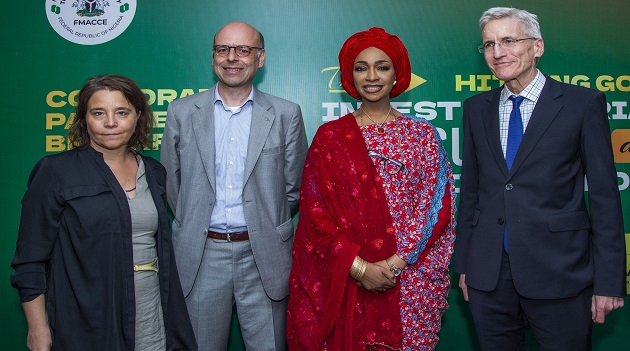
L-r: Dr. Nadine Siegert; Director, Goethe-Institut Nigeria; Michel L.H. Deelen, Consul General, Consulate General of the Kingdom of the Netherlands; Hanatu Musa Musawa, Minister of Art, Culture, and Creative Economy, and Gerald Wolf, Deputy Consul General, Consulate General of the Federal Republic of Germany, Lagos, at a Corporate Partners’ Roundtable with Corporate Nigeria held on Wednesday September 11, 2024, at The Wheat Baker, Ikoyi, Lagos.
Kindly share this post

Following months of comprehensive planning, the Federal Government has unveiled details of its bold and strategic plans to generate at least $100 billion and create over two million jobs from Nigeria’s creative economy yearly.

The Government’s plan was unveiled Wednesday September 11, 2024 by the Honourable Minister of Art, Culture and the Creative Economy, Hannatu Musa Musawa at a roundtable for local and international investors where she presented her ministry’s 8-Point Plan and Roadmap.

Speaking at the event hosted by the Ministry at the Wheatbaker in Ikoyi, the Minister said that if implemented to its fullest, the plan has the potential to achieve the above-stated objectives. She listed the 8-Point Plan as follows:

Nigeria Destination 2023, a national initiative designed to grow the arts, culture and creative economy under one united vision

Skills Development

Fastrack Policy Frameworks

Strategy Governance and Collaboration

Smart Strategic Partnerships

Growth Targets for GDP Contribution & Sectoral Output

Enabling Business Environments

Cultural Heritage Preservation and Sustainability

She lamented that despite its huge potentials, Nigeria’s creative industry currently contributes just $5 billion to the economy, with its different sub-sectors at various stages of development.

The sectors include music (sound recording, live performances and music videos), visual media (movies, TV shows, comedy shows, podcast, content creation), visual arts & craft (canvas painting, design, sculpturing, woodwork and other craft works), heritage & museums, culinary arts, fashion, publishing (books, literary arts, poetry, magazine, etc), and video gaming.

According to the National Bureau of Statistics, Nigeria’s creative economy has a very low contribution to overall GDP in comparison with benchmark countries, with the industry contributing just 1.2% to Nigeria’s GDP in 2022, the least when compared to other African countries like Morocco (2.7%), South Africa (3.0%), and Egypt (4.3%). It also ranks low (1.0%) in its ability to earn government revenue from the sector, compared to South Africa’s 12.5%.

To achieve its ambition, Musawa said the ministry has identified 14 pivotal initiatives that will drive the sector’s growth and significantly boost government revenue $10b – $20b. She grouped these initiatives under four unique pillars, namely: Technology, Infrastructure and Funding, International Culture Promotion, and Intellectual Property Monitisation.

Under the Technology pillar, the Minister said the Ministry intends to launch a digital content creation tool accessibility program to provide improved and discounted digital tools for Nigerian creatives. Others include the launch the Nigeria content distribution initiative to increase the nationwide adoption of digital tools for content distribution, the launch of a study to estimate the size of the creative industry in Nigeria including a framework to size the market going forward, and the expansion of internet accessibility in underserved regions in Nigeria to expand the reach of the other digital initiatives.

For Infrastructure and Funding, she said, this entails cataloguing existing infrastructure for the Arts, Culture and Creative Economy and its current state, developing the appropriate infrastructure needed to the industry and leveraging public-private partnership to fund development, providing incentives to stakeholders in the creative economy to boost investment and adoption of strategic initiatives, and launching a creative accelerator program to provide capital, and capacity building to creative companies.

Under International Culture Promotion, Musawa said the Ministry will establish a culture promotion office collaborating with Nigerian embassies abroad, to promote Nigerian arts, culture and creative economy, and leverage AFCTA to boost Nigerian creative output export regionally and globally.

For Intellectual Property Monetisation, she said the Ministry will seek to establish Globally standardised CMOs (Collection Management Organisations) for most of the sectors, launch a Copyright Oversight Initiative in partnership with the Nigeria Communications Commission (NCC) to enhance tracking, monitoring, and enforcement of copyright standards, ensuring CMOs’ adherence to CISAC standards.

It will also develop and implement the intellectual property framework and operationalise Nigeria’s IP licencing framework.

Musawa said that Nigeria’s Creative Economy has the potential to grow by 400% by 2027, positioning the sector to leapfrog in the long term and deliver the vision for the sector. She revealed that the Ministry has already created several initiatives and entered collaborations towards the realisation of its set goals.

She listed some of these initiatives to include, among others, the Creative Leap Acceleration Program, CultRise, an infrastructure development initiative and Origins, an advanced data capture and management initiative designed to collect, store, analyse, and share critical data related to Nigeria’s cultural and creative industries.

The Minister also listed some of the Ministry’s infrastructure project pipelines, including the Digital & Immersive Art Centre, the Renewed Hope Creative City at the Wole Soyinka Centre, Arts Village in Abuja, setting up of Creative Hubs in Nigeria’s 36 states, the National Entertainment Centre, Abuja Creative City, and the National Gallery of Art, among others.

To aid in the realisation of the government’s job creation target in the creative industry, the Minister disclosed that the Ministry has entered a partnership with BigWin Philanthropy, a major international development partner, to deliver a transformative capacity building and job creation strategy.

The event featured a panel session involving the Minister herself and top officials of the Ministry including: Director-General, National Council for Arts and Culture, Obi Azika; Principal Adviser to the Minister of Art, Culture and Creative Economy, Faiz Imam; Managing Director, Nigerian Film Corporation, Aliyu Nuhu.




Kindly share this post

Dear Reader, Your support matters. But we believe that technology makes life more exciting and helps improve the lives of people around Nigeria and indeed the world. That is why, we have devoted our energy to independent reportage of technology and finance and how they affect lives. Our incisive and analytical view of how technology news affects the daily life help individuals and organizations make up their minds. Quality journalism costs money. Today, we're asking that you support us to do more. Kindly support our effort to deliver technology and finance journalism to everyone in the world. Donate as little as N1,000. Bank transfers can be made to: UBA Plc 1017156876 Communication Week Media Ltd

Continue Reading
Advertisement
Comments

News

InsomniaQ Spotlights African Creativity in Lagos

Published

on

Kindly share this post

Quickteller successfully hosted the maiden edition of InsomniaQ recently in Lagos, delivering a 12-hour non-stop celebration of African music, culture, and creativity.

A statement from the firm on Sunday stated that the event attracted a diverse audience of music lovers, culture enthusiasts, and festive diaspora returnees, marking a strong debut for what organisers described as a potential signature December event.

InsomniaQ featured a dynamic mix of live performances and DJ sets, showcasing Africa’s rich musical diversity and creative depth. From soulful sounds to high-energy performances, the festival offered a thoughtfully curated journey designed to follow the natural rhythm of its audience’s circadian cycle, sustaining energy, connection, and excitement throughout the night.

Beyond the performances, InsomniaQ emerged as a platform for shared cultural expression, creating space for celebration, discovery, and community. The experience reinforced Lagos’ position as the heartbeat of Africa’s December entertainment season and highlighted the growing appetite for premium, culturally grounded experiences.

Commenting on the success of the event, the Executive Vice President, Group Marketing and Communications, Interswitch Group, Cherry Eromosele, described InsomniaQ as an organic extension of Quickteller’s place in everyday moments of connection, culture, and celebration.

“InsomniaQ was created as a space to celebrate African creativity in its full expression, the music, the energy, and the people who make our culture so powerful.

“Seeing that vision come to life, with thousands of people connecting through sound, movement, and shared experience, has been truly rewarding. This debut edition reinforces our belief in creating platforms that bring people together and spotlights the richness of African talent in meaningful ways,” Eromosele said.

The success of InsomniaQ, according to the organisers, reflects a broader commitment within the Interswitch ecosystem to support experiences that extend beyond transactions into everyday life. By championing platforms that blend culture, innovation, and community, Interswitch continues to shape how people connect, celebrate, and experience Africa’s evolving creative economy.

With its strong debut, InsomniaQ has set the tone for future editions and established itself as a new fixture in Africa’s December calendar, celebrating culture, driving connection, and creating memorable experiences.


Kindly share this post
Continue Reading

News

How Moniepoint’s Founders, Tosin Eniolorunda and Felix Ike are Redefining African Tech and Finance

Published

on

Kindly share this post

In an era where global tech giants dominate headlines, two Nigerian entrepreneurs are quietly revolutionizing financial services across Africa, proving that world-class innovation can emerge from homegrown talent and local institutions.

Tosin Eniolorunda and Felix Ike, co-founders of Moniepoint Inc, have built one of Africa’s fastest-growing fintech companies, not despite their exclusively Nigerian education, but in many ways, because of it.

Their journey from the lecture halls of Obafemi Awolowo University and the University of Lagos to the TIME100 Most Influential Companies list stands as a powerful testament to the caliber of talent nurtured within Nigerian universities and the transformative potential of locally-rooted vision.

Tosin Eniolorunda’s path exemplifies how Nigerian educational institutions can cultivate entrepreneurial excellence. After earning his degree in Mechanical Engineering from Obafemi Awolowo University, he didn’t follow the well-trodden path abroad but instead chose to build solutions for Nigerian challenges within Nigeria itself. This decision proved prescient.

Understanding the unique financial ecosystem and infrastructure gaps firsthand from the work at TeamApt Ltd where they were building from majority of the country’s banks, Tosin pioneered several industry firsts: introducing instant POS transfers to Nigeria, launching the country’s first virtual account services, and constructing a vertically integrated payments processing switch with full switching and processing licenses.

These feats and technological achievements must be viewed from the prism that these were deeply contextual innovations born from intimate knowledge of local needs, the kind of understanding that comes from being educated and embedded in the communities one serves.

Felix Ike’s contribution complements this vision with technical brilliance equally rooted in Nigerian educational excellence. Graduating with first-class honors in Computer Science from the University of Lagos, Felix brought to Moniepoint the kind of engineering rigor required to build mission-critical financial infrastructure.

As Chief Technology Officer, he has architected systems that are not just functional but scalable, resilient, and secure enough to serve over 10 million businesses and individuals across Nigeria and Africa. His work demonstrates that Nigerian universities are producing software engineering leaders capable of building world-class technology that can compete on the global stage with technology that processes millions of transactions daily and underpins the financial dreams of an entire continent.

Since its founding in 2015, Moniepoint has evolved into Africa’s largest distributor of financial services in Nigeria, with presence across all 774 local government areas. The company’s all-in-one financial ecosystem offering seamless payments, banking, credit, and business management solutions reflects a sophisticated understanding of what African businesses and individuals actually need to thrive.

The accolades have followed: recognition by TIME as one of the 100 Most Influential Companies in 2025, listing among CNBC’s top UK fintech firms, and ranking in the Financial Times’ Africa’s Fastest-Growing Companies for three consecutive years.

The Moniepoint story as an indigenously rooted but globally compliant player challenges prevailing narratives about where innovation must originate and what credentials are necessary for building transformative companies. Tosin and Felix’s success illustrates that Nigerian universities, when their graduates are empowered with vision, opportunity, and determination, can produce founders who don’t just participate in the global economy but reshape it.


Kindly share this post
Continue Reading

News

FIRS Declares NIN, CAC Numbers as Tax IDs from 2026

Published

on

Kindly share this post

Federal Inland Revenue Service (FIRS) has announced that the National Identification Number (NIN) issued by the National Identity Management Commission (NIMC) will automatically serve as the Tax Identification Number (Tax ID) for all Nigerian citizens, while registered businesses will use their Corporate Affairs Commission (CAC) registration numbers.

FIRS Declares NIN, CAC Numbers as Tax IDs from 2026

FIRS

The disclosure was made during a public awareness campaign on the new tax laws posted on X (formerly Twitter) on Monday.

According to the Service, the Nigeria Tax Administration Act (NTAA), which comes into force in January 2026, mandates the use of Tax IDs for certain financial and commercial transactions, including bank account ownership.

FIRS explained that the measure is part of efforts to unify all previously issued Tax Identification Numbers (TINs) by both the federal and state revenue services into a single identifier.

“For individuals, your NIN automatically serves as your Tax ID, while for registered companies, your CAC RC number is used. You do not need a physical card; the Tax ID is a unique number linked directly to your identity,” the Service stated.

The agency noted that the requirement has been in place since the Finance Act of 2019 but has now been strengthened under the NTAA to ensure compliance and ease of administration.

Officials emphasized that the reform would simplify tax processes, reduce duplication, and improve transparency in Nigeria’s tax system.

The Service added that the integration of NIN and CAC numbers into the tax framework would also enhance data accuracy, curb tax evasion, and streamline the monitoring of taxable activities across the country.

Tax experts have described the development as a significant step toward modernizing Nigeria’s revenue administration, noting that it aligns with global best practices where national identity systems are linked to tax compliance.

The FIRS urged Nigerians to ensure that their NINs and CAC registration details are up-to-date, stressing that the identifiers would be required for transactions such as property purchases, contract awards, and access to certain financial services once the NTAA takes effect


Kindly share this post
Continue Reading

Trending