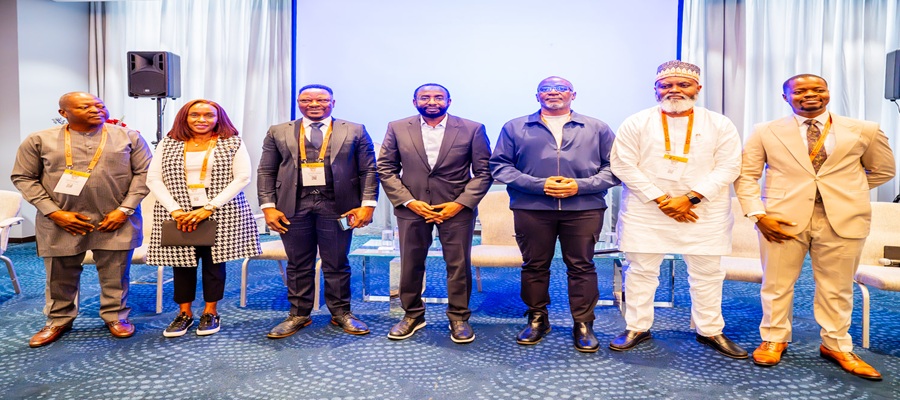
An inter-agency committee set, up by Dr. Isa Ali Ibrahim Pantami, minister of Communications and Digital Economy, to discuss areas of collaboration between the agencies of the Federal Ministry of Communications and Digital Economy and the Federal Inland Revenue Service (FIRS) in relation to the Finance Act 2020 has held an interactive session.

Chaired by Prof. Umar Danbatta, executive vice chairman (EVC) of the Nigerian Communications Commission (NCC), the membership of the committee is comprised of the Executive Chairman of FIRS and heads of agencies in the ministry.
The Committee was set up to discuss critical areas of synergy for the implementation of key provisions in the amended Finance Act 2020 as they affect the operations of the agencies in the ministry.
On December 31, 2020, President Muhammadu Buhari signed the Finance Bill 2020 (now Finance Act) into law.
The new law which introduced over 80 amendments to 14 different laws took effect from January 1, 2021.
Some of the amendments have implications for agencies under the ministry, especially regarding the provision of information for tax purposes and deployment of technology for tax operations in the country, among others.
Speaking at the interactive session, Danbatta stated that “the objective of the interactive session is to deliberate on areas of collaboration between agencies in the ministry and FIRS for the common good of the economy.”
Also speaking, Muhammad Nami, FIRS executive chairman, said: “we have come here to emphasize the need for cooperation and collaboration among the various agencies in terms of revenue generation in order to move the nation forward.”
Accordingly, heads of agencies in the ministry in attendance at the meeting made their contributions with respect to the implementation of the new finance law. They are Dr. Ismail Adewusi, post-master general, Nigeria Postal Service (NIPOST), and Kashifu Abdullahi, director-general, National Information Technology Development Agency (NITDA).
Other contributors during the interactive session include the Managing Director, Galaxy Backbone, Prof. Muhammad Abubakar; Managing Director, Nigerian Communications Satellite Limited (NIGCOMSAT), Dr. Abimbola Alale and the representative of the Director-General, National Identity Management Commission (NIMC) and Dr. Nonye Nwachukwu, Director, Planning, Research and Statistics at the ministry.
Two sub-committees were later formed to deliberate on specific areas that require further dialogue for effective collaboration towards the implementation of the new tax law as it affects agencies under the Ministry of Communications and Digital Economy.
They are the committees on FIRS/NIPOST and on FIRS/NITDA. The two committees are expected to complete their assignment and make recommendations for consideration by the Minister of Communications and Digital Economy .