Connect with us

E-Financial

Heritage Bank Wins Lagos Environmental Sustainability Award, Commits to Nature Protection

Published

on

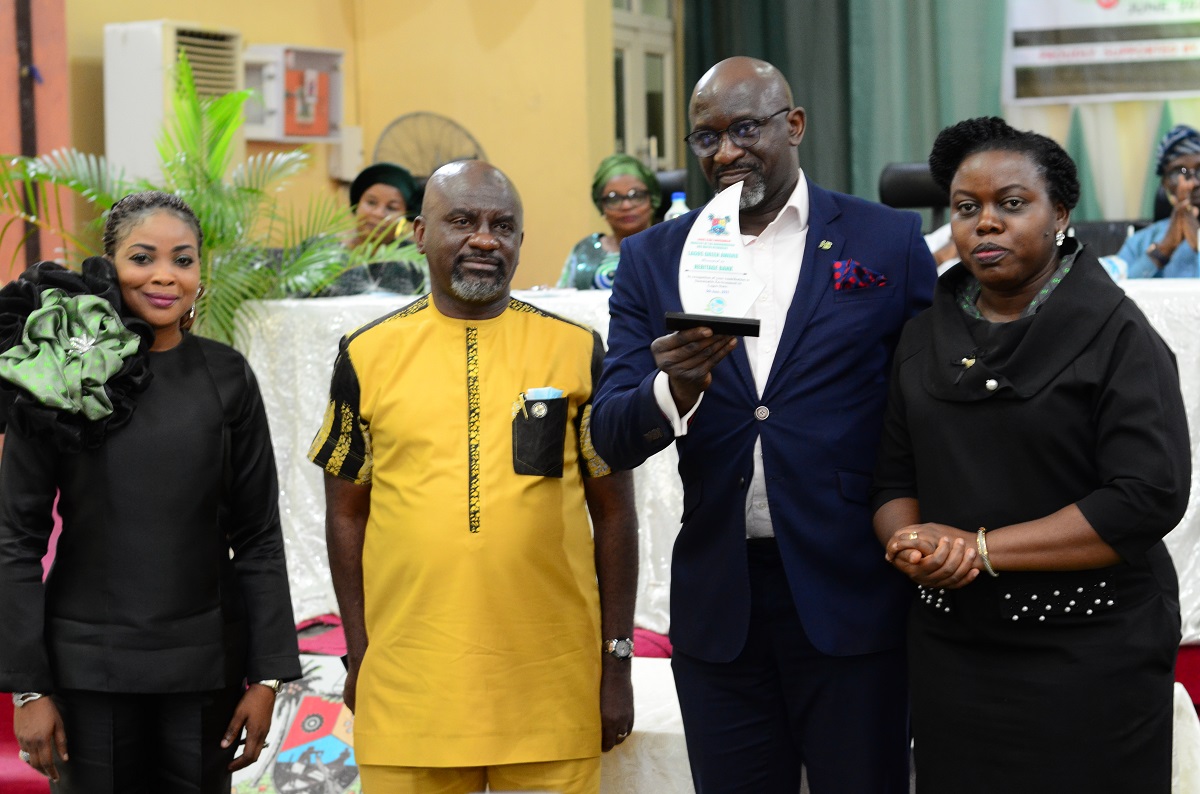
R-L: Ozena Utulu, Ag. Group Head, Corporate Communications, Heritage Bank; Kehinde Olugbemi, Ag. Chief Risk Officer, Heritage Bank; Dr. S. Olayiwole Onasanya, Permanent Secretary, Lagos State Independent Electoral Commission (LASEIC) and Titilola Docemo, Regional Head, Lagos Island 2A, as Heritage Bank wins Environmental Sustainability Award at the 2022 World Environment Day event held in Lagos State.
Kindly share this post

For its contribution and support towards Environmental Sustainability, especially, in Lagos, the state government, awarded Heritage Bank with its 2022 Environmental Sustainability Award.
R-L: Ozena Utulu, Ag. Group Head, Corporate Communications, Heritage Bank; Kehinde Olugbemi, Ag. Chief Risk Officer, Heritage Bank; Dr. S. Olayiwole Onasanya, Permanent Secretary, Lagos State Independent Electoral Commission (LASEIC) and Titilola Docemo, Regional Head, Lagos Island 2A, as Heritage Bank wins Environmental Sustainability Award at the 2022 World Environment Day event held in Lagos State.

The bank joined other corporate organisations and schools within the State, awarded for their efforts towards protecting nature and limiting the impact of climate change on Earth.

The Award was given to the bank by the state government through the Ministry of Environment and Water Resources, Lagos State in the commemoration of 2022 World Environment Day Celebrations in which the bank was also a major sponsor.

Speaking at the year 2022 World Environment Day finale held at Alausa, Ikeja, Lagos at the weekend, Ifie Sekibo, managing director/CEO, Heritage Bank Plc, commended Lagos state government and its ministry for the efforts exuded during environmental sustainability to protect ecosystems in supporting health and wellbeing of all creatures.

Sekibo, who was represented by the Chief Risk Officer, Heritage Bank, Mr. Kehinde Olugbemi, said: “as this year’s World Environmental Day Celebration theme implies, we have ‘Only One Earth,’ and truly, only one earth to protect. The fact is that human well-being is closely linked to the health of the environment. And our planet is reaching a breaking point. We are beginning to see the consequences of global warming on ecosystems and communities.”

Today, he said, industrialisation, though positive for human well-being on the flip side, has raked lots of havoc on human existence.

Quoting the World Health Organisation (WHO), he said, 24% of deaths can be traced back to avoidable environmental factors, adding that, Heritage Bank Plc has continued to prioritise and make huge commitments to environmentally sustainable practices to help build thriving communities and secure future growth potential.

“We realized that our people and other dwellers need clean air to breathe, fresh water to drink, and places to live that are free of toxic substances and hazards.

“So, as a part of our sustainability drive in the Corporate social responsibility space, we have continued to put sustainability at the heart of our decision-making for the sake of humanity and the bank’s own bottom line because a healthy planet is the backbone of nearly every industry on Earth,” he pointed out.

Earlier at the event, Lagos state governor, Mr. Babajide Sanwo-Olu stated that, there is an urgent need for everyone to focus on the need to live sustainably with nature for the benefit of mankind, adding that, this has become necessary to shift to a greener lifestyle through both policies and individual choices.

He added that sustainability of the environment is among the most pressing issues in the world today out of which the Earth faces triple planetary emergencies namely, Climate change, loss of biodiversity and Environmental Pollution.

The governor, who was represented by the Permanent Secretary, Office of Environmental Services, Dr. Omolaji Gaji, added that, the impact of the challenges has negatively made the achievements of Sustainable Development Goals (SDGs) less successful.

“With nature in emergency mode, the #OnlyOneEarth campaign for World Environment Day 2022, wants us to celebrate the planet through collective environmental action”, he said.

The governor commended Corporate Organisations, such as Heritage Bank for ensuring that the persistent drive of the State’s policy towards entrusting the legacy of greening and restoration of indigenous trees to the citizen is sustained.

Similarly, Mr. Tunji Bello, commissioner for the Environment and Water Resources, said, government through the ministry of the Environment & Water Resources has implemented several programmes to mitigate these challenges through Tree planting, Climate change summit, Environmental bees’ clubs in schools, waste to wealth and ban on open defecation.

Speaking through the Director of Sanitation Services Department, Dr. Hassan Sanuth, the PS added that, the government keyed into this call in 2021 by commencing the greening of Abraham Adesanya setback, together with restoration of some historical plants in specific locations like Agege, Idi-Mangoro where Mango trees were planted, Idi-Agbon in Ifako-Ijaiye where coconut trees were planted and in Lagos Island where breadfruit trees were planted at St. Paul Anglican Primary School, Breadfruit Lagos as part of this year’s celebration.

The guest lecturer, Dr. Ayo Tella while delivering his paper, noted that, Anthropogenic effects caused by human activities such as the felling of trees have altered the earth’s natural systems and survival of many species.

Heritage Bank had earlier donated plastic bins to Navy Town Secondary School, Ojo, Lagos, to mark the World Earth Day even as it has embarked on a project to address water crisis, whilst contributing towards making clean and potable water accessible to all.

Similarly, a global open-source movement known as Liter of Light Nigeria partnered with Heritage Bank Plc to provide sustainable solar electricity for Itomaro community in Lagos State while the bank, in 2020, had been on the move to distribute over 10, 000 mosquito nets to rural dwellers.


Kindly share this post

Ugo Onwuaso is an ICT enthusiast. He believes technology should be used for general good. He holds a Master of Public Administration (MPA) degree from the Lagos state University. Dear Reader, Your support matters. But we believe that technology makes life more exciting and helps improve the lives of people around Nigeria and indeed the world. That is why, we have devoted our energy to independent reportage of technology and finance and how they affect lives. Our incisive and analytical view of how technology news affects the daily life help individuals and organizations make up their minds. Quality journalism costs money. Today, we're asking that you support us to do more. Kindly support our effort to deliver technology and finance journalism to everyone in the world. Donate as little as N1,000. Bank transfers can be made to: UBA Plc 1017156876 Communication Week Media Ltd

E-Financial

World Bank Reveals Obstacles to Growth of Mobile Money Accounts in Sub-Saharan Africa

Published

on

Kindly share this post

Despite being the global epicentre of mobile money innovation, Sub-Saharan Africa remains home to tens of millions of adults who do not own a mobile money account. A new World Bank report disclosed.

According to the Global Findex Database 2025, Sub-Saharan Africa is widely celebrated as the birthplace of mobile money, a technology that has transformed how people send, receive, save, and borrow money using basic mobile phones.

“Yet, the region still accounts for one of the world’s largest concentrations of adults without mobile money accounts,” it said.

The report shows that while about 40 percent of adults in Sub-Saharan Africa had a mobile money account in 2024, up sharply from 27 percent in 2021, roughly 60 percent still do not.

The reasons, the report argues, are less about lack of awareness and more about deep structural barriers that continue to exclude large segments of the population.

According to the report, a lack of money is the single most common barrier to mobile money account ownership in the region.

For many low-income households, irregular earnings, subsistence livelihoods, and dependence on cash-based transactions reduce the perceived value of maintaining an account, even when services are widely available.

This challenge is compounded by affordability issues. Transaction fees, charges for cashing out, and the cost of maintaining an active SIM card can deter the poorest adults, reinforcing the perception that mobile money is not designed for very small or infrequent transactions.

In Nigeria, the World Bank Group has announced an estimate that 139 million in 2025 will be living in poverty despite the reforms of the federal government.

Mobile phone ownership gaps persist

Mobile money cannot function without a mobile phone, yet phone ownership itself remains uneven. The report finds that 40 percent of adults now own a mobile money account, up from 27 percent in 2021.

And those who do not have a financial account also do not own a mobile phone of any kind.

This creates a double barrier: adults who are financially excluded are often also digitally excluded.

Among those without phones, the cost of the device is cited as the primary obstacle. While basic phones are more affordable than smartphones, the report notes that even these can be out of reach for the poorest households, especially in rural areas. Without addressing device affordability, efforts to expand mobile money risk leaving behind the very groups they aim to serve.

The report disclosed that even when phones and accounts are available, digital capability remains a challenge. The report finds that only about half of mobile money account owners in Sub-Saharan Africa protect their phones with passwords, compared with much higher shares in other regions.

Limited digital literacy raises concerns about fraud, mistaken transfers, and scams, which in turn undermines trust in mobile financial services.

Trust issues are further reinforced by negative user experiences. Only about half of the adults in the region who sent money to the wrong person using mobile money reported getting it back, according to the report. Such experiences can discourage first-time users and lead dormant users to abandon their accounts.

A large untapped opportunity

Despite these challenges, the report points to a significant opportunity. In Sub-Saharan Africa, about a quarter of adults without accounts already own a mobile phone, have official ID, and have a SIM card registered in their own name, meaning they have all the prerequisites for mobile money adoption.

“Closing the gap will require coordinated action: reducing the cost of devices, expanding ID coverage, strengthening consumer protection, and designing low-cost products that reflect the financial realities of poor and rural households,” the World Bank argues.

ation for Africa, turning ambition into scalable capital and risk mitigation solutions.


Kindly share this post
Continue Reading

E-Financial

AfDB Group Mobilises Global Private Capital to Close Africa’s Financing Gap

Published

on

Kindly share this post

Building on the successful conclusion of the 17th replenishment of the African Development Fund (ADF-17), which mobilised $11 billion for Africa’s most vulnerable countries, the African Development Bank Group and the Government of the United Kingdom convened global investors and private sector leaders in London to accelerate a new phase of private capital mobilisation for Africa’s development.

The inaugural Africa Private Capital Mobilisation Day, held on 17 December at Lancaster House, brought together more than 150 senior decision-makers from private equity firms, sovereign wealth funds, pension funds, insurers, philanthropies, and development finance institutions and export credit agencies—marking a decisive shift from dialogue to execution.

The high-level event was hosted by the African Development Bank Group in partnership with UK government institutions, the Foreign Commonwealth and Development Office, UK Export Finance and British International Investment, reflecting a shared ambition to scale private capital flows into African economies.

Speaking at the opening, African Development Bank Group President Dr Sidi Ould Tah described the event as a natural continuation of the ADF-17 replenishment process and a decisive step toward addressing Africa’s estimated $402 billion annual development financing gap.

“We will build on recent engagements with development finance institutions, export credit agencies, pension funds, sovereign wealth funds, insurers, and philanthropic partners to advance concrete initiatives under our vision for a New African Financial Architecture,” said Dr Ould Tah.

The Africa Private Capital Mobilisation Day aligns with President Ould Tah’s Four Cardinal Points vision, which focuses on unlocking Africa’s capital potential, strengthening financial sovereignty, transforming demographic growth into a dividend, and delivering resilient infrastructure and value chains.

UK Minister for Development, Jenny Chapman said, “We are delighted that President Ould Tah decided to hold the first Private Capital Mobilisation Day here in London, recognising the critical role of the City of London in mobilising investment for Africa. The UK’s shifting role—from donor to investor—will support countries who want to grow their economies and ultimately ultimately exit the need for aid.”

The programme featured focused discussions on reshaping perceptions of risk in Africa, designing innovative financial platforms, and mobilising capital in fragile and frontier markets.

New analysis on the Global Emerging Markets Risk Database delivered by the Center for Global Development presented new evidence showing that long-term lending to African borrowers has historically been significantly less risky than commonly perceived.

Sector-focused discussions underscored the strategic role of healthcare and aviation in strengthening Africa’s economic resilience, productivity and integration. Participants were introduced to two flagship initiatives championed by the Bank Group and its partners:

– The Africa Medicines and Equipment Facility, developed in partnership with the Gates Foundation, will provide African countries with predictable, timely, and affordable financing to secure essential medicines and medical equipment.

– The Integrated Aviation Transformation Programme for Africa—supported by a dedicated blended-finance facility—aims to modernise and expand Africa’s aviation ecosystem—from airports and airlines to enabling services critical to trade, tourism, and regional integration.

In parallel, President Ould Tah convened a closed-door roundtable with senior executives from approximately 30 leading institutional investors to explore the launch of an Africa-focused Private Sector Innovation Lab. The proposed platform would serve as a dedicated space to co-create new financing instruments, partnership models, and risk-sharing solutions tailored to African markets.

The outcomes of the Africa Private Capital Mobilisation Day are captured in the London Communiqué, setting out clear commitments by the African Development Bank Group and its partners to scale private capital mobilisation for Africa.

Further work will go into setting out priority actions and implementation pathways to scale private capital mobilisation for Africa, turning ambition into scalable capital and risk mitigation solutions.


Kindly share this post
Continue Reading

E-Financial

FIRS says NIN, CAC Numbers to Serve as Tax IDs from 2026

Published

on

Kindly share this post

The Federal Inland Revenue Service (FIRS) has announced that the National Identification Number (NIN) will automatically serve as the Tax Identification Number (TIN) for individual Nigerians beginning in 2026.

The clarification was issued on Monday through a public awareness campaign on the new tax laws shared by the Service on X.

According to the FIRS, registered businesses will also no longer need a separate Tax Identification Number, as their Corporate Affairs Commission (CAC) registration numbers will now function as their official tax identifiers under the revised tax framework.

The announcement follows public concerns over aspects of the new tax laws that require a Tax ID for certain transactions, including the operation and ownership of bank accounts.

Providing further explanation, the FIRS said the Nigeria Tax Administration Act (NTAA), scheduled to take effect in January 2026, mandates the use of a Tax ID for specified transactions. It, however, noted that the requirement is not entirely new, stressing that it has been in existence since the Finance Act of 2019 but has now been strengthened.

“The Tax ID unifies all Tax Identification Numbers previously issued by the FIRS and State Internal Revenue Services into a single identifier,” the Service said.

“For individuals, your NIN automatically serves as your Tax ID, while for registered companies, your CAC RC number is used. You do not need a physical card, as the Tax ID is a unique number linked directly to your identity.”

The FIRS explained that the new system is intended to simplify identification processes, eliminate duplication, close gaps that enable tax evasion, and promote fairness by ensuring that all individuals earning taxable income contribute accordingly.

The agency also urged Nigerians to ignore misinformation surrounding the reform, assuring the public that the new tax framework is designed to improve efficiency and transparency in tax administration.

Meanwhile, the Chairman of the Presidential Committee on Fiscal Policy and Tax Reforms, Taiwo Oyedele, disclosed that banks will be required to request a TIN from all taxable Nigerians as part of the federal government’s new tax administration framework, which will take effect on January 1, 2026.


Kindly share this post
Continue Reading

Trending