Africa has approximately 200 million people between the ages of 15 and 24. By 2040, the continent is expected to be home to the world's largest labor force, with an estimated working age population of 1 billion.
Meanwhile, the Continent's economies grapple with economic development challenges and the quest for growth and a new social order driven by technology, they will also need to make corresponding qualitative investments in their abundant human resource – or skills markets.
But, IBM boss has identified "new collar" jobs as the transformational.
The Continent’s economies continue to struggle with numerous development challenges and opportunities, underpinned by shifting commodity trade flows, global realignment of capital flows and the emergence of a new class of businesses and citizens keen on exploiting the latest technology tools and trends.
There is also a growing awareness that successive generations of Africans will need new skills sets which will enable them to compete globally.
This local-to-global mindset exists in Africa as well as in societies grappling with social and economic development across the world.
Analysts have referred to this trend as the arrival of economic globalization. Whether we realize it or not, economic globalization is real.
It brings with it advanced technologies, global value chains and pent up demand for a new caliber of technology-aware, mentally agile work force.
A raft of public and private sector initiatives seem poised to radically change the way companies calibrate job specifications and engage the job market for requisite skills and competencies.
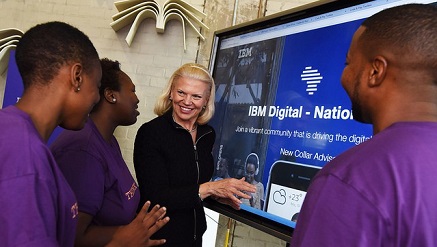
Dipo Faulkner, IBM’s country general manager for West Africa said IBM’s new “Digital – Nation Africa” initiative is a direct response to this unfolding scenario, as it seeks to transform Africa’s skills landscape, beginning with the fast-growing economies of Nigeria, South Africa, Kenya, Egypt and Morocco.
Findings by Nigeria CommunicationsWeek, has also revealed that Ghana, Mozambique and Mauritius will also be rolling out versions of this ground breaking initiative next year.
“You’ve obviously heard about white collar jobs, and blue collar jobs. This traditional classification was probably sufficient for the old era of work and industrialization. We are now in the new era of the knowledge-based economy and this unfolding era requires new skills sets, something we like to refer to as new collar jobs,” Faulkner says.
“New Collar” is a term used by IBM to describe new kinds of careers that do not always require a four-year college degree but rather sought-after skills in cybersecurity, data science, artificial intelligence, cloud, and much more.
Faulkner explained that as part of IBM’s global agenda to build the next generation of skills required for the “new collar” careers, IBM is investing $70 million in much-needed digital, cloud, and cognitive IT skills to help support Africa’s 21st century workforce.
The initiative will provide a cloud-based learning platform designed to provide free skills development programs for up to 25 million African youths over five years, enabling digital competence and nurturing innovation in Africa.
“Investing in human capital development and equipping the work force with relevant skill sets for fast changing world of work is crucial for economic growth,” Faulkner said. “In Nigeria, specifically, IBM will be partnering with government bodies and agencies, institutions in academia, civil society, technology incubators and development agencies including the United Nations Development Program (UNDP), which has a special focus on fostering market-driven ICT skills in Africa and the Middle East.”
From all indications, the IBM initiative aligns with and supports the Nigerian government’s social investment programs, as outlined in the proposed 2017 fiscal budget. The Nigerian authorities plan to create jobs for 350,000 unemployed graduates as well as 50,000 non-graduate youths who will be engaged as artisans and in other creative fields.
This plan is under the N-Power Volunteer Corps, a component of the government’s Social Investment Programme. Of the N157.75bn reportedly being appropriated for the N-Power Volunteer Corps scheme in the 2017 budget, N4.5bn is expected to be earmarked for science, technology, engineering and mathematics program to support young Nigerians in building skills in those disciplines.
IBM’s big picture perspective is that for the youth of Africa to be able to benefit from a cognitive future there needs to be a much higher level of digital literacy. The global technology firm says that at the top of the skills pyramid are developers, who need to know how to create solutions that can leverage the power of cognitive, and entrepreneurs who are aware of marketplace opportunities and potential.
Experts in technology and academia say that the “IBM Digital - Nation Africa” scheme should help raise the continent’s overall digital literacy, increase the number of skilled developers able to tap into cognitive engines and enable entrepreneurs and would be entrepreneurs grow businesses around the new solutions.
Through a free, cloud-based online learning environment delivered on IBM Bluemix, the premier cloud platform for business, the initiative will provide a range of programs from basic IT literacy to highly sought-after advanced IT skills including social engagement, digital privacy, and cyber protection.
Advanced users will be able to explore career-oriented IT topics including programming, cybersecurity, data science and agile methodologies, as well as important business skills like critical thinking, innovation, and entrepreneurship. The initiative aims to empower African citizens, entrepreneurs, and communities with the knowledge and tools to design, develop, and launch their own digital solutions.
IBM’s latest skills initiative for Africa will provide access to thousands of resources, in English, free of charge, including: Ready-to-use mobile apps; Guides - web guides, demonstrations, interactive simulations, video series, and articles; Online Assessments – A range of self-assessment tests to track the progress of individuals, together with industry recognized ‘Open Badges’ aligned to digital competencies.
The badges can then be shared with prospective employers: Volunteers – Creation of a volunteer program to support and promote digital literacy within their communities and App Marketplace – Provision of a platform on which new applications can either be made freely available or sold.
Faulkner was exchanging views with tech industry experts and media at IBM’s Client Innovation Center in Lagos, Nigeria’s commercial hub.
“The demand for new collar skills will continue to grow, and we need to increase the number and nature of opportunities made available to workers,” he said.
IBM Boss Says “New Collar” Jobs to Transform Skills Market
Comms Week27 Jun 20170 Comments
Africa has approximately 200 million people between the ages of 15 and 24. By 2040, the continent is expected to be home to the world's largest labor force, with an estimated working age population…
C
Published by
Comms Week
Trained and practicing journalist passionate about telecommunications, fintech, cybersecurity, and digital economy reporting.
You May Like

Google Issues Urgent Chrome Update to Block Active Attacks

RockPay Launches, Targets Digital Payments through Social Finance

NDIC Still Paying Depositors of 46 Failed MFBs — Sunday
NITDA Inaugurates Taskforce to Drive Sovereign Cloud Implementation

SEC Proposes N2bn Capital Requirement, N30m Registration Fee for Crypto Firms