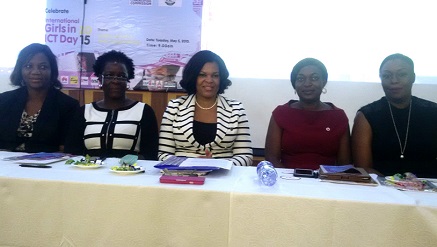
Dr. (Mrs.) Omobola Johnson, minister of Communication Technology and other guests at eBusiness Life Girls in ICT Day 2015 unanimously called for the removal of barriers before women and girls in embracing Information Communication Technology (ICT).
Johnson said strongly believes that ICT is an enabler with the significant potential to transform the lives of women and girls.
The Minister who was represented by her Special (Media) Adviser, Mrs. Efem Nkanga, described ICTs as powerful transformative tools that foster development and advancement of developing and advanced economies.
According to her, it is not just a useful tool for bridging the digital divide, but also a tool for enabling inclusive development at all levels.
The Minister told girls (Students) from different schools in Lagos present at the event that, “ICT has today become an accessible channel for information and knowledge sharing, increasing levels of participation and decision-making, addressing gaps in learning and skills acquisition, bridging gaps to critical public and social services.
“Nigeria in recognition of the potential of ICT for development has placed gender inclusion and empowerment on the front burner especially in the area of ICT utilization.
“In Nigeria, women and girls makeup approximately 50% of Nigeria’s population and Dr Johnson believes that embracing ICTS will help Nigerian women and girls actualize their potentials and contribute to the economic development of Nigeria…… however, due to factors such as income, education and social position, fewer women than men own, access and use ICTs.
“Removing the barriers that stop women and girls from embracing ICTs and getting more women and girls to adopt and appropriate ICTs for their own benefit is a task that Dr Johnson is committed to especially in the light of damming global statistics that place women behind in the adoption and utilization of ICTs.
“Do you know that various global reports and statistics reveal that women and girls are grossly underrepresented in the field of ICTs? Men dominate the field of ICTs more than women. For example, the Broadband Commission Working Group on Broadbandand Gender in a report in 2013 entitled ‘’Doubling Digital Opportunities: Enhancing the inclusion of women and girls in the information society’’ lamented the pervasive gap in access to ICTs globally”.
According to the Broadband Commission Working Group on Broadbandand Gender report, there are currently 200 million fewer women online than men, and this yawning gap could grow to 350 million in three years.
The report also reveals that globally women are coming online later and more slowly than men. Out of the world’s 2.8 billion Internet users, only 1.3 billion are women.
The report also states that women account for fewer than 20% of ICT specialists in developing economies and estimates that, by 2015, 90% of formal employment across all sectors will require ICT skills.
The report additionally stated that 21% of women are less likely than their male counterparts to own a mobile phone – representing a mobile gender gap of 300 million.
In Africa, only about half of the female population makeup the number of men connected to the internet.
Also, the International Telecommunications Union ITU in a 2013 report also disclosed that -in developing countries, 16% fewer women than men use the Internet, compared with only 2% fewer women than men in the developed world.
“We can see from the above statistics that the disparity in adoption of ICT by women and girls globally reveal a big gulf between women and men in the adoption of ICTs. Dr Johnson is very passionate about encouraging more girls to come into ICT.
When studying engineering at the university in her undergraduate days,she was one of 5 girls in a class of about 80. Thirty years later, her daughter who just graduated and also studied engineering, was also one of about 5 or 6 girls in a class dominated by boys. This kind of disparity shows that there is a need to get more girls in ICTs and the ITU is championing a global push to get more girls in ICT, through the Girls in ICT Day celebrated on the 4th Thursday of every year across the globe,” Johnson said.
She further noted that the Ministry, a key partner in the Federal Government’s Growing Girls and Women in Nigeria (GWIN) initiative, is empowering women and girls in Nigeria via ICTs with three specific technology initiatives aimed at enabling women and girls to realise their potentials.
The initiatives are the Smart Woman Nigeria project (SHE APP), the 1000 Girls ICT training program and the Digital Girls Club program.
The SmartWoman Nigeria (SHE APP) is geared at providing and empowering women with access to affordable, reliable and relevant content through the S.H.E Mobile App-a brand of SmartWoman Nigeria.
S.H.E Mobile App is developed as a brand of SmartWoman Nigeria to create the largest network of connected Nigerian women;
Through (SHE) which means Smart-Happy and Empowered, the Ministry aims to create the largest network of connected Nigerian women.
The App will provide women with regular content on health, parenting, finance, business etc. thereby empowering them to improve their lives; Women in the rural areas on SHE Mobile App network will receive relevant content via text and voice SMS and where necessary in any of the 5 major local dialects.
The second initiative, the 1000 Girls ICT Training Initiative is geared at building the skills set of Nigerian girls so that they can occupy vacant IT jobs in the country. 1,000 young female graduates of tertiary institutions from across the 36 states of the Federation underwent training in Fundamentals of Telecommunications.
Many of the participants at this programme did not have related background in ICT but performed excellently. The best performing participant of the 1000 trainees with a score of 98% is a graduate of Economics.
The third initiative, the Digital Girls club program is an early intervention program targeted at getting young girls in secondary schools to embrace ICTs early. Digital Girls ICT (after-school) Clubs are increasing interest of girls in Science, Technology, Engineering and Mathematics (STEM) in Nigerian school girls; and helping them to enjoy using technology.
The Clubs were created to remove the barriers that discourage girls from embracing ICTs. The goal is to ensure that more girls embrace and adopt ICTs by learning about ICTs in a fun and engaging way.
A Digital Girls curriculum was developed and piloted in 12 Federal Government Girls Colleges across the six geo-political zones. About 1850 Girls registered as members surpassing the 1200 initially projected.
A revised curriculum has been unveiled and is available for girls in all secondary schools across the country.
The main goal of these initiatives is to remove the barriers that discourage women/girls from embracing ICTs and the imbalance in ICT adoption and appropriation among Nigeria men and women.
In recognition of the Ministry’s initiatives, the International Telecommunication Union ITU recently conferred an international GEM-TECH award on the Ministry of Communication Technology for initiating policies and programs empowering women and girls via ICTs.
From 360 nominations from 74 countries, Nigeria emerged winner in the 7th Category of “ICT and Broadband strategies, policies and frameworks that promote women's digital empowerment.”
The Ministry has also been celebrating the Girls in ICT Day for some years now. To further encourage girls to embrace ICTs, the Ministry has put together a national competition tagged ‘’My ICT innovation” for girls in secondary schools nationwide, while advising interested girls and women to log on to the Digital Girls Club on www.digitalgirls.org.ng to find out more about the competition.
On her part, Mrs. Lynda Nwafor, chief technology officer, MTN Nigeria it’s high time all Nigerian young girls knew that with hard work and adopting ICTs, they have a bright future.
According to her, with stereotypes shattered and enhanced skills, girls must know that they have bright future in the field now.
She believes that with hard work, girls can achieve anything they set their minds to.
Nwafor aligned with Dr Johnson’s goal to get as many girls and women as possible to embrace ICTs, learn ICT skills and embrace careers in ICTs because the digital economy is today a reality for most economies including Nigeria.
Earlier, Mrs. Ufuoma Emuophedaro, editor-in-chief/CEO, e-Business Life Magazine and Convener of Girls in ICT, said that Nigeria should not shy away from the ITU’s vision to encourage women participation in all cadres of technology engagements.
She said that impact of the event in the past four years have shown increase in interest among participants to embrace ICT related career goals, “Which is very encouraging and we are not relenting on this, because it is about the present and the future of the nation”.
The event attracted some women in the ICT sector in Nigeria whose testimonials were inspirations to the participating school girls.