E-Business
LG Launches World’s First Rollable OLED TV in Nigeria

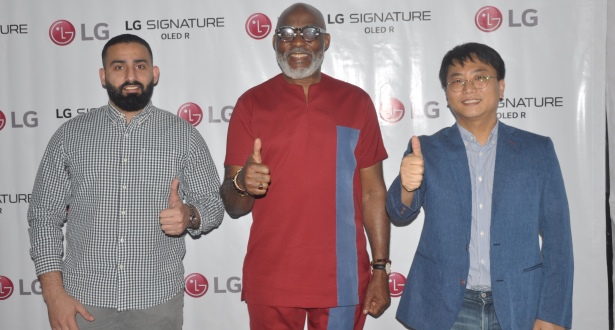
LG Electronics has officially launched the LG Signature OLED R, the world’s first rollable television, in Nigeria featuring an unprecedented design.
Each LG Signature OLED R rollable TV is custom built to order, meticulously assembled and finished with top quality craftsmanship by LG’s most experienced production professionals. The epitome of exclusivity, LG SIGNATURE OLED R has been lauded as a triumph in engineering and user-centric design.
The 65-inch flexible OLED display is created from one sheet of glass and features self-lit pixels and independent dimming control. The unique TV features a number of different viewing formats — Full, View, Line View, and Zero View — where the display adjusts its size accordingly.
According to Mr. Choong Bae Seok, General Manager Home Entertainment, TV Division, LG Electronics, West Africa Operations, “Users of the LG Signature OLED R may manage other home equipment remotely via line view, which allows the television to be partially unrolled, by selecting features and settings such as clock, frame, mood, music, and home dashboard”.
“The OLED display vanishes completely in zero view, allowing users to enjoy music and other audio material through the 4.2-channel, 100w front-firing Dolby Atmos audio system.
“The R in the name indicates that the TV is not only rollable, but also revolutionary in the home entertainment arena, revolutionizing the interaction between a TV that can be hidden from view at the push of a button and the surrounding environment”, he explained.
“This is a true luxury product that reimagines what television can be” Choong said. “This unique TV delivers a differentiated user experience and a new way of thinking about space while once again confirming LG’s leadership in the premium TV market.”
According to him, the LG Signature OLED R is a work of art that will appeal to people who demand the best and understand the true value of game-changing innovation.
“This TV is not only an incredible feat of engineering and user-centric design, but it is also a work of art that will upgrade any space and compliment any lifestyle. From the brushed aluminium casing to the stylish and modern wool speaker cover by Kvadrat of Denmark, LG Signature OLED R was specially designed.
“With a liquid smooth 65-inch flexible OLED display that leverages self-lighting,pixel technology, LG Signature OLED R boasts an individual dimming control to produce supreme picture quality.
“Moreover, the new TV represents LG’s unrivaled ability to innovate and create new possibilities that directly contribute to consumer benefits beyond the advanced hardware”, Mr. Seok asserted.
Mr. Mohamed Fouani, Managing Director, Fouani Nigeria Limited, during the event, also reaffirmed the company’s commitment to work with LG Electronics as its sole distributor in Nigeria to make available the futuristic TV and other LG products in Nigeria.
“We are happy that the much anticipated LG Signature OLED R is now available in Nigeria. We believe our customers deserve the best of LG products and so we look forward to having everyone at our showroom to check out the world’s first rollable television and other products that can help them live a smarter and more convenient lifestyle”, he excitingly said.
Artificial intelligence powered
The Signature OLED R uses Artificial Intelligence (AI) and a deep learning system to optimize image and sound quality according to the environment and content being showcased.
With Natural Language Processing (NLP), the TV can understand complex questions. For example, users can ask for the name of an actor, the films they have starred in, the background music and more.
Follow-up inquiries will also be recognized by the television as part of the same context, eliminating the need for repeating.
Eye-safe certified
LG Signature OLED R employs an OLED panel certified by Swiss-based Societe Generale de Surveillance (SGS) for producing less air pollutants, reducing the use of hazardous substances and being easier to recycle.
The TV employs the world’s first Eyesafe-certified TV panels that meet the low blue light emission requirement of US-based Eyesafe and has also been rated favorably by TÜV Rheinland and Underwriters Laboratories.
Specifications
In terms of specifications, the LG Signature OLED TV comes with a 120Hz 4K OLED display, with a 3840 x 2160 resolution. The display supports 4K Cinematic HDR technology and a 4K up-scaler. The television set also supports smart assistants like Alexa, Google Assistant and also has LG ThinQ AI.
In terms of connectivity, the television set comes with 4 HDMI ports, 3 USB ports, Wi-Fi 802.11ac and Bluetooth 5.0. The screen offers infinite contrast, resulting in perfects blacks on the display. The ultra-thin LG Signature OLED R screen rolls neatly into its own sound system.
Also on display at the launch were the rest of the LG Signature line, an elegant collection of cutting-edge appliances. Exhibited next to each other, each Signature product certainly catches your eye, but together they also leave a lasting impression.
Their sleek, high-quality finishes, combined with cutting-edge technology, create a visually integrated home system that meets the demands of today’s lifestyle. The OLED R, on the other hand, is the collection’s apex, with its potential to elevate any space.
E-Business
Nigeria Takes the Lead in the Global WSIS+20 Digital Agenda

Nigeria has unveiled a comprehensive, multi-pronged strategy designed to localise WSIS+20 commitments. This roadmap accelerates national transformation by prioritising robust infrastructure, transparent internet governance, and advanced cybersecurity through deep stakeholder collaboration.

Unveiled in New York at the Nigerian high-level side event titled “Re-Imagining Digital Cooperation for Sustainable Development: From WSIS+20 Vision to Local Action,” the strategy cements Nigeria’s position as a primary architect of the world’s digital future.
Speaking at the event, the Director General of the National Information Technology Development Agency (NITDA), Kashifu Inuwa, CCIE represented by Director, Corporate Planning and Strategy, Dr. Dimie Shively Wariowei said Nigeria’s approach is deliberately aligned with the four core activity areas identified under the ongoing WSIS+20 review process.
According to him, the focus areas provide a practical framework for translating global digital commitments into measurable national outcomes, ensuring that international resolutions drive inclusive growth and sustainable digital development at the country level.
Inuwa identified digital infrastructure as the foundation of effective localisation, noting persistent challenges in extending connectivity to underserved and remote communities. Beyond infrastructure gaps, he highlighted affordability constraints and digital literacy deficits, stressing that addressing these issues remains central to Nigeria’s digital inclusion drive.
He explained that government alone cannot shoulder the burden of nationwide digital infrastructure deployment, given Nigeria’s vast geographical spread, hence the adoption of collaborative Public-Private Partnership (PPP) models. He disclosed that Nigeria, in collaboration with the World Bank, is implementing a major fibre-optic project spanning about 90,000 kilometres nationwide to boost connectivity.
The NITDA DG also revealed that the current National Broadband Plan, which has guided broadband expansion in recent years, is nearing completion, with plans underway to renew and reposition it for the next five years. The renewed plan, he said, will strategically target increased broadband penetration as a catalyst for digital access and economic growth.
On internet governance, Inuwa referenced Nigeria’s active participation in the Internet Governance Forum (IGF), noting that the country successfully hosted its annual national IGF. He said the forum operates on a multi-stakeholder model that brings together government, the private sector, civil society and the technical community to foster cooperation and informed policy dialogue.
Cybersecurity, he added, remains a critical pillar of Nigeria’s localisation efforts. He cited the existing Cybersecurity Act and ongoing efforts to strengthen the legal framework through a reviewed version currently awaiting parliamentary approval. These measures, he said, are designed to mitigate risks associated with increased internet use and to protect users and critical digital infrastructure.
Inuwa further stressed Nigeria’s ambition to play a leadership role in advancing digital cooperation across Africa through inclusive, multi-stakeholder engagement. He underscored the importance of coordinated national data collection, noting that reliable, country-specific data is essential for tracking progress and presenting Africa’s digital development story on the global stage.
He concluded that sustained engagement and follow-up actions arising from the WSIS+20 review would strengthen digital cooperation among African countries and ensure that global digital commitments translate into tangible national and regional impact.
Stakeholders commended Nigeria’s efforts in the digital space, acknowledging the country’s growing role in shaping Africa’s digital future.
Earlier, Ms. Jennifer Chung, Co-Convener of the Informal Multi-Stakeholder Sounding Board (IMSB), praised Nigeria for convening a broad-based, multi-stakeholder delegation and for its commitment to the meaningful implementation of WSIS+20 outcomes.
Chung stressed the growing demand for localised WSIS follow-up mechanisms, noting that platforms such as the annual IGF, National and Regional IGF Initiatives (NRIs), and youth-led forums are vital for tracking progress towards the 2030 Agenda and Africa’s Agenda 2063.
She described the WSIS+20 review as a critical step toward effective monitoring, reliable data collection and evidence-based evaluation, particularly for developing countries in the Global South. According to her, these measures are essential to achieving WSIS targets and ensuring that no region is left behind.
Drawing parallels with the Asia-Pacific region, Chung noted that challenges around affordable and meaningful connectivity remain widespread across developing economies. She emphasised that expanding broadband penetration and reducing the cost of access are crucial to closing digital divides in Africa, Asia-Pacific and other parts of the Global South.
She also highlighted the need to enable active citizen participation in emerging technologies, including artificial intelligence and future innovations such as quantum technologies, stressing that inclusive digital access is key to maximising the benefits of digital transformation.
Reflecting on the WSIS+20 review process, Chung praised the innovative and inclusive approach adopted through the informal multi-stakeholder sounding board, describing it as one of the first of its kind in global digital governance. She called for sustained collaboration among governments, the private sector, civil society and the technical community to carry the WSIS vision from global commitments to local action.
E-Business
UBA Partners CIG Motors, Lagride, Launches $100m “Drive to Own” Scheme

United Bank for Africa (UBA) Plc has announced a $100 million financing partnership with CIG Motors, Lagride and the Lagos State Government to promote urban mobility and financial inclusion through a scheme tagged “Drive to Own.”

Group Managing Director/CEO, United Bank for Africa(UBA) and, Chairman, LagRide, Chief Diana Chen, flagged by LagRide drivers, at the signing ceremony of $100 Million Expansion Facility, strengthening smart mobility, driver asset ownership of over 3,500 cars, financed by UBA in partnership with Lagos State Government and LagRide, held in Lagos on Tuesday.
The initiative, unveiled on Wednesday in Alausa, Lagos, will empower 3,500 drivers in the state by enabling them to own vehicles with an equity contribution of 10 per cent of the total cost, while the balance is payable over 48 months.
UBA’s Group Managing Director/CEO, Oliver Alawuba, described the scheme as transformational, noting that it would foster inclusive economic growth, support MSME development and create opportunities for the younger generation.
“This partnership with Lagride is transformational. It will drive inclusivity for economic growth and ensure progress for everyone,” he said.
Alawuba shared a personal story, recalling that his father worked as a driver and was able to fund his education through that income. He said the scheme would provide similar opportunities for many families.
UBA’s Head of SME Banking, Babatunde Ajayi, said the partnership reflected a rethinking of traditional banking models.
“Not every business has a shop. Some businesses have wheels. Every commercial driver is running a business, yet they have remained outside formal finance. We designed credit that fits their reality,” he said.
Chairman of Lagride, Diana Chen, said the company had built a data-driven and credit-ready mobility platform for drivers, stressing that transportation remained the backbone of Africa’s economic future.
“Lagride now stands as the most structured, data-driven and credit-ready mobility platform in Nigeria,” Chen said.
The partnership aligns the strengths of the three organisations, with UBA providing financial support, CIG Motors offering viable business opportunities, and Lagride delivering a technology-driven platform to ensure sustainable livelihoods for driver-partners.
E-Business
Check Point Reveals Nigeria as Second Most Targeted African Country for Cyberattacks in November

The November 2025 Global Threat Intelligence report released by Check Point Research on Tuesday, shows Nigerian organisations faced an average of 3,374 cyberattacks per week.

Making the country as one of the primary targets for cybercriminals in Africa last month, with a record of a staggering volume of digital threats despite an overall decline in attacks across the continent.
The report shows that this figure places Nigeria second among the four major African nations analysed, trailing only Angola, which topped the list with 4,251 weekly attacks per organisation.
While Africa as a whole saw a 13 percent year-on-year decrease in cyber incidents, Nigeria’s high numbers reveal a persistent vulnerability within its digital infrastructure. Kenya and South Africa followed Nigeria with 2,384 and 1,863 weekly attacks, respectively.
The report also identified government institutions and financial services as the most targeted sectors across Africa. Globally, the education and research sector remained the most frequent victim, hit by an average of 4,656 attacks per week.
A significant highlight of the report is the emerging threat posed by Generative Artificial Intelligence (GenAI). Check Point Research found that one in every 35 GenAI prompts submitted within corporate networks globally posed a high risk of sensitive data leakage.
In Nigeria and abroad, employees are increasingly using AI tools that operate outside of formal security frameworks. The report noted that 87 percent of organisations using GenAI were affected by ‘high-risk’ prompts, which often included the input of proprietary code, customer data, or internal communications into public AI models.
Ransomware continues to be a primary tool for extortion, with global incidents rising by 22 percent year-on-year. While North America remains the most targeted region for ransomware, the impact is increasingly felt in emerging markets like Nigeria.
The most active ransomware groups identified in November were Qilin, Clop, and Akira, which primarily targeted industrial manufacturing and consumer goods sectors.
News3 days agoSiBAN New Executive Council to Champion Vision for Nigeria’s Digital Economy
E-Financial3 days agoTax Reform or Financial Exclusion? The Trouble with Mandatory TINs
Telecom3 days agoNCC Blames NOGASA for Abuja Outage
General News3 days agoNITDA DG Calls for Innovation-Led Economic Rebirth @ Kano Startup Weekend
Telecom2 days agoAirtel Africa Partners Starlink to Launch Direct-to-cell Service in 14 Markets
E-Business2 days agoCheck Point Reveals Nigeria as Second Most Targeted African Country for Cyberattacks in November
News3 days agoAPC National Chairman Appoints Mr. Abimbola Tooki as Special Adviser on Media
News2 days agoREA, NBS Partner to Deliver Comprehensive Energy Data for Nigeria