

E-Business
microManna Launches Manna OTG Flash Drives

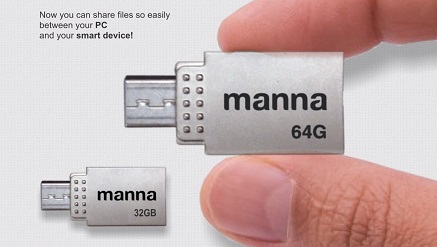
microManna has announced the arrival of Manna Dual-Flash OTG drives for smartphones, tablets.
The On-The-Go (OTG) drives have a standard USB port on one end and a Micro-USB on the other end. So, one can connect them directly to Android smartphones/tablets as well as on computers.
(Virtually all recent Android smartphones/tablets have a micro-USB port.)
Manna Dual-Flash drives are optimized for Android smartphone and tablet users and are fully compatible with Android devices having USB OTG support.
The other end which features a USB port can be connected to a computer and is compatible with Windows and Mac Operating Systems.
“With Manna On-The-Go USB drives, one can transfer files easily between smartphones, tablets and computers. They can copy songs, pictures and movies from a computer and play them on their smartphones or tablets when they are on the move. Imagine having 42 hours of movies or 16,000 songs or 20,000 high resolution pictures in such a tiny device.
Again, users can copy files from one smartphone/tablet to another smartphone/tablet without needing WiFi or connecting to a computer.
“They also serve as a storage option for smartphones without a microSD card slot. Manna DF drives are the smallest OTG drives in the market so you will not have a huge device coming out of your phone. File sharing has never been this cool!”, said Mr. Chima Nnaedozie, president of microManna Ltd.
Manna OTG USB drives are currently available in 32GB and 64GB capacity and are already available in all leading computer and electronics shops.


e-commerce company, Jumia Nigeria, has announced a significant expansion of its logistics and pickup network across Nigeria, extending its reach into underserved regions and strengthening access to e-commerce services for millions of consumers.

The expansion, executed during the first quarter of 2026, marks a deliberate shift toward upcountry growth, with new and expanded operations across Northern Nigeria, including Kebbi, Sokoto, and Kaduna, while also strengthening presence in strategic cities like Zaria. The move is designed to close long-standing coverage gaps in high-potential areas and bring its services closer to more customers.
According to the company, the expansion reflects a convergence of customer demand, infrastructure strategy, and long-term market development, as more Nigerians outside major urban centres seek reliable access to digital retail.
“We are seeing a structural shift in where demand is coming from. What this expansion does is align our infrastructure with that reality. By extending our network deeper into the country, we are not only improving service delivery, but we are also unlocking new demand, enabling more sellers to participate in the digital economy, and building a more inclusive retail ecosystem that reflects the true scale of the Nigerian market,” said Temidayo Ojo, CEO of Jumia Nigeria.
The rollout includes a significant increase in pickup stations and delivery touchpoints across both established and emerging cities. Existing urban centres such as Lagos, Ibadan, Abuja and Port Harcourt have seen network density increase, while new and previously underserved locations are being integrated into Jumia’s logistics grid. This broader footprint is supported by investments towards parcel distribution centres, designed to decentralise inventory flow, reduce delivery time, and optimise operating costs across regions.
As part of the expansion, Jumia has also strengthened its logistics partnerships and delivery capacity, enabling more efficient last-mile fulfilment while creating income opportunities for a growing network of logistics partners and JForce agents. The company notes that these investments are critical to sustaining scale as order volumes increase across a more geographically diverse customer base.
Looking ahead, Jumia plans to extend its expansion into the South-East and South-South regions ahead of the peak retail season, further increasing its national coverage and reinforcing its position as a leading e-commerce platform in Nigeria.


RHUCE, a new social platform designed for African creatives, has officially launched today, introducing a new model for how creators across the continent can turn their skills, learning, and content into income.

RHUCE
As Africa’s creator economy, estimated at over $3 billion, continues to grow, millions of young people are building digital skills but struggle to convert them into sustainable opportunities. RHUCE aims to bridge this gap by combining professional identity, creator monetisation, and opportunity discovery in a single ecosystem.
“Across Africa, talent is everywhere, but opportunity is fragmented,” said Simeon Ifeoluwa Adeyanju, CEO of RHUCE Limited. “Creators are learning, building, and sharing their work, but they lack a structured way to turn that into visibility, credibility, and income.”
Unlike traditional platforms that prioritise virality or finished work, RHUCE enables users to document their growth in real time, transforming their learning journey into a living portfolio.
“We believe your journey is your greatest asset,” Adeyanju said. “On RHUCE, your growth becomes your portfolio, your consistency builds your credibility, and opportunities can discover you based on what you’re becoming, not just what you’ve done.”
The platform introduces a shift from application-based hiring to discovery-driven opportunities, where creators are matched with jobs, gigs, and collaborations based on their evolving skills and documented progress.
“Instead of chasing opportunities across WhatsApp groups, DMs, and multiple platforms, we’ve built a system where you can post once and be discovered continuously,” he added.
RHUCE also provides monetisation tools that allow creators to earn through digital products, paid learning content, and brand-sponsored campaigns, unlocking new income streams within Africa’s fast-growing digital economy.
With over 60% of Africa’s population under 25, the platform positions itself as infrastructure for the continent’s next generation of talent.
“RHUCE is not just a platform for finished professionals,” Adeyanju said. “It is for people becoming something. Our goal is simple: help Africans turn learning into opportunity, and opportunity into income.”

On World Health Day, Kaspersky warns of risks tied to the digitisation of healthcare and use of telemedicine. Recent incidents show that medical services can be breached, and as a result, medical records may be leaked and then traded on the dark web.

The operations of healthcare services can get disrupted. Another aspect is that healthcare platforms may share user data with third parties that handle it irresponsibly.
Telemedicine has moved from a convenience to a core part of healthcare delivery, but its security model has not kept pace with its adoption, and the risks are not theoretical. Recent incidents highlight how real these risks have become.
In 2023, it was disclosed that Cerebral, a major telehealth provider focused on mental health services, had been sharing sensitive patient data – including mental health assessments, intake information, and personal identifiers – with third-party platforms such as social media and advertising networks. Millions of users were affected over several years.
More broadly, incidents in 2025 illustrate a different but equally critical risk – large-scale disruption of digital healthcare infrastructure. The breach of the ManageMyHealth patient portal exposed sensitive medical records of more than 120,000 patients, while the attack on SimonMed Imaging compromised over a million records and led to ransomware demands. These cases show that both telemedicine platforms and the broader digital healthcare ecosystems are increasingly targeted by attackers.
In parallel, scam campaigns focusing on medical topics are evolving, inviting patients for check-ups or follow-up consultations. Often the domains of the alleged “medical services” websites were created just a few weeks ago, links to the social media accounts on their pages are not working, and the Terms of Use and Privacy Policy pages are absent.
At the same time, these pages request users’ personal information, including photos of documents and even photos of parts of the body that need medical attention. Such websites often try to convince users with branding, fake doctor profiles, and urgent calls to action.
Users risk submitting sensitive personal data that can be either sold on the dark web, be used for identity theft, or subsequently used in more sophisticated attacks in the future that are targeted specifically at them for further data extortion.
To safeguard sensitive data, use a reliable security solution with an AI-powered anti-phishing component which prevents clicking on malicious links.
“The digital healthcare experience is transforming access to care, but it is also expanding the attack surface in ways many users underestimate. Medical data is highly valuable and actively traded on the dark web, making patients a prime target for fraud and targeted phishing.
“At the same time, health-related scams exploit urgency and trust, using fake consultations or discounted offers to trick users into sharing sensitive information. Patients should approach digital healthcare with the same caution as financial services – verifying providers, avoiding unsolicited links, and understanding how their data is used. Security and privacy must become a core part of the digital healthcare experience,” comments Anna Larkina, Web Content and Privacy Analysis Expert at Kaspersky.

See Key Changes in BVN Rule from May 1 by CBN

INEC Warns Broadcasters against Misinformation ahead of 2027 Polls

Paga Group Rejigs Leadership as Oviosu, Founder Becomes Group CEO

Reputation: The Real Currency Powering Fintechs

Jumia Expands Nationwide Footprint, Deepens Reach Across Underserved Nigerian Cities

Spotify’s Loud & Clear Report Reveals Over ₦60Bn Revenue for Nigerian Artists in 2025

China Threatens to Shut Nigeria’s Satellite Over $11.44m Unpaid Debt

Why JustMarkets Is a Strong Choice for Gold Trading

Kuda MFB Increases Kuda for Her Business Grants to ₦10 Million

Canal+ to Cut Jobs as Part Sweeping Restructuring




 E-Business3 days ago
Nigeria Cyberattacks: Stronger Collaboration as a Panacea

 Telecom3 days ago
Airtel Becomes World’s Second Largest Telco as Global Customer Base Surpasses 650 Million

 General News3 days ago
NIBSS Says 28 Percent of Nigerians have Registered for BVN

 Telecom2 days ago
From Import Dependency to Local Capacity: Nigeria’s Tech Manufacturing Journey

 General News3 days ago
NITDA DG Urges Stronger Collaboration to Drive Nigeria’s Digital Economy

 E-Business3 days ago
CBN Slams Custodian Investment with N419m Fines over Rule Breaches

 General News3 days ago
Ogun Set for Direct London Flights as Gateway Airport Gains Momentum

 News3 days ago
Lagos Govt Drags Top Firms to Court Over Billion-Naira Tax Debts