Ernest Ndukwe, executive vice chairman, Nigerian Communications Commission, NCC, has listed the prerequisites for sustaining the successes recorded in the sector in the last ten years.
Engr. Ndukwe who spoke as guest speaker at the maiden edition of “Breakfast With ” , hosted by the alumni association of the School of Media and Communications at the Pan African University in Lagos, said such factors include a regulatory regime that is independent, transparent, and predictable; an updated national telecom policy and laws, a conducive operational environment; an efficient frequency spectrum management and allocation; improved power supply; expansion of the broadband infrastructure, capacity building of indigenous manpower, stable financial stability, among others.
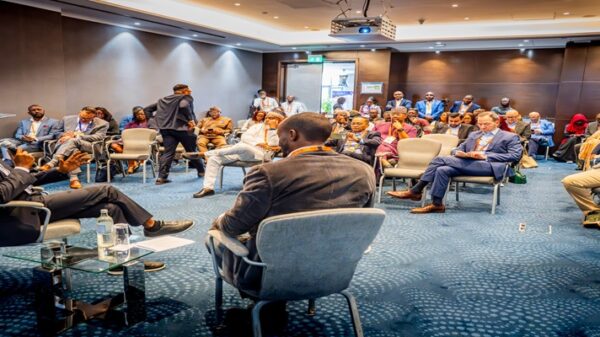
At the breakfast meeting which held at the Ahmed Onibudo campus of the university and chaired by Professor Juan Elegido, the Vice Chancellor, the NCC boss noted that the successes recorded by the Commission in the past ten years is attributed to the successful sector reform, made possible by conducive environment with respect to policies and the regulatory regime.
“I think to sustain the growth, we must lay emphasis to a few things and I will start by advocating that we must maintain stability in the policy and regulatory environment”, he said. He said these two factors are critical for any investor to make an investment decision.
Engr. Ndukwe whose audience included Engr. Vincent Maduka, former director general of NTA, Professor Emevwo Biakolo, the dean of the School of Communications, Mr. Ben Egbuna, former director general of FRCN, Mr. Olukayode Olubunmi, president of SMCA, said the current telecom policy in Nigeria needs to be updated, while the forward-looking 2003 Act needs to be revisited to accommodate one or two emergent issues in the sector.
The NCC boss said with hindsight of experience, it is critical that the financial and operational independence of the regulator is maintained. “Why we moved as fast as we did over this period is as a result of fair amount of regulatory independence that the organization had”, he said. He said this independence is not just independence from the political hierarchy but also from the operating companies, which he said, makes financial independence very critical too.
He said it is not wrong for investors to make profit as it was government’s decision to invite the investors and without returns on such investments, perhaps, Nigeria’s paltry 400,000 lines in 2001 would not have grown to the more than 70 million active subscriber lines today. “Our focus should not only be that money is being made in the industry but that this decision of government has suddenly changed the landscape and provided phones in the hands of most
Nigerians, and provided telephone “access” because even if you do not own a phone, you will likely find a place to make calls near your location today”, he said.
Ndukwe said apart from efficient management of the frequency spectrum, the regulator must always ensure that frequencies are earmarked for new services are reserved in order to enable the country to be on same page with the rest of the world. He said this is the reason why Nigeria is quite active at the International Telecommunications Union, ITU, at the moment.
“I think also going forward, we must emphasize on growing broadband infrastructure, and not just growing it for the sake of it but catalyzing its adoption and usage, nationwide”, he said. He hoped that the ongoing optics fibre infrastructure deployment going on in the country will accelerate broadband Internet adoption and usage.
While relating this to his pet concept, Fibre Without Borders”, Engr. Ndukwe said “even within the African continent, we should encourage building of optic fibre that links the countries of Africa because that will help us do local peering of Internet, keep local networks linked to each other, reduce price of communicating within the countries in Africa and perhaps greatly increase broadband speed”.
He also noted that the much the nation is able to develop the manpower resources available for the industry will determine how the industry performs in the next ten years and beyond. He cited some countries like India that export such resources to other parts of the world. Ndukwe said the Digital Bridge Institute which was NCC’s contribution to this capacity budging requirement is currently waiting the approval of its application to the National University Commission, NUC, for approval as a university.
He said some areas that are external to the telecom industry but very critical for its success are the power sector and banking and finance sectors of the economy. He advocated for an idea regional management where each state of the federation will have the responsibility to generate and provide power to the state. He wondered why many countries that are less in geographical spread and population than any given state in Nigeria were able to enthrone uninterruptible power supply over the years.
Ndukwe who recalled his parts in the telecom industry as a private operator and President of the Association of Telecommunications Companies of Nigeria before he joined the NCC, said he has had an interesting and fulfilling time.
“It’s been a big part of my life and I consider myself really opportune to be in this place at this time especially in the past ten years in seeing the telecom industry transform to what it is today.
“And obviously, in thinking about sustaining the growth also means that it is still work in progress and there is still much to be done despite the achievements we have been made so far”, he said.
Professor Elegido praised Engr. Ndukwe for the transformational work he had bequeathed to the Nigeria’s telecom industry, and the Nigerian nation in finding its feet in the committee of nations.
Ndukwe Lists Factors for Sustaining Telecom Growth
Comms Week1 Feb 20100 Comments
Ernest Ndukwe, executive vice chairman, Nigerian Communications Commission, NCC, has listed the prerequisites for sustaining the successes recorded in the sector in the last ten years. Engr. Ndukwe…
C
Published by
Comms Week
Trained and practicing journalist passionate about telecommunications, fintech, cybersecurity, and digital economy reporting.
You May Like

MTN Nigeria Endorses eWorldForum and Book Launch as GSM Revolution Turns 25

MTN Nigeria's ₦1.62 trillion network Investment builds 100 million subscribers using more data than ever

FG Plans Regulation of Internet Access for Nigerians below 16 Years

The Leadership Reset Powering West Africa’s Customer Experience Revolution

Digital Parks, Master Power Plan New Data Centre Facility in Lagos