

Telecom
Nigeria Approves Spectrum for 5G Trial


Nigerian Communications Commission (NCC) has approved the spectrum for the trial of 5G services in the country, according to Umar Danbatta, executive vice chairman of the commission,
Danbatta, who disclosed this at the maiden International Telecommunications Union (ITU) Digital African Week in Abuja, said that Nigeria had exceeded the 30 per cent penetration target set by the National Broadband Plan of 2013 to 2018 and stood at 33.31 per cent at the end of June 2019.
He said the commission had developed a framework to facilitate the deployment of broadband infrastructure across the country through the licensing of Infrastructure Companies (INFRACO).
Mr Danbatta said the framework would also deploy metro and intercity fibre and broadband Point of Access with a minimum capacity of IOG bps across the 774 local government areas of Nigeria.
He said the NCC had taken steps to involve members of the Academia as strategic stakeholders in the activities towards developing the Telecom sector.
Mr Danbatta said the Research and Development Department of NCC was collaborating with universities and other institutions of higher learning to develop the Information and Communication Technology (ICT) sector.
He assured that the NCC would continue to drive and implement policies, projects and programmes aimed at facilitating digital revolution and digital inclusion in Nigeria.
”We have Put in place, Broadband implementation and Monitoring Committee (BIMC) to monitor the full implementation of the INFRACO projects within the four-year implementation plan.
“With the development of Smart Cities KPIs by the ITU, it is imperative to have pervasive and ubiquitous broadband infrastructure across all our towns and cities to achieve the objectives of making them Smart.
“We will continue to work hard to ensure that all citizens of Nigeria have access to affordable broadband connection in respective of their circumstances or location,’’ he said.
In his remarks, Bako Wakil, director, Technical Standards and Network Integrity, NCC, said that the programme was to bring the African perspective to the standardisation of the new technologies to fit and support African nations.
Mr Wakil said that the African nations could also contribute to the standardisation process of the ITU and also come up with proposals and ideas that best suit the African nation.
Helen Nakiguli, a representative of Uganda, explained that the group was responsible for evaluating ICT effects on climate change and study design methodology for ICT environmental effects generally.
Ms Nakiguli noted that the interest was to engage the African region to be part of the standards development that will help the African region and the study group.
“This particular event is really critical for Africa to be part of the contribution to the development of standards that will help the region generally.
“Standardisation of emerging technologies such as the Internet of Things (IOT), smart cities and communities, e-waste and circular economy and electromagnetic radiation are very important to the African continent,” she said



MTN Nigeria has raised the bar for corporate disclosure in Africa after publishing its 2025 sustainability report in full compliance with International Financial Reporting Standards S1 and S2.

Dr. Karl Toriola, CEO of MTN Nigeria,
The report, independently assured by Ernst & Young, marks the telecom operator’s seventh consecutive annual sustainability publication and third year as an early adopter of the global framework ahead of its mandatory implementation.
Dr. Karl Toriola, CEO of MTN Nigeria, said, “strong governance and ethical conduct are foundational to our sustainability strategy. We reinforced compliance through our Conduct Passport Framework and robust internal controls.”
He added that “in May 2025, we became the first telecommunications company in Nigeria to publicly present a sustainability report on the Nigerian Exchange Group platform, an important milestone in our commitment to IFRS S1 and S2- aligned disclosure and accountability.”
The company also secured Carbon Disclosure Project ratings of ‘B-’ for climate change and ‘C’ for water security.
Under the IFRS S2 framework, the telecoms operator disclosed climate-related risks linked to flooding, heat stress, regulatory changes and possible future taxes or charges on carbon emissions, following a climate scenario analysis completed in 2024.
The report also showed that MTN Nigeria now uses a digital reporting format – XBRL. This makes its sustainability and governance data easier for investors and ESG rating agencies to access and analyse through automated systems.
The Company also carried out assessments to understand how sustainability issues affect both its business operations and society at large, while measuring its overall economic, environmental and social impact from 2021 to 2024.
In addition, over one-third of MTN Nigeria’s biggest suppliers (based on spending) have committed to supporting the company’s net-zero emissions goals, although these commitments have not yet gone through an independent audit or verification process.

National Agency for Science and Engineering Infrastructure (NASENI) has signed a Memorandum of Understanding (MoU) with the Rural Electrification Agency (REA) to promote locally manufactured renewable energy technologies under the Federal Government’s ‘Nigeria First Policy’.

L-R: EVC/CEO, National Agency for Science and Engineering Infrastructure, Mr. Khalil Suleiman Halilu; Director-General of the Bureau of Public Procurement (BPP), Dr. Adebowale Abraham Adedokun; and Dr. Abba Abubakar Aliyu, Managing Director and Chief Executive Officer of the Rural Electrification Agency (REA), at the signing of the MoU on implementation of Nigeria First Policy for offtake of NSSENI’s renewable energy products for rural electrification projects held on Friday, June 19, 2026 at BPP’s office in Abuja.
The agreement signing was facilitated by the Director-General of the Bureau of Public Procurement (BPP), Dr. Adebowale Abraham Adedokun at the BPP headquarters in Abuja on Friday, June 19, 2026.
Speaking at the event, the Executive Vice Chairman/CEO of NASENI, Mr. Khalil Suleiman Halilu, said the Agency is focused on linking research, production, and commercialization to ensure that innovations are translated into market-ready products.
He said “NASENI would scale up renewable energy production, including solar panels and streetlights, through initiatives such as DefFrontier, to strengthen local manufacturing and reduce import dependence, adding that the Agency will meet the renewable energy requirements of REA.”
Instead of continuous importation of technologies, machines and equipment for producing renewable energy solutions, NASENI by this MoU will be committed to local manufacturing and domestication of the technologies, equipment and other ways and means of proliferation of renewable resource in the country and to increase the nation’s off-grid energy solutions.
The Managing Director/CEO of REA, Dr. Abba Abubakar Aliyu, described the relationship with NASENI as a strategic partnership aimed at building Nigeria’s renewable energy ecosystem through local production and deployment.
He stated that “while NASENI provides the manufacturing and technological capacity for renewable equipment, REA will focus on deploying solutions to expand electricity across rural areas.”
Meanwhile, the Director-General of BPP, Dr. Adebowale Abraham Adedokun, said the Nigeria First Policy, exemplified by this agreement, is aimed at strengthening local content, ensuring value for money, and promoting accountability in public procurement.
He emphasized that implementation of the agreement will be performance-based, with strict monitoring to ensure compliance and measurable outcome. He added that the MoU is expected to deepen collaboration between NASENI and REA in expanding renewable energy and reducing dependence on imported technologies.
The MoU will be implemented through NASENI’s subsidiary company, NASENI Devfrontier Green Energy FZE and REA limited liability company, RAMco.The two Federal Government agencies seek to establish a strategic collaboration under which REA shall offtake PV modules, inverters, energy storage batteries of NASENI-Devfrontier Green Energy FZE directly or through its approved distribution companies/assembly and manufacturing factory.
As part of the agreement, REA shall provide institutional visibility to enable NASENI participate in electrification projects; facilitate opportunities for engagements between NASENI and eligible developers/contractors under REA programs; ensure that such facilitation is consistent with applicable procurement, local content, and transparency requirements; and also collaborate with NASENI in promoting standardized, high-quality PV technologies across its programme portfolio.
Telecom
TikTok, ICC Gather Nigeria’s Entrepreneurs to Drive Small Business Growth and Digital Transformation

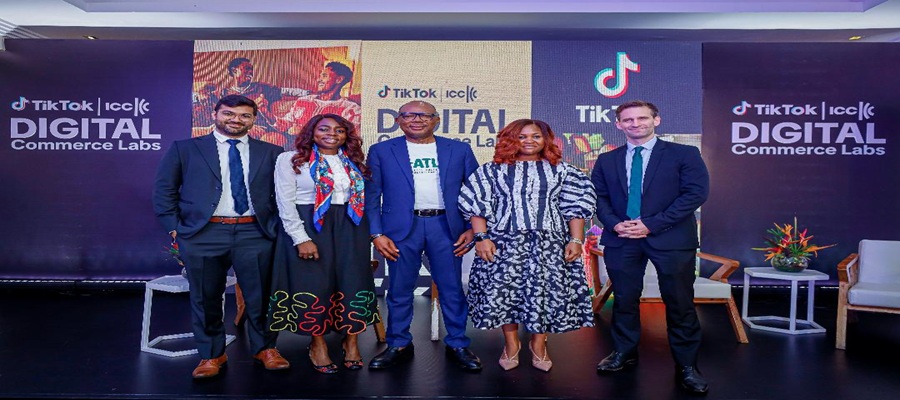
TikTok, in collaboration with the International Chamber of Commerce (ICC), on Thursday convened hundreds of entrepreneurs, small business owners, digital creators and industry stakeholders in Lagos for a flagship Digital Commerce Labs (DCL) event aimed at accelerating digital skills development and economic inclusion across Sub-Saharan Africa.

TikTok
The event, supported by the National Information Technology Development Agency (NITDA) and the Lagos State Employment Trust Fund (LSETF), brought together participants from across Nigeria’s business and technology ecosystem to explore how digital platforms can be leveraged to scale enterprises, improve market access and drive job creation.
Speaking at the event, organisers said the initiative marks the beginning of a broader programme designed to train thousands of small and medium-sized enterprises (SMEs) across the region in digital commerce skills through both online and physical learning platforms.
According to TikTok, the partnership reflects its commitment to supporting small businesses and strengthening Africa’s growing digital economy.
“Digital commerce is reshaping how businesses grow across Sub-Saharan Africa, and Nigerian entrepreneurs are at the heart of that shift,” said Tokunbo Ibrahim, Acting Head of Government Relations and Public Policy, Sub-Saharan Africa, TikTok.
He said the initiative would ensure that small businesses benefit from emerging opportunities in social commerce and digital trade.
The Director-General of NITDA, Kashifu Inuwa Abdullahi, said digital platforms have evolved beyond entertainment and are now key drivers of economic growth and innovation.
He noted that Nigeria’s youth population and growing digital adoption position the country to benefit significantly from the expansion of online commerce and creator-led businesses.
“At NITDA, our vision is to make Nigeria a digitally enabled nation, fostering inclusive economic development through technological innovation,” he said.
The ICC Deputy Secretary General, Julian Kassum, described the programme as a strategic effort to equip small businesses with tools needed to compete in the global digital economy.
He said the Digital Commerce Labs initiative would help expand opportunities for trade, entrepreneurship and employment.
The Lagos State Employment Trust Fund (LSETF) also announced support for the programme through capacity-building training in financial literacy, business structuring, record keeping, taxation and legal advisory services. It said participating businesses would gain access to funding opportunities after completing the programme.
Data presented at the event showed that Nigeria’s social commerce sector is projected to reach $2.04 billion in 2025 and nearly $4 billion by 2030, while Africa’s wider market is expected to grow to $9.43 billion within the same period.
Speakers at the event noted that social media platforms have become central to business growth in Nigeria, with many SMEs relying exclusively on digital channels to reach customers and drive sales.
The programme also featured keynote presentations, business training sessions, and a creator economy spotlight where Nigerian entrepreneurs shared experiences on building brands and scaling businesses through digital platforms such as TikTok.
Organisers said the initiative is expected to strengthen digital literacy, expand market access for SMEs, and deepen Nigeria’s participation in the global digital economy.

Galaxy Backbone @ 20, Unveils New Identity

ALTON Backs CBN on Local Data Hosting Rule for Banks, Fintechs

MTN Nigeria Commits to Ethical Conduct with IFRS S1, S2 Compliance

NDPC to Review Data Law to Address AI, Privacy Concerns

FG Moves to End Double Taxation

CBN Extends PoS Geo-Fencing Enforcement Deadline to August 2026

London Strengthens Global Investment Ties with Africa @ First Ever London-Africa Business Summit

FG Targets Alleged N3tn Capital Flight, Opens Airtime Credit Market to Nigerian Fintechs

Japan, UNESCO Boost Digital Learning in 15 CoEs with Donation of ICT Equipment

African Electric Vehicle Platform Raises $215m to Scale Electric Mobility in Nigeria, Others




 E-Financial3 days ago
How Fraudsters Stole N134Bn from Banks, Customers in 6 Years – CBN

 General News3 days ago
Police Uncovers N7.7Bn Telecom Data Fraud Syndicate, Recovers Assets Worth Millions

 Telecom2 days ago
TikTok, ICC Gather Nigeria’s Entrepreneurs to Drive Small Business Growth and Digital Transformation

 E-Business2 days ago
Payaza Launches AI-powered Storefront Platform to Drive Cross-border Commerce

 Telecom2 days ago
How a New NITDA-TikTok Partnership Could Transform Thousands of Nigerian Businesses

 Telecom2 days ago
Nigeria Moves to End Solar Imports as NASENI, REA Seal Major Renewable Energy Deal

 E-Financial2 days ago
NAICOM’s 18 Months Management Spill @ African Alliance Ends

 E-Financial2 days ago
Standard Bank Targets $15.4b SME Growth in Nigeria, Others with Trade Expansion Drive