

Telecom
OAU, Unilag students win BlueChip Inter-Campus Machine Learning competition

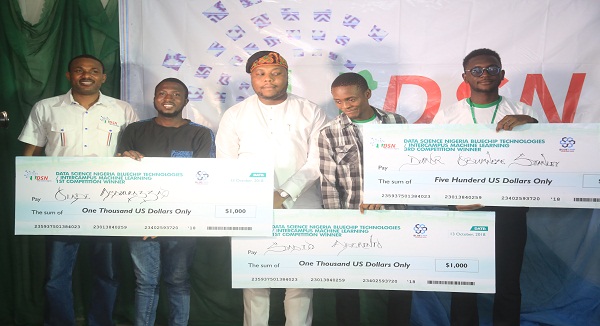
After an intensive 5-day learning bootcamp, Olajide Abdulrazzaq Folarin (from Obafemi Awolowo University, Ile-Ife, Osun State), Sadiq Aderinto and Stanley Obumneme Dukor (both of the University of Lagos, Akoka, Lagos) jointly won the first Inter-Campus Machine Learning competition.
Sponsored by Bluechip Technologies and organised by Data Science Nigeria, the three first-place winners individually earned the highest score for machine learning algorithm development.
The bootcamp was facilitated by 11 visiting international experts in artificial intelligence, 5 online tutors and 15 Nigerian-based business leaders.

More than 10,000 students from 95 campuses participated in the 4-stage competition. It included a pre-qualification pre-study, a quiz, a Kaggle competition and a validation call.
The top 85 students competed at the 5-day all-expenses-paid bootcamp at the Peninsula Resort, Lekki-Ajah Expressway, Lagos, from 10-14 October 2018.
At the bootcamp, the students were immersed in intensive sessions of theoretical learning, use case applications, face-to-face teaching, virtual online classes, and a hands-on hackathon using the newly launched Zindi platform for real-time model evaluation.
Distinguished data scientists from leading global institutions including Google’s AI Lab, GitHub, MIIA and Bankable Frontiers Associate, USA facilitated the sessions.
Leading executives from the Nigerian banking, telecommunications, energy, and investment sectors shared their invaluable contextual insights with the students.
The Inter-Campus Machine Learning competition strives to increase Nigeria’s experience and expertise in data science and to enhance the opportunities and employability of Nigerian students through an incentivized exposure to advanced world-class knowledge.
Data Science is now the world’s no. 1 career, and is critical to high-impact transformation and innovation in Nigeria and worldwide.
In order to ensure the maximum inclusive participation, all the participants who travelled to the bootcamp from outside Lagos received full travel grant, while 10 additional special provisions were made for ladies who did not meet the cut-off selection mark.
The bootcamp included participants from all six geopolitical zones of Nigeria.
Mr Bayo Adekanmbi, convener, Data Science Nigeria, in his welcome speech, said, “in our quest to play big in the Artificial Intelligence space, we must raise our game and combine the best of theoretical knowledge and real use cases with solution orientation, hence our tutorial approach of having world-class experts from leading AI centres in the world and local business leaders at the bootcamp”.
Olumide Soyombo, the co-founder of Bluechip Technologies Limited, shared Bluechip’s 10-year story and inspired the participants about the possibilities of artificial intelligence and how the students could leverage their knowledge to become technology entrepreneurs.

A group photograph of facilitators and participants at the Inter-campus Machine Learning competition.
Mr. Soyombo emphasized the importance of collaborative learning, network building and high-quality solution orientation.
He said, “We are proud to sponsor the 1st ever Intercampus Machine Learning Competition as part of our 10th anniversary, which is a demonstration of our commitment to knowledge development, especially in strategic areas like AI which will shape the future and make the world a better place”.
Kazeem Tewogbade, the managing director of Bluechip Technologies Limited, said “Bluechip Technologies is excited to have created a platform that brought together some of the world’s best and Nigeria’s budding talent across over 90 higher institutions.
“We are convinced that Nigeria is raising a new breed of experts that will play big on the global space”.
Each of the three winners received $1,000 US dollars and an opportunity for a short-term internship at the Bluechip technology firm.
In addition, campus volunteers from the universities with the highest number of participants in the pre-qualification process were also rewarded for promoting and mobilizing participation in the competition.
The University of Lagos, Ladoke Akintola University Ogbomoso, and the University of Ibadan campus volunteers received N150,000, N100,000 and N50,000 respectively.
Some of the speakers at the bootcamp included Matt Grasser, Director, Inclusive Fintech, Bankable Frontiers Associate, USA; Moustapha Cisse PhD, Google AI Lab; Professor Tom Dietterich, Distinguished Professor and Director, Oregon State University and the founder of BigML; Dr Emmanuel Doro, Principal Data Scientist, Jet.com, USA; Dr Sulaimon Afolabi, Argility, South Africa; Ekow Duker, ex-Chief Analytics Officer of Barclays Africa/MD IxioAnalytics, South Africa;
Other were Dr Jacques Ludik, CEO of Cortex Logic, South Africa; Karim Beguir, the founder/CEO of Instadeep AI, London; Omoju Miller PhD, Senior Data Scientist, GitHub, USA; Abiodun Modupe, PhD Researcher, University of the Witwatersrand, South Africa; Adewale Akinfaderin, Graduate Researcher, FSU & Senior Data Scientist, Lowe’s Inc., USA; Osayi Igharo, Founding and Managing partner, Ripple VC, San Francisco, SA; Robert John, Chief Data Scientist at Enter5ive and.
In addition to theoretical and hands-on exploration of topics like Anomaly detection, unsupervised classification, sequential rule mining, Deep Learning theories, Deep learning in Natural language processing; the bootcamp attendees spent time brainstorming on real business problems which were facilitated by the leadership teams of companies like FCMB (credit risk scoring), Terragon Group (AdTech recommendation), Guardian News (recommendation system), Octave Analytics (Financial inclusion geomapping), Axa Mansard (AI for insurance) and Microsoft (possibilities in MS Azure).
The bootcamp focused on applying Artificial Intelligence to a real-world problem of financial inclusion in Nigeria.
The bootcamp’s Machine Learning Hackathon was based on loan default models for an anonymised real-world dataset of low-income customers and required the participants to use geographical data (longitude and latitude), historical usage and mobile phone behaviour to determine the likely risk of loan defaults, as captured here.


Asset Management Corporation of Nigeria (AMCON) has commenced the process of divesting its interest in NTEL/NATCOM, saying the telecommunications company has undergone a major transformation that positions it as one of its most promising asset recovery success stories.

NatCom Development and Investment Limited, trading as ntel, is a Nigerian telecommunications company that acquired the core legacy assets of the defunct Nigerian Telecommunications Limited (NITEL) and its mobile arm (MTel) in 2015.
Mr. Gbenga Alade, managing director and chief executive officer, AMCON, disclosed this during an interactive session with senior media executives in Lagos at the weekend, where he also revealed that the Corporation recovered about N165 billion in the first half of 2026, representing a 64 per cent increase over the N107 billion recovered during the corresponding period of 2025.
Alade said the planned sale of NTEL follows the successful divestment of the Ibadan Electricity Distribution Company (IBEDC) and forms part of AMCON’s strategy to unlock value from distressed assets while attracting credible investors into key sectors of the economy.
According to him, the divestment programme is being conducted through a transparent and structured process designed to attract strategic investors capable of repositioning the telecoms company for sustainable growth.
He explained that NTEL, the successor to the defunct Nigerian Telecommunications Limited (NITEL), has embarked on a comprehensive three-pronged transformation strategy aimed at restoring its competitiveness and enhancing its investment appeal.
“The repositioning effort is designed to maximise value, strengthen operational competitiveness and prepare the business for long-term sustainability under new investment,” Alade said.
He described the transformation of NTEL as a significant milestone in the revitalisation of Nigeria’s legacy telecommunications assets, noting that the company remains an important part of the country’s telecom infrastructure and history.
Alade expressed confidence in the Board and Management of NTEL/NATCOM, saying their leadership has laid a solid foundation for the company’s next phase of growth.
“The remarkable transformation of NTEL is poised to become one of AMCON’s most notable success stories in the telecommunications sector. We have full confidence in the Board and Management of NTEL/NATCOM as they continue to demonstrate experience, innovation, diligence and commitment towards positioning this Nigerian-owned company to compete favourably with its peers both locally and internationally,” he stated.
He assured stakeholders that further updates on the divestment exercise would be communicated as major milestones are achieved, stressing AMCON’s commitment to transparency throughout the process.
Alade said the telecommunications divestment aligns with AMCON’s statutory mandate of maximising value from distressed assets, supporting economic growth and strengthening confidence in Nigeria’s financial system.
Beyond the planned sale of NTEL, the AMCON boss highlighted the Corporation’s improved operational performance, revealing that recoveries rose sharply in the first six months of the year.
According to him, the Corporation recovered approximately N165 billion between January and June 2026, compared to N107 billion recorded in the same period last year, while maintaining a cost-to-recovery ratio of just 2.3 per cent, reflecting greater operational efficiency.
Alade also announced what he described as a landmark Supreme Court judgment that strengthens AMCON’s debt recovery powers and clarifies key provisions of its enabling law.
He said the apex court affirmed that the AMCON Act constitutes a special legal regime that must be interpreted purposively because the Corporation was established to address the financial crisis triggered by the systemic banking challenges of 2008.
According to him, the Supreme Court further ruled that AMCON is exempt from paying stamp duties and confirmed that regardless of the size of an obligor’s indebtedness, the Corporation has the statutory authority to dispose of collateral assets in enforcing its rights and recovering outstanding debts.
“While we celebrate this landmark judgment and several other legal successes, we are not resting on our oars. We remain mindful of the various tactics employed by recalcitrant obligors to frustrate the Corporation’s operations,” Alade stated.
Responding to calls for the winding down of AMCON, the Managing Director alleged that many of those advocating the Corporation’s closure are debtors seeking to frustrate its recovery efforts.
He stressed that any decision on AMCON’s sunset remains the exclusive responsibility of its Board and the Central Bank of Nigeria (CBN), adding that the Corporation remains focused on recovering debts owed on behalf of the Nigerian people.
Alade also said AMCON has intensified collaboration with debt recovery partners, solicitors and receiver managers to improve the effectiveness of its recovery strategies.
“We regularly engage and sensitise our debt recovery partners, solicitors and receiver managers on the unique provisions of the AMCON Act. This ensures that when they appear in court on matters concerning the Corporation, they are fully conversant with both the facts and the applicable legal framework.
“In recognition of their commitment, and in response to prevailing economic realities, the Corporation has reviewed the commission structure for debt recovery agents and partners across the board. Together, we remain confident that we will continue to achieve significant success in our recovery efforts,” he said.


Africa risks falling behind in the global artificial intelligence (AI) economy, unless governments and the private sector rapidly increase investment in digital infrastructure, data capabilities and home-grown innovation.

This is according to a research report by Boston Consulting Group (BCG), titled: “Advancing Africa’s AI and digital economy”.
It focuses on how Africa can accelerate investment in digital infrastructure, AI capabilities and regional collaboration, to build a competitive AI-driven economy and avoid falling behind in the global AI race.
The report argues that while AI is expected to contribute $15.7 trillion to the global economy by 2030, Africa is capturing only a fraction of the opportunity because it lacks the infrastructure, skills and investment needed to compete in the emerging AI economy.
Although the continent has one of the world’s youngest populations and rapidly growing digital adoption, BCG warns that Africa remains primarily a consumer of digital technologies, rather than a producer of the infrastructure, platforms and intellectual property that will underpin future economic growth.
“Africa stands at a defining moment in the global AI revolution,” says Hamid Maher, MD and senior partner at BCG and one of the report’s authors.
“The continent has significant structural advantages, including a young population, growing digital adoption and the opportunity to build without legacy constraints.
“However, unless Africa invests in owning its digital infrastructure, data and AI capabilities, it risks becoming a consumer rather than a creator of the technologies that will shape future economic growth.
“The decisions taken today will determine whether Africa captures value from AI or simply imports it.”
Structural weaknesses
The report highlights the widening gap between Africa and the rest of the world. While digital activities account for about 15% of global GDP, Africa’s digital economy contributes only 5% of the continent’s GDP. At its current pace, this figure is projected to reach only 8.5% by 2050, it notes.
BCG says this slow progress comes despite encouraging developments, including Africa’s position as the world’s fastest-growing cloud market and strong adoption of mobile technology.
However, the continent accounts for 18% of the world’s population but less than 1% of global data centre capacity. At the same time, fewer than 2% of Africa’s approximately 2 000 languages are supported by large language models, limiting the relevance and accessibility of AI technologies for millions of people.
The report warns that these shortcomings are becoming increasingly significant as AI reshapes global industries. Traditional growth sectors − such as business process outsourcing, call centres and labour-intensive manufacturing − are likely to become increasingly automated, reducing opportunities that previously helped emerging economies industrialize.
“Without stronger participation in AI production, Africa risks exporting its data, while importing expensive AI services developed elsewhere, repeating historical patterns in which the continent supplied raw materials but captured little value from downstream industries,” it warns.
Three key barriers
BCG identifies the top challenges that continue to constrain Africa’s AI ambitions.
The first is economic fragmentation. “Africa’s 54 economies are individually too small to justify many of the large-scale investments required for AI infrastructure, while organisations within countries often lack sufficient capital to build digital platforms independently, “it says.
The second challenge is a shortage of AI talent. According to the report, Africa has about 62 000 AI specialists, representing only around 5% of the global AI workforce. Many of these professionals work remotely for overseas employers, limiting the development of domestic AI ecosystems.
“Africa has the ambition and, crucially, the talent it needs. With focus, coordination and political will, the continent can transition from disadvantaged digital consumer to empowered digital value creator and can secure its economic future.”
The third barrier is reliance on imported technology. African organisations often face higher software licensing costs than their international counterparts, while remaining dependent on foreign technology vendors, restricting innovation and limiting local value creation, the report asserts.
Patrick Dupoux, MD and senior partner at BCG, said these structural constraints are not unique to Africa, but require coordinated action.
“The challenge is not simply about adopting more digital technologies,” he points out.
“It is about ensuring African institutions increasingly build, govern and own the infrastructure, data and innovation ecosystems that power AI. Countries that produce AI capabilities rather than merely consume them will capture far greater economic value and create more sustainable jobs for future generations.”
Building Africa’s AI future
Rather than focusing solely on technology adoption, the report argues that Africa must establish the foundations needed to create its own AI economy.
BCG recommends building digital public infrastructure through public-private partnerships, with digital identity systems, payment platforms and secure data exchange networks serving as core building blocks.
The report also stresses the importance of stronger data governance to ensure information can be securely shared, while remaining under African ownership and control.
Ali Ziat, MD and partner at BCG, said collaboration will be essential if Africa is to compete globally.
“No single country or organisation can build Africa’s digital future alone,” he said.
“Pooling investment, creating shared infrastructure and embracing open systems will make projects financially viable, while encouraging innovation across borders. Combined with strong governance and coordinated leadership, these actions can help Africa become a global AI value creator instead of remaining on the side-lines.”
Telecom
Nkata Ndi Iyom Igbo Foundation, Leo Stan Ekeh Foundation Empower Trainers to Drive Youth Value Reorientation
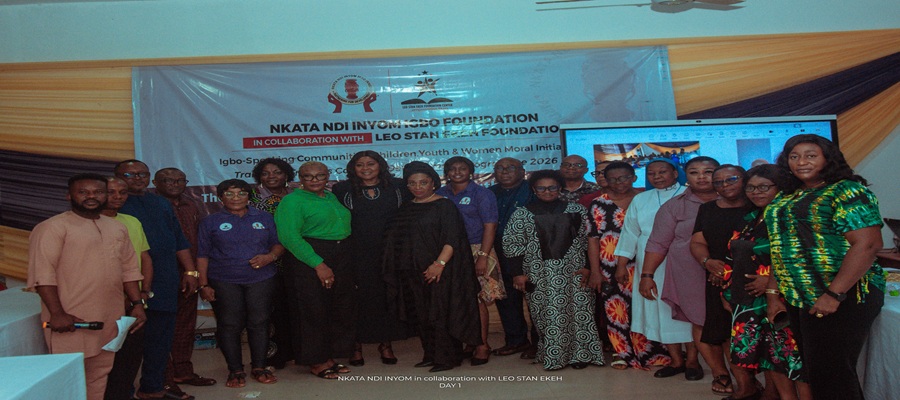
Nkata Ndi Iyom Igbo Foundation and the Leo Stan Ekeh Foundation (LSEF) have successfully concluded a four-day regional seminar aimed at equipping trainers with the knowledge, values, and practical skills required to inspire positive behavioural change among young people across Southeast Nigeria.

The seminar, themed “Rebuilding Character, Strengthening Values, Empowering Minds, Enabling the Future,” was designed as a Train-the-Trainers initiative to prepare women, teachers, mothers, and community leaders as catalysts for moral reorientation and social transformation.
Participants were drawn from the five states of Southeast Nigeria including Edo and Delta states, underscoring the organisers’ commitment to fostering regional collaboration in addressing the moral and social challenges confronting today’s youth.
Declaring the seminar open, the Vice-Chancellor of Imo State University, Prof. U.U. Chukwumaeze, stressed the urgent need for collective action to rebuild the moral fabric of society.
He noted that the growing decline in moral values and increasing social vices among young people require deliberate and sustained intervention from all stakeholders.
According to the Vice-Chancellor, “The responsibility of raising responsible and productive citizens rests with all of us. We must deliberately reorient our young people by teaching and nurturing them in line with our cherished cultural norms and values.
“Only then can we build a society founded on integrity, discipline, respect, and communal responsibility.”
The Nkata Ndi Iyom Igbo Foundation, founded by Iyom Josephine Anenih, former Minister of Women Affairs, has remained committed to promoting the welfare, cultural values, and development of women and families across the Southeast.
Through initiatives such as this seminar, the Foundation continues to champion character development and community empowerment as vital pillars for national progress.
The seminar featured a robust lineup of practical sessions facilitated by leading experts, including Prof. Gloria Ernest-Samuel, Director of the Leo Stan Ekeh Foundation, Roz Okagbue, and Grace Okezie, who are experts in education, leadership, communication, and human development.
Among the major topics are Training for Behavior Change, Etiquette and Emotional Intelligence Tools for Trainers, effective communication strategies, value-based leadership, mentoring techniques, and approaches to inspiring positive social attitudes among young people.
Speaking on behalf of the organisers, Dr. Grace Okudo, representing the Nkata Ndi Iyom Igbo Foundation, described the initiative as a strategic response to the growing concerns over declining moral standards and the increasing prevalence of social vices.
She emphasised that women, particularly mothers and teachers, remain the first and most influential mentors in every society and must therefore be equipped with contemporary skills for character formation and effective mentoring.
Also speaking, Prof. Gloria Ernest-Samuel, the programme co-organiser, expressed confidence that the knowledge and practical skills acquired during the four-day training would empower participants to return to their respective communities as certified trainers capable of influencing families, schools, faith-based organisations, and youth groups towards lasting behavioural transformation.
The seminar further reinforced the shared commitment of the Nkata Ndi Iyom Igbo Foundation, the Leo Stan Ekeh Foundation, and Imo State University to promoting ethical leadership, preserving cultural values, strengthening communities, and raising a generation of responsible, value-driven young people equipped to make meaningful contributions to Nigeria’s future.

History as Lagos Becomes First Nigerian State to Launch Greenhouse Gas Registry

AMCON Puts ntel Up for Sale, Seeks Investors

Nigeria Atomic Energy Commission Seeks Collaboration on Power Plants

AI Investment Gap Threatens Africa’s Future Growth

UNN to Partner Firm on AI, Smart Mobility Innovation Centre

NRC, Ponzi Scheme Collapses Resulting Loss of Billions of Naira

EFCC Busts NIS Visa Overstay Racket, Uncovers N700m in an Account

Tokenization, Blockchain Technology will Transform Financial Institutions – IMF

From Scarcity to Scale: What Africa Can Learn from India’s Agricultural Transformation

BON Establishes Six Ad Hoc Committees to Modernize Broadcasting




 News2 days ago
See Verified 20 Countries Nigerian Passport Holders Can Travel Visa-Free

 E-Business2 days ago
Report Says Cybercriminals Deploy Malware to Hijack Crypto Wallets, Monitor Browsers Telegram

 Telecom2 days ago
Subscribers, Telcos Warn FCCPC over Airtime Lending Enforcement

 Telecom2 days ago
NCC, REA Partner to Cut Telecom Costs with Renewable Energy

 E-Business2 days ago
NPC Opens 131 Births, Deaths Registration Centres in Anambra

 General News2 days ago
AfDB, Nigeria Urge African Control of Mineral Resources

 General News2 days ago
Lagos Chamber Opposes 21 Percent Pension Contribution, Warns of Job Losses

 Telecom2 days ago
Nigeria Pushes for United African Front Ahead of Global Telecoms Elections