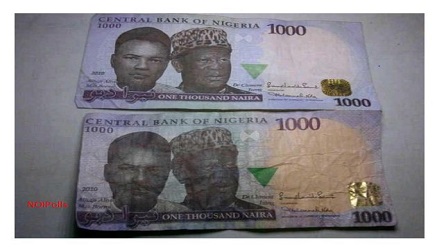
A new poll has revealed that 41 percent of respondents are aware of the recent circulation of counterfeit currencies (also known as fake Naira notes) in the country, and 19 percent of this proportion disclosed that they have personally come in contact with counterfeit currencies within the last three months.
The market with 67 percent, proved to be the most common place where these currencies are circulated.
The new poll released by NOIPolls shows this comes as no surprise, as some counterfeiters may see the market place as the most porous place to spread fake notes due to the wide range of small business establishments who may not notice during transactions.
Hence, some businesses suffer losses due to their inability to recoup their money as banks confiscate fake notes at sight. Commercial banks (20 percent), public transport (5 percent) and ATMs (3 percent) were also mentioned as avenues for circulation. Further probing revealed that only 5 percent of the respondents admitted to spending the fake Naira notes that came into their possession.
More findings from the poll revealed that there is some level of awareness of the circulation of counterfeit naira notes in the country as 41 percent admitted that they have been privy to such information, mainly through word of mouth (53 percent) and traditional media (25 percent) amongst others; although the majority (59 percent) showed no awareness.
In addition, while the Naira notes are protected by a number of security features to enable the recognition of genuine notes, the distinguishing features can immediately be recognized by touch and visibility such as the raised print, the security thread and the watermark, to mention a few. In line with this, some Nigerians are knowledgeable of these features, citing texture (42 percent) and the absence of the distorted hologram (25 percent) as ways of distinguishing between genuine and fake notes.
Lastly, 56 percent of the respondents are of the opinion that the Central Bank of Nigeria is not doing enough to create awareness about the circulation of these counterfeit currencies, neither are they giving citizens adequate tips on how to detect them. The implication of this is that more fake Naira notes may be allowed to circulate in the society. This in turn will lead to a reduction in the value of the genuine currency; increase in prices (inflation) due to more money getting circulated in the economy, an unauthorised artificial increase in money supply; and losses, when traders are not reimbursed for counterfeit money detected and confiscated by banks.
This suggests that the Central Bank of Nigeria needs to do more to create awareness on the implications of the circulation of fake currencies, as well as provide tips on how to detect a fake currency.
These are some of the key findings from the Counterfeit Currencies poll conducted in the week commencing March 6th, 2017.
Survey Findings
The poll sought to gauge the awareness of Nigerians on the recent circulation of counterfeit currencies in Nigeria and the results revealed that 41 percent said they were aware, while 59 percent claimed to be unaware of the recent circulation of counterfeit currencies in the country.
Respondents who were unaware had their interviews terminated at this point whereas those who said yes continued with the interview.
Further probing revealed that slightly more than half of the respondents who are aware of the recent circulation of counterfeit currencies reported that they got to hear about it through word of mouth (53 percent) while 25 percent mentioned traditional media.
Interestingly 15 percent disclosed that they had personal experience and this implies that they must have at some point being in possession of fake Naira notes. Other sources mentioned include; social media (10 percent), market place (3 percent) and commercial bank (2 percent).
More analysis showed that residents from the South-South zone (67 percent) and the North-East zone (61 percent) formed the largest proportion of Nigerians that indicated that they heard about the recent circulation of counterfeit currencies through word of mouth.
In the same manner, residents from the South-East zone (27 percent) had the highest representation of respondents that mentioned that they had a personal experience with counterfeit currencies which could be attributed to the daily heavy commercial activities in the area, causing these fake notes to go unnoticed by business establishments until they get to the point of depositing them in a commercial bank, among other findings.
Study Confirms Counterfeit Naira Notes Circulation on Increase
Comms Week29 Mar 20170 Comments
A new poll has revealed that 41 percent of respondents are aware of the recent circulation of counterfeit currencies (also known as fake Naira notes) in the country, and 19 percent of this proportion…
C
Published by
Comms Week
Trained and practicing journalist passionate about telecommunications, fintech, cybersecurity, and digital economy reporting.
You May Like

EFCC Arraigns FCMB Staff, Accomplice over Alleged $25,000 Access Credential Deal
Agusto & Co Withdraws A-credit Rating on Geregu Power Over Bond Default
Banks, Others Report 42,082 Transactions to NFIU

Supporting and Partnering in a New Dynamic and Cultural Environment - Precious Momife-Emechebe

PwC Nigeria Points at Ambiguities in Virtual Assets Tax Rules