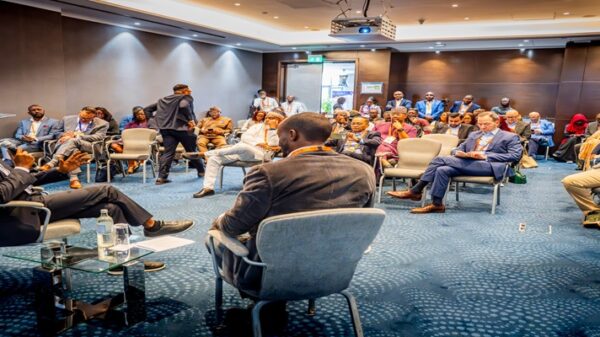
The World Radiocommunication Conference 2015 (WRC-15) has concluded its deliberations as delegates sign the Final Acts that revise the Radio Regulations, the international treaty governing the use of radio-frequency spectrum and satellite orbits.
Around 3300 participants, representing 162 out of ITU’s 193 Member States attended the four-week conference from 2 to 27 November. Some 500 participants representing 130 other entities, including industry, also attended the conference as observers.
The Conference was steered under the Chairmanship of Mr Festus Yusufu Narai Daudu of Nigeria. He was assisted in the task by six Vice Chairmen: Mr A. Jamieson (New Zealand), Mr Y. Al-Bulushi (Oman), Mr D. Obam (Kenya), Ms D. Tomimura (Brazil), Mr A. Kühn (Germany), and Mr N. Nikiforov (Russian Federation).
New challenges, new opportunities
“As new technological innovations and applications emerge, they set new challenges as well as bring new opportunities for billions around the world,” said Mr Festus Daudu, Chairman of WRC-15. “This conference dealt with a large number of important and sensitive issues, ranging from mobile broadband communications and satellite systems to emergency communications and disaster relief, maritime and aeronautical communications, environmental monitoring and climate change, universal time and space research as well as radiocommunication services that the public relies on for health, information, education, security and safety.”
“This World Radiocommunication Conference will define new and better ways to regulate radio services and applications,” said ITU Secretary-General Houlin Zhao. “In a world where radiocommunications are playing an increasingly important role in connecting people, I am convinced that the outcome of this conference will represent a major contribution in making the world a better – and safer – place for all.”
“A great deal has been achieved in the last four weeks and the results will have a major impact on the future of the telecommunication sector in general and radiocommunications in particular,” said Mr François Rancy, Director of the ITU Radiocommunication Bureau. “The outcomes of WRC-15 are aimed at maintaining a stable, predictable and universally applied regulatory environment that secures long-term investments for the multi-trillion dollar ICT industry.”
WRC-15 addressed over 40 topics related to frequency allocation and frequency sharing for the efficient use of spectrum and orbital resources. The outcomes ensure high quality radiocommunication services for mobile and satellite communications, maritime and aeronautical transport, air and road safety as well as for scientific purposes related to the environment, meteorology and climatology, disaster prediction, mitigation and relief. The ITU Radiocommunication Sector has been set an ambitious studies programme for the next four years covering a wide range of services from amateur radio to broadcasting, mobile broadband, mobile satellite, fixed satellite, earth stations on mobile platforms, and space exploration services.
WRC-15 adopted a revised version of Resolution 12 on Assistance and Support to Palestine, which resolves to continue assistance to Palestine and to enable Palestine to obtain and manage the spectrum required to operate telecommunications networks and wireless services. This followed an Israeli-Palestinian agreement to facilitate cellular phone operations and the establishment of a modern and reliable telecommunication network in Palestine.
Mobile broadband communications
Following the growing demand for spectrum for mobile broadband services, WRC-15 identified frequency bands in the L-band (1427-1518 MHz) and in the lower part of the C-band (3.4 -3.6 MHz). WRC-15 achieved agreement on some additional portions in other bands that were also allocated to mobile broadband services in order to be used in regions where there was no interference with other services.
To counteract the difficulties encountered in finding additional spectrum for IMT in bands below 6 GHz, WRC-15 decided to include studies in the agenda for the next WRC in 2019 for the identification of bands above 6 GHz that will allow technology to meet demand for greater capacity. Administrations and industry can now concentrate on the development of necessary technologies in line with the schedule for the implementation of IMT-2020.
WRC-15 took a key decision that will provide enhanced capacity for mobile broadband in the 694-790 MHz frequency band in ITU Region-1 (Europe, Africa, the Middle East and Central Asia) and a globally harmonized solution for the implementation of the digital dividend. Full protection has been given to television broadcasting as well as to the aeronautical radionavigation systems operating in this frequency band.
Amateur radio service gets new allocation
New allocation for amateur radio service in the frequency band 5351.5 - 5366.5 kHz will maintain stable communications over various distances, especially for use when providing communications in disaster situations and for relief operations.
WRC-15 Allocates Spectrum for Future Innovation
Comms Week30 Nov 20150 Comments
The World Radiocommunication Conference 2015 (WRC-15) has concluded its deliberations as delegates sign the Final Acts that revise the Radio Regulations, the international treaty governing the use of…
C
Published by
Comms Week
Trained and practicing journalist passionate about telecommunications, fintech, cybersecurity, and digital economy reporting.
You May Like

MTN Nigeria Endorses eWorldForum and Book Launch as GSM Revolution Turns 25

MTN Nigeria's ₦1.62 trillion network Investment builds 100 million subscribers using more data than ever

FG Plans Regulation of Internet Access for Nigerians below 16 Years

The Leadership Reset Powering West Africa’s Customer Experience Revolution

Digital Parks, Master Power Plan New Data Centre Facility in Lagos