Nigeria is likely to have the lion’s share in a five-year, $13 million collaboration between Michigan State University and the MasterCard Foundation launched on Monday to help 15,000 young people access employment and entrepreneurship opportunities in the fast-growing horticulture, aquaculture, poultry, cassava and oilseed sectors in Tanzania and Nigeria.
The partnership, the AgriFood Youth Opportunity Lab, will focus on youth ages 18 to 24 in major food shed regions surrounding Lagos and Dar es Salaam.
The Ag Youth Lab will assist economically disadvantaged, hard-to-reach and out-of-school youth transition into employment and entrepreneurship opportunities in the agrifood system.
“Working with The MasterCard Foundation and African partners to address one of the most critical problems facing the continent—youth unemployment—reflects how we pursue MSU’s global vision,” said Lou Anna K. Simon, MSU President. “We see great potential to expand youth agrifood employment both on and off the farm.”
More than 60 percent of Africa’s young people are jobless or underemployed, and formal job creation efforts in Africa’s growing economies have been insufficient, according to African Economic Outlook. Comprising 20 percent of Africa’s population, Tanzania and Nigeria together represent an important opportunity for intervention in skills acquisition, job creation and employment for youth.
The program will have a special focus on gender equity, aiming for equal representation of young men and women across its programs and addressing policy, training, mentoring and other constraints that affect the ability of young women to start enterprises or obtain employment.
The Ag Youth Lab will respond directly to opportunities and constraints identified in the 2016 MSU andThe MasterCard Foundation-Agrifood Youth Employment and Engagement Study (AgYees).
The report highlighted the need to:
Actively engage the private sector in the design, development and implementation of youth employment programs;
Improve training curricula to ensure its relevance to the modern agrifood sector;
Apply information and communication technologies (ICT)and other advanced technologies to solve agrifood system problems; and
Adapt youth programs to meet the expanding consumer demand for fresh fruits, vegetables, high-quality proteins, semi-processed and ready-to eat meals.
“This partnership with Michigan State University is an excellent example of using evidence to address youth unemployment,” said Reeta Roy, president and CEO of The MasterCard Foundation. By engaging the private sector to develop business opportunities for young people the project also addresses some of the challenges youth face in seeking work.”
MSU will lead implementation of the Ag Youth Lab in close collaboration with regional partners. They include the International Institute of Tropical Agriculture; Venture Garden Group, a Nigerian company; Tanzania’s Sokoine University Graduate Entrepreneurs Cooperative (SUGECO); and Nigeria’s Oyo State College of Agriculture and Technology.
The Ag Youth Lab will emphasize policy research, data and analytics to develop a cost-effective, scalable model for youth training and facilitation. “Our e-learning and monitoring and evaluation platforms will support the program by providing trainees and other stakeholders with the information needed to succeed,” said Bunmi Akinyemiju, CEO of Venture Garden Group, the lead partner responsible for data and information technology activities.
Using a “train the trainers” approach, local colleges and their graduates will train community facilitators to expose youth to new opportunities and pass on skills using an experiential learning approach. “We will work together to establish an atmosphere where youth will be able to create jobs and become agents of food sufficiency as well as ambassadors of character,” said J.G. Adewale, provost at OYSCATECH.
The project will give youth the skills they need to build their own businesses and, in turn, create additional employment opportunities for other out-of-school youth. “Agriculture is much more than just farming,” said Anna Andrew Temu, founder of SUGECO. “Equipped with the right entrepreneurial and technical skills, and with guidance from experienced mentors, youth can imagine and bring to life their own innovative agribusinesses.”
Ultimately, the Ag Youth Lab seeks long-term impact by building the capacity of local organizations, working directly with the private sector to help youth transition to quality agrifood employment, addressing key policy constraints, and reducing the cost of expanding youth employment. “IITA will bring the lessons from its experience to help Ag Youth Lab tap the dynamism of Africa’s youth,” said N. Sanginga, director general of IITA. “By creating better jobs for themselves, youth can transform Africa’s agrifood systems and build a brighter future for Africa.”
Michigan State University (MSU) has been advancing the common good with uncommon will for more than 160 years.
One of the top research universities in the world, MSU pushes the boundaries of discovery and forges enduring partnerships to solve the most pressing global challenges while providing life-changing opportunities to a diverse and inclusive academic community through more than 200 programs of study in 17 degree-granting colleges, while the MasterCard Foundation works with visionary organizations to provide greater access to education, skills training and financial services for people living in poverty, primarily in Africa.
10,000 Nigerians to Benefit from MSU, MasterCard Foundation ‘Agri Youth Lab’
Comms Week16 May 20170 Comments
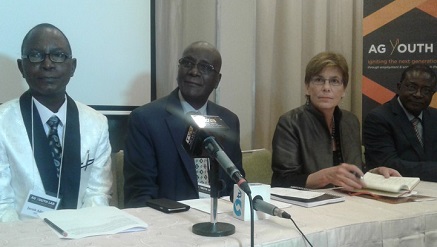
Nigeria is likely to have the lion’s share in a five-year, $13 million collaboration between Michigan State University and the MasterCard Foundation launched on Monday to help 15,000 young people…
C
Published by
Comms Week
Trained and practicing journalist passionate about telecommunications, fintech, cybersecurity, and digital economy reporting.
You May Like
FG Approves Revised National Biotechnology Policy

How Creators Are Earning From Their Content Instantly Through Gifting on Yolly

What Dollar Strength Cycle Mean for Traders

Firm Warns As Popular Cloud Platforms Have Been Used in Over 390,000 Phishing Attacks

FG inaugurates National Digital Cloud Policy, Targets $750m in Private Investment