Nigeria has an estimated number 740,000 people in slavery despite her massive oil reserves and recent plans for rapid socio-economic development, according to Global Slavery Index 2013 which provides a ranking of 162 countries around the world.
The index based on a combined measure of three factors: estimated prevalence of modern slavery by population, a measure of child marriage, and a measure of human trafficking in and out of a country, stated that about 60% of the Nigerian population lives at, or below the poverty line with the average income at US$1 per day.
This widespread poverty, rabid urbanization, exponential population growth coupled with the lack of enforcement of legal instruments and high levels of crime and corruption increases the vulnerability of Nigerians – particularly children – to various forms of modern slavery, both within and outside the borders of Nigeria.
Child labour is also an issue, where high levels of poverty and unemployment means children are more likely to be forced to work to outside their family network to support themselves and their family. 8
The majority of enslaved Nigerians are subjected to forced labour and sexual exploitation within the country, throughout Africa and overseas in Europe, Asia and the Middle East.
There is a connection between people recruited in rural areas and vulnerability to modern slavery, as women and children from these areas often do not have access to accurate information regarding the position for which they are applying.
Often, once they arrive at their new job, they are subjected to domestic servitude and sexual exploitation, particularly in neighbouring regions of Africa. 9 A large number of children in particular are exploited in this manner.
According to the index, Nigerian women and girls represent a large proportion of women enslaved in Europe for commercial sexual exploitation, with the International Organisation for Migration (IOM) estimating that in Italy alone, between 10,000 and 12,000 Nigerian women have been enslaved in the sex industry.
In addition to sexual exploitation, many Nigerians – particularly men and boys – are in forced labour and exploited in street vending, domestic service, mining, stone quarrying, agriculture or begging.
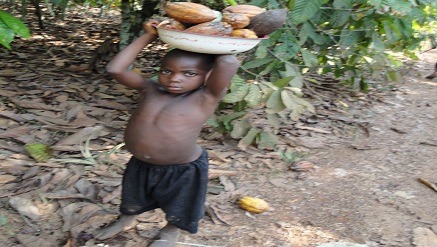
Nigeria has high numbers of child labourers, with an estimated 47% of children aged 4- 15 in child labour. Nigeria has been highlighted in the 2010 Child Labour Index as being one of 68 countries of ‘extreme risk’ of the most widespread abuse of child workers, with a ranking of eighth on the Index.
Children take part in many different forms of labour, including mining (particularly for solid minerals like coal, cassiterite, kaolin, gypsum, columbite, gold, gemstones, barites, graphite, marble and tantalite) and stone quarrying, domestic service and cocoa harvesting.
Children are also vulnerable to domestic servitude through the traditional practice of child-fosterage. Evidence suggests that families in rural areas send their children to work as domestic helpers in homes of wealthier families in cities, in exchange for board and education.
In recent times, traffickers (“agents”) have taken advantage of this practice to recruit children and “farm” them to employers for wages that are meant for the children, and remit a small percentage of the wages either to the parents or teenagers among them.16 Many of these children are physically, mentally and sexually abused and denied access to any education.
The index advised that Nigeria should recognise that Boko Haram is using forced marriage and sexual slavery as a weapon of fear and social control. Nigerian response to Boko Haram should be the intensification of efforts to eradicate Boko Haram and other terrorist groups.
It also urged Nigeria to intensify efforts to pursue modern slavery investigations and prosecutions, including trafficking and forced labour; as well as intensify current efforts at training police and immigration officials to identify victims of modern slavery among vulnerable populations, such as young women and children.
GSI Raises Alarm over Growing Slavery in Nigeria
Comms Week9 Sept 20140 Comments
Nigeria has an estimated number 740,000 people in slavery despite her massive oil reserves and recent plans for rapid socio-economic development, according to Global Slavery Index 2013 which provides…
C
Published by
Comms Week
Trained and practicing journalist passionate about telecommunications, fintech, cybersecurity, and digital economy reporting.
You May Like

Releasing President Tinubu’s Records Can Endanger Lives – FBI

Tinubu Orders Arrest of Nwabueze, Head of Another Fake Agency, Suspension of 3 Perm Secs
How AI, Poor Governance Aid Transnational Scams —UNODC

Access to Equipment, Specialists Key to Survival of Preterm Babies — Haven Pediatric CMD

Shell Reinforces Safety Commitment @ CEO Contractors Forum