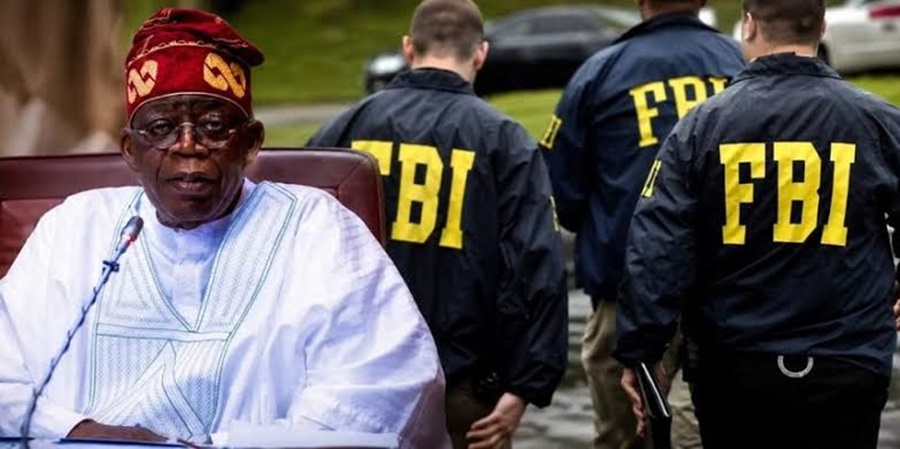
Von Batten-Montague-York, United States-based political advisory and lobbying firm, has said that the Federal Bureau of Investigation (FBI), has President Bola Tinubu on wire tape in the ongoing alleged drug trafficking case against him.
The Presidency reacted swiftly and stressed that the matter is a civil dispute over access to government records and does not constitute a criminal case against Tinubu.
But Von Batten-Montague-York in a statement posted on its verified X handle on Thursday, said that the FBI asked the court not to allow the disclosure of highly sensitive wiretape recordings responsive to Nigerian President Bola Tinubu.
According to the firm, the FBI admitted that the Tinubu-responsive records contain wiretape material, noting that afterward, the FBI stated that the wiretap-responsive records were compiled in furtherance of its investigation of multiple individuals for heroin-trafficking crimes.
Elswhere, the presidency has clarified that the ongoing Freedom of Information Act (FOIA) case involving President Tinubu in the United States is a civil records-disclosure dispute and not a criminal proceeding.
Bayo Onanuga, special adviser to the president on information and strategy, said in a statement issued on Thursday that no US court had found Tinubu guilty of criminal wrongdoing in the case.
“For clarity, the matter is a civil records-disclosure dispute under the United States Freedom of Information Act. It is not a criminal case against President Bola Ahmed Tinubu, nor has the court found him guilty of any criminal wrongdoing,” the statement reads.
The clarification follows recent commentary on the suit before the United States district court for the District of Columbia, where a dispute is ongoing over the release of records held by the Federal Bureau of Investigation and Drug Enforcement Administration (DEA) concerning Tinubu.
Tinubu, who joined the case as an intervenor, has asked the court to allow the FBI and DEA to maintain redactions and withholdings in documents already released to Aaron Greenspan, founder of PlainSite.
Greenspan filed FOIA requests in 2022 and 2023 seeking records from six US government agencies concerning investigations linked to a Chicago drug-trafficking case in the early 1990s. Tinubu was among four people named in the requests.
His requests included what he described as the “entire FBI file” on Tinubu and FBI interview records from 1992 to 1993.
Several of the agencies initially declined to confirm or deny whether they had records relating to Tinubu, relying on what is known as the “Glomar” response.
In April 2025, Beryl Howell, a US district judge, ruled that the FBI and DEA had not adequately justified their refusal to confirm or deny the existence of records relating to Tinubu.
Howell ordered the two agencies to search for and process non-exempt records responsive to Greenspan’s requests.
Following the ruling, the FBI and DEA produced thousands of pages of documents, some of which contained redactions.
The agencies also provided a Vaughn index setting out the basis for some of the withheld information.
Greenspan subsequently asked the court to order further disclosure, arguing that the agencies had not fully complied with the court’s order.
In a response filed on August 28, Tinubu argued that the records should remain partly withheld or redacted, citing privacy protections under US law.
His lawyers said FOIA is intended to provide information about government activities and not to expose private information collected by government agencies about individuals.
They relied on FOIA Exemption 7(C), which protects law-enforcement records where disclosure could constitute an unwarranted invasion of personal privacy, as well as provisions of the US Privacy Act.
Advertisement
Tinubu’s lawyers also argued that Howell’s 2025 ruling, which rejected the FBI and DEA’s Glomar responses, did not eliminate his privacy rights over the contents of any investigative files.
However, Onanuga said the FBI and DEA had so far produced 399 pages of records, with portions withheld under exemptions provided by US law.
He said the exemptions cover, among other things, grand-jury proceedings, attorney-client and attorney-work-product privileges, law-enforcement information, personal privacy, confidential sources and investigative techniques.
Onanuga said Tinubu had also asserted his rights under FOIA Exemption 7(C), adding that the court’s decision on whether information should be released or withheld would not, by itself, establish criminal liability.
“The litigation is a civil records-disclosure dispute under FOIA. It does not constitute a criminal charge, trial, or judicial finding against President Tinubu,” he said.
The presidential spokesperson also referred to a February 4, 2003, letter from the American Consulate in Lagos to Tafa Balogun, then inspector-general of police (IGP).
According to Onanuga, the letter said an FBI records check had found no criminal arrest records, wants or warrants for Tinubu, who was then governor of Lagos State.
He said the plaintiff has until September 11 to file an opposition and reply to the processes filed by the defendants and Tinubu, while the FBI, DEA and the president have until September 18 to respond.
Onanuga also said the presidency rejected recent claims concerning the involvement of Atiku Abubakar and Karl Von Batten in the litigation, saying neither is a party to the case.
He urged the media and public to distinguish the court proceedings from what the presidency described as partisan commentary, saying the US court would determine whether the disputed redactions are lawful based on the applicable law and evidence.