General News
54gene’s ACTG Awards $64,000 Scholarship to Further Genomics Research

54gene, the health technology company advancing African genomics research for improved global health outcomes, has announced the awarding of $64,000 in scholarships to four PhD candidates in Nigeria, Uganda and South Africa.
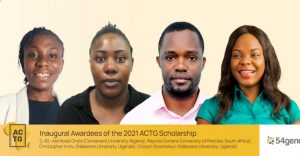
Through the African Centre for Translational Genetics (ACTG), a non-profit initiative launched by 54gene in February 2020, the grants awarded will be used to further develop translational genomics research capacity across Africa, and will cover all expenses of the recipients during their postgraduate study.
The ACTG’s mission is to invest in the continent’s health ecosystem by empowering the next generation of African genomics scientists through the provision of scholarships, grants, fellowships, internships and training programmes. The PhD scholarship awards were the primary focus for the ACTG in 2021.
Following a three month pan-African call for applications and a rigorous selection process, four successful recipients were handpicked from a total of 46 applications and were awarded grants to advance their genomics research studies in the areas of cardiometabolic diseases, cancers, neurological diseases and sickle cell disorders.
The four candidates that have now been awarded the PhD scholarships are studying at different institutions spread across Africa – two are based at Makerere University, Uganda, one at University of Pretoria, South Africa and the last awardee is based at Covenant University in NIgeria.
- Rejoice Gomera – University of Pretoria, South Africa
- Christopher Kintu – Makerere University, Uganda
- Abimbola Onyia – Covenant University, Nigeria
- Chisom Soremekun – Makerere University, Uganda
54gene, through the ACTG in 2020, launched the NCD-GHS Consortium composed of Nigerian geneticists in partnership with the Nigerian Institute of Medical Research (NIMR) and the National Biotechnology Development Agency’s Center for Genomics Research and Innovation (NABDA-CGRI).
Preliminary findings from the Consortium’s landmark study into non-communicable and cardio-metabolic diseases were shared at the American Society of Human Genetics Conference in October, 2021.
The study found seven distinct clusters among the 50 under-studied ethnolinguistic groups in Nigeria with some groups showing evidence of shared genomic regions with northern African and European groups. In comparison to European populations, the study also replicated previous research showing lower levels of Neanderthal genome sharing in Nigerian groups.
Speaking on the scholarships, Dr. Abasi Ene-Obong, CEO of 54gene, said, “Developing the next generation of genomic scientists is critical in ensuring that the knowledge, resources and insights derived from homegrown research benefits not only Africans but the global population.
Access to funding as well as to our international team of genetic and bio-medical specialists is a unique opportunity for these talented African researchers who, like us, want to unlock the boundless potential offered by the human genomic diversity of African populations. The funding and available resources will put them at par with their counterparts in developed countries and make them more confident in leading future research studies.”
With over $45 million in investment raised by the company since its launch, the PhD candidates will receive up to $4,000 annually for four years, to cover tuition fees and living expenses.
Recipients will have the opportunity to work alongside leading researchers at 54gene and its partner institutions (NIMR and CGRI), who are experts in genomic data science, bioinformatics and molecular genetics. Recipients will also be given access to state-of-the-art genomic technologies and the opportunity to co-publish novel findings in collaboration with these leading scientists.
Aminu Yakubu, VP Research Governance and Ethics at 54gene and ACTG representative said, “There is incredible African talent in the genomics space, but opportunities to undertake research and conduct desired tests is limited due to inadequate infrastructure. Supporting and powering pan-African genomics research, especially for non-communicable diseases, has been a key impact marker for 54gene since the company launched in 2019.
“This is why we are thrilled to offer these outstanding researchers the opportunity to carry out ground-breaking research that will contribute to future health outcomes and benefit the field of genomics research on the continent and also globally.”
Prof. Babatunde Salako, Chairman NCD-GHS Steering Committee and Director-General, Nigerian Institute of Medical Research (NIMR),said, “Despite the global health crisis of the past two years, genomic science has not ceased to be important, nor have our scientists allowed their thirst for ground-breaking research to become extinguished.
“It has been a great pleasure to serve the committee by reviewing the 46 applicants, who are some of the brightest minds on the continent. This initiative is also a massive win for Africa as we deepen our efforts to become leaders in genomic research.”
As 54gene expands its operations and partnerships in the coming years, the ACTG looks forward to equally expanding the coverage of its empowerment activities to reach more research scientists in academia and research institutes.
Through these efforts, the ACTG is building on the giant precedent work undertaken by organizations like the Human Hereditary and Health in Africa (H3Africa) Consortium, and the African Academy of Sciences among others.

General News
Ecobank Guarantees Seamless Digital Banking Services Throughout the Christmas and Year-End Period

Ecobank Nigeria, a member of Africa’s leading pan-African banking group, has assured customers of uninterrupted access to banking services throughout the year-end holiday period via its secure and robust digital platforms. The Bank also urged customers to remain vigilant against fraud and scams during the festive season.

Ecobank Bank
Speaking on the development, Victor Yalokwu, Head, Products & Analytics, Consumer & Commercial Banking, Ecobank Nigeria, said the Bank’s digital channels – including the Ecobank Mobile App, Ecobank Business App, USSD *326#, Ecobank Online, OmniPlus, Omnilite, EcobankPay, RapidTransfer, Ecobank Cards, ATMs, PoS terminals, and over 35,000 Ecobank Xpress Point (Agent Banking) locations nationwide – will remain fully available to support customers throughout the yuletide and year-end holiday period.
He noted that customers will continue to enjoy a wide range of services during the period, including local and international funds transfers, bill payments and airtime top-ups, merchant payments, balance inquiries and account statements, as well as cardless cash withdrawals via ATMs.
According to Yalokwu, “Ecobank encourages customers to leverage these digital solutions for safe, fast, and efficient banking, especially during the festive season when convenience and reliability are essential.
“While physical branch operations may be subject to adjusted working hours in line with public holidays, customers can be assured that Ecobank’s digital platforms are designed to deliver uninterrupted service and enhanced security at all times.
“Ecobank remains committed to providing innovative financial solutions and exceptional customer service, and we wish all our customers a joyful festive season and a prosperous New Year.”
Yalokwu also cautioned customers to remain vigilant against fraudsters and scammers during the period. “Before you wrap up the year, tighten your security. December brings online sales, travel, and year-end distractions—this is exactly when scammers are most active. From fake festive deals to cloned merchant sites and suspicious messages, staying vigilant helps keep your money safe.”
He advised customers to shop only on trusted websites, never share their PINs, passwords, or one-time passwords (OTPs), avoid banking on public Wi-Fi networks, be cautious of urgent or emotionally charged messages, and regularly review their account activity.
General News
Woherem Proposes Pragmatic Roadmap to End Terrorism and Banditry in Nigeria

Dr. Evans Woherem, an award-winning African technology researcher, analyst, and writer, has proposed a comprehensive and implementable strategy to end terrorism, banditry, and criminal violence in Nigeria, warning that the country’s prolonged insecurity has reached a critical point that demands urgent, coordinated action.

Titled “A Comprehensive Strategy for Ending Terrorism, Banditry, and Criminal Violence in Nigeria: A Pragmatic, Multi-Layered, and Implementable Framework,” the paper presents a holistic roadmap designed to reverse more than a decade of escalating violence that has claimed thousands of lives, displaced communities, weakened local economies, and eroded public trust in governance.
According to him, insecurity has become deeply entrenched in everyday life across the country. “Terrorism, banditry, and criminal violence have become so commonplace that they now dominate daily conversations among Nigerians,” Dr. Woherem noted, adding that while the crisis is most acute in the North-East, North-West, and North-Central regions, “its effects are now being felt even in the southern parts of the country.”
Citing the 2025 Global Terrorism Index, which ranks Nigeria sixth globally in terms of terrorism impact, Dr. Woherem described the ranking as “a sobering statistical confirmation that terrorism still weighs heavily on the Nigerian state.”
The paper traces the roots of the crisis to the emergence of Boko Haram in 2009 and the subsequent rise of splinter groups such as ISWAP. It recalls high-profile incidents including the 2014 abduction of schoolgirls in Chibok, the Dapchi and Kankara kidnappings, and a series of mass abductions and attacks on schools and places of worship recorded in 2025.
Dr. Woherem observed that banditry, largely driven by ransom payments, “has spread across the entire nation, creating fear, weakening productivity, and pushing millions of households deeper into poverty.”
While acknowledging the role of military action, the author cautioned against relying on force alone. “Nigeria cannot defeat insurgency and violent crime through arms and ammunition alone,” he said. “Any sustainable solution must confront the internal conditions that allow insecurity to thrive.”
Among the key drivers identified in the paper by Dr. Woherem, are porous borders, arms proliferation, youth unemployment, economic stagnation, and persistent conflicts over land and resources, challenges Dr. Woherem stressed can be addressed through “a deliberate, intelligence-led, and whole-of-society approach.”
At the heart of the proposed framework, Woherem noted, is a call for intelligence-driven security operations, including the establishment of a National Counter-Insurgency and Intelligence Fusion Centre. “Security operations must be guided by accurate, actionable intelligence rather than fear-led mass actions that often harm civilians and undermine public trust,” he stated.
The paper also advocates comprehensive policing reforms, including the creation of constitutionally backed state police systems supported by a more specialized federal police structure. “Nigeria’s over-centralised policing model is structurally incapable of effectively addressing widespread criminality across such a vast and diverse country.”
Recognising the realities at the grassroots, Woherem calls for the formal regulation of community-based security groups, and noted that “ignoring vigilante groups is dangerous, and banning them outright is unrealistic,” but stressed that their roles must be clearly defined, regulated, and subject to strict oversight.
On border security, particularly in the Lake Chad Basin, the author warned that instability in neighbouring countries continues to fuel Nigeria’s insecurity. “No permanent solution is possible without deep regional cooperation,” he said, advocating an Integrated Border Management system supported by joint operations with neighbouring states.
The paper places strong emphasis on prevention through economic inclusion, youth employment, and skills development. “Jobs and income remain the most powerful tools for preventing recruitment into violent groups,” Dr. Woherem asserted, adding that immediate livelihood opportunities significantly weaken the appeal of extremist narratives.
He also called for structured deradicalisation and reintegration programmes, noting that “a humane, community-accepted process is essential for breaking cycles of violence and preventing relapse into extremism.”
Dr. Woherem further emphasised the need for governance reforms and accountability in the security sector. “Without transparency, oversight, and institutional integrity, even the best security strategies will fail,” he warned.
The white paper outlines a phased implementation plan from 2025 to 2030, beginning with intelligence fusion, pilot state police initiatives, community security registration, drone surveillance, and financial crackdowns on terror networks, before expanding into nationwide reforms and long-term consolidation.
Concluding, Dr. Woherem expressed cautious optimism about Nigeria’s future. “Nigeria can overcome this prolonged phase of insecurity,” he said, “but only through political will, coordinated institutions, and the active participation of society.”
He added that the proposed framework offers “a realistic pathway to restoring security, rebuilding public trust, and unlocking Nigeria’s vast human and economic potential.”
General News
REDAN Seals Landmark MoU, Validates Sytemap’s Real Estate Infrastructure

In a market where less than 3% of land is formally registered and property fraud remains systemic, infrastructure, not apps, is becoming the defining battleground for real estate innovation.

L-R: Ndifreke Ikokpu, COO, Sytemap, HRM Oba Akintoye Adeoye, President REDAN & Cholatte Odunlade-Akeji, Director, RightHome
That reality came into sharp focus on December 18, 2025, as the Real Estate Developers Association of Nigeria (REDAN) signed a Memorandum of Understanding (MoU) with Sytemap Technologies Limited, signaling a major industry endorsement of Sytemap’s land and real estate transaction infrastructure.
The partnership centers on RightHOME, a jointly developed digital real estate platform powered by Sytemap’s secure cloud infrastructure, mapping systems, transaction monitoring, and fraud-prevention architecture, with REDAN driving ecosystem adoption through its nationwide developer network.
Nigeria’s real estate sector processes transactions worth trillions of naira annually, yet remains heavily manual, fragmented, and vulnerable to disputes. Industry data suggests unresolved title issues alone lock up ₦36 trillion in dead capital, limiting access to finance and slowing development.
“This MoU represents a shift from fragmented digitization to coordinated infrastructure,” said Nnamdi Uba, CEO at Sytemap. “When the industry body itself aligns around shared standards, verification, and technology, innovation can finally scale responsibly.”
Under the agreement:
· REDAN will onboard registered developers and promote adoption of the platform as a trusted digital channel.
· Sytemap will deliver secure hosting, real-time monitoring, escrow-aligned transaction workflows, and compliance with Nigeria’s data protection regulations.
· Joint standards will be developed for digital verification, transparency, and asset mapping.
From a technology perspective, the partnership reflects a growing consensus that solving African real estate challenges requires deep infrastructure, not surface-level marketplaces. Fraud detection, uptime reliability, auditability, and regulatory alignment, areas often overlooked in proptech, are central to Sytemap’s approach.
HRM Oba Akintoye Adeoye, representing REDAN noted, “This collaboration allows developers to operate in a system where trust is embedded, not assumed. That is critical for long-term growth.”
For the broader tech ecosystem, the MoU stands out as a rare example of industry-led validation, where a national association formally aligns with a technology provider to modernize an entire sector.
Ndifreke Ikokpu, COO at Sytemap signed on behalf of Sytemap while Cholatte Odunlade – Akeji, CEO of RightHome signed on behalf of the Special Purpose Vehicle.
As pressure mounts to unlock housing finance, attract institutional capital, and reduce transaction risk, the REDAN–Sytemap partnership positions digital land infrastructure not as an optional upgrade, but as a foundational requirement for the future of real estate in Nigeria.
E-Financial2 days agoBanks quietly move to enforce new ₦50 transfer levy from Jan. 1
Telecom3 days agoNigeria’s Internet Usage Hits 1.24m Terabytes – NCC
General News2 days agoEcobank Guarantees Seamless Digital Banking Services Throughout the Christmas and Year-End Period
News24 hours agoHow Moniepoint’s Founders, Tosin Eniolorunda and Felix Ike are Redefining African Tech and Finance