Connect with us

E-Financial

UBA Makes History with Leo, Chat Banking Personality on Social Media

Published

on

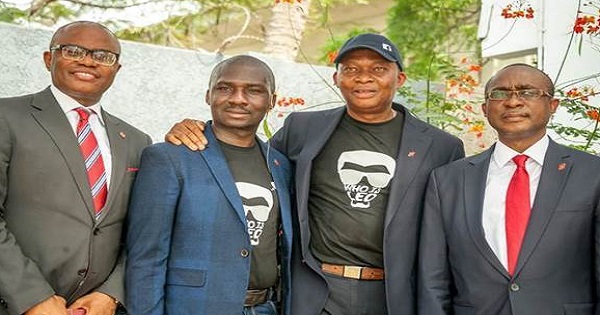
l-r: CEO, UBA Francophone Africa, UBA Plc, Mr. Emeke Iweriebor; Group Head, Online Banking, UBA Plc, Mr. Austin Abolusoro; GMD/CEO, UBA Plc, Mr. Kennedy Uzoka; and Executive Director and Group Chief Operations Officer, UBA Plc, Mr. Chukwuma Nweke, during the launch and introduction of Leo, a Chat Banking Personality on Social Media Platforms by UBA in Lagos
Kindly share this post

United Bank for Africa (UBA) is fundamentally changing the way people communicate with their banks with Leo, the UBA Chat Banker that enables customers make use of their social media accounts to carry out key banking transaction.


On Thursday, January 11, 2018, the bank brought together its customers and financial journalists at The Backyard Bar & Grill on Musa Yar’Adua Street, Victoria Island, Lagos for the launch of its latest app.


Everyone present at the event knew it had to be something revolutionary.


For a bank that has scored many firsts in the industry and is ranked among the top three banks in effective use of social media in Nigeria in a social media report by Alder Consulting; a bank that has invested heavily in building a robust and secure e-banking platform that supports its e-banking operations globally through strategic partnerships with various local and international organizations, you could only expect the bar to keep going higher.


Beyond being active on Twitter, Facebook, Youtube, Instagram, Google Plus, and also running a corporate blog, Africa’s global bank is continuously innovating and developing strategies aimed at making banking seamless and effortless for millions of its existing and potential customers, while also ensuring utmost safety of their transactions.


It was, therefore, not surprising that UBA would score yet another first with the introduction of Leo, an innovation that is capable of revolutionizing the way banking is done in Africa.


Leo, a UBA Chat Banking personality that enables the bank’s customers to make use of their social media accounts to carry out key banking transactions, comes as a solution developed with people’s lifestyles in mind.


With Leo, customers are able to open new accounts, receive instant transaction notifications, check their balances on the go, carry out money transfers and airtime top-up, pay for Uber, as well as perform other transactions like payment of bills, data top-up, mini-statements, loan applications, cheque confirmation, account freezing, among others right on their mobile phones.


Designed to work within the platforms people are already familiar with, Leo has already taken off on Facebook Messenger. In the nearest future, the app is expected to show up on other social media platforms and all it takes to enjoy the services is simply to have a Facebook account.


At the official launch of Leo in Lagos, Kennedy Uzoka, Group Managing Director/CEO, UBA Plc, explained that Leo, being an intelligent personality, will give customers instant feedback as they transact their business on the platform, describing it as “a solution that is from the customer’s standpoint which is easy to use by anyone regardless of your career”.


“The formulation of this product is consistent with the bank’s customer-first philosophy, where we are doing things not the way we like but exactly what the customers want, where they want it, and in the exact platform they want,” Uzoka said.


“And so, we have been working with technology giants from around the world because for UBA with so many customers, we have to deal with those who have the global capacity. Therefore, we at UBA have collaborated with Facebook to come up with this. In future, Leo will show up with other platforms. All you need to do is to have an account with Facebook,” he said.


Highlighting some of the advantages of using the app, Uzoka said the chat language is elementary, and Leo can even help one remember what he or she needs to do at every particular point in time. On security of the platform, he said that Chat Banking with Leo does not elevate the risk already available.


“You do not need to learn to use it because it has always been part of your life. It is solution from customers’ point of view. Its greatest asset is its simplicity. Leo is an artificial intelligence. He will address all banking concerns. He should help pay for everything but you need to have an account with UBA to transact with Leo,” Uzoka said.


“This is the first time that a financial institution in Africa has come up with this manner of solution to simplify the way customers transact, something that has become necessary in today’s fast-paced world with demands for quick-time transactions and response,” he said.


He expressed belief that with the huge number of customers the bank has as well as its growing customer base in all the 19 countries of operation, customers would be served using modern and forward-looking technology.


Austine Abolusoro, group head, Online Banking, UBA Plc, who took UBA customers and journalists present through a step-by-step demonstration on how to make use of Facebook chat function to enjoy seamless banking services through chat sessions, explained that Leo is not just a chat machine but an artificial intelligence service as well a personality meant to address any type of banking concern.


“Leo is ready and waiting to help with most transactions and to deliver any form of banking services. Leo is operating a lifestyle banking platform on Facebook Messenger to assist with your transactions while chatting with your friends and business partners,” Abolusoro said.


“The security with this platform is that for every transaction, an OTP (One Time Password) is generated to the phone number that is registered on the account,” he said.


He explained further that to open an account and enjoy the chat banking advantage, the prospective customer just needs to log on to the Facebook Messenger and open up chat with Leo, who then takes over the conversation by telling the customer what steps to take.


On security measures, he said the prospective customer needs to provide a Bank Verification Number (BVN) and phone number that is linked to the BVN.


But there is a ceiling on the volume of transaction that can be done by customers, the bank said. Customers with low-key Know Your Customer (KYC) will transact to a limit of N50,000 daily, already existing customers can do N200,000 and N100,000 in the first seven days even as the accounts can be upgraded to do higher transaction volumes.


“We are increasing customers’ happiness level with this product. We have brought banking to the chartroom,” Uzoka said.


No doubt, as e-banking continues to reshape the way bank customers carry out their financial transactions by providing 24-hour services and saving customers the stress of joining long queues in banking halls, UBA Plc is leaving no stone unturned in its bid to not just keep up with technology but to always stay ahead of the game.


With eyes on the future, and conversant with the new trend in customer behaviour, the bank is constantly innovating, taking strategic steps to integrate more people into the digital financial services net, drive down cost of service, and build consumer confidence in digital platforms.


Kindly share this post

Nigeria CommunicationsWeek believes that technology makes life more exciting and helps improve the lives of people around Nigeria and indeed the world. So since 2007, we have devoted our energy to independent reportage of technology and how they affect lives.

E-Financial

CBN Revokes Licenses of Two Mortgage Banks, NDIC Begins Liquidation

Published

on

Kindly share this post

Nigeria’s banking regulators have moved to shut down two mortgage lenders after prolonged financial distress, as authorities intensify efforts to enforce capital discipline and restore confidence in the country’s housing finance system.

The Central Bank of Nigeria (CBN) has withdrew the operating licenses of Aso Savings and Loans Plc and Union Homes Savings and Loans Plc, setting in motion a liquidation process that will see insured depositors paid by the Nigeria Deposit Insurance Corporation (NDIC).

The revocation marks a decisive intervention by the central bank, which said the lenders repeatedly failed to meet regulatory standards despite supervisory actions.

In a statement signed by Hakama Sidi Ali, acting director of corporate communications, the CBN said the decision was taken under the Banks and Other Financial Institutions Act, BOFIA 2020, and the revised guidelines for mortgage banks, as it seeks to re-position the sub-sector and entrench compliance.

“As part of its efforts to re-position the mortgage sub-sector and promote a culture of compliance with relevant laws and regulations, the Central Bank of Nigeria has revoked the licenses of Aso Savings and Loans Plc and Union Homes Savings and Loans Plc,” the statement said.

The central bank said the two institutions breached several provisions of BOFIA 2020 and regulatory guidelines, citing weak capital, balance-sheet strain and persistent non-compliance.

According to the CBN, the lenders failed to meet the minimum paid-up share capital requirement for their licence category and did not have sufficient assets to meet their liabilities.

The lenders were also “critically undercapitalised with a capital adequacy ratio below the prudential minimum ratio as prescribed by the CBN,” the regulator said, adding that both institutions failed to comply with several directives imposed by the central bank over time.

The action highlights the CBN’s broader push to tighten oversight of Nigeria’s financial system after years of regulatory forbearance, particularly in niche segments such as mortgage banking that have been weighed down by funding constraints, rising credit risk and weak profitability.

While the sector accounts for a small share of total banking assets, it is viewed as key to expanding access to long-term housing finance in Africa’s most populous economy.

The CBN said it remains focused on safeguarding systemic stability. “The CBN remains committed to its core mandate of ensuring financial system stability,” the statement said.

Following the withdrawal of the licenses, the NDIC was appointed liquidator of the two lenders and has begun the process of winding them up, including reimbursing eligible depositors.

In a separate statement on Tuesday, the Corporation said it had commenced liquidation in line with the NDIC Act 2023 and started verification and payment of insured deposits to customers of the defunct banks.

Depositors are entitled to receive up to ₦2 million per depositor, with payments to be made using Bank Verification Numbers (BVN) to identify alternate bank accounts for automatic credit.

Customers with balances above the insured limit will receive the initial ₦2 million, while the remaining sums will be paid as liquidation dividends after the realisation of assets and recovery of outstanding loans, the NDIC said. The corporation added that it would begin selling the banks’ assets and intensify debt recovery efforts to accelerate payments of uninsured balances.

The NDIC advised depositors to submit claims either online or physically at branches of the closed banks during the verification period, with valid identification and proof of account ownership. Creditors were also asked to file claims, with payments to follow after all depositors have been fully settled, in line with statutory provisions.

Staff and shareholders of the defunct banks will only be paid after depositors and creditors, from proceeds realised during liquidation, the NDIC said, while urging borrowers to repay outstanding loans and assuring the public that other licensed banks remain safe and sound.


Kindly share this post
Continue Reading

E-Financial

CBN Revokes Licences of Aso, Union Homes Mortgage Banks Over Regulatory Breaches

Published

on

Kindly share this post

Central Bank of Nigeria (CBN) has revoked the operating licences of Aso Savings and Loans Plc and Union Homes Savings and Loans Plc, citing persistent regulatory breaches that undermined the safety and soundness of the institutions.

CBN Revokes Licences of Aso, Union Homes Mortgage Banks Over Regulatory Breaches

CBN

In a statement issued on Tuesday, the Acting Director of Corporate Communications, Mrs. Hakama Sidi Ali, said the decision was part of renewed efforts to sanitise the mortgage sub-sector and enforce strict compliance with banking regulations.

According to her, the affected institutions violated several provisions of the Banks and Other Financial Institutions Act (BOFIA) 2020 and the Revised Guidelines for Mortgage Banks in Nigeria.

“The institutions failed to meet minimum paid-up share capital requirements, were critically undercapitalised, and did not comply with multiple regulatory directives. They also lacked sufficient assets to cover liabilities,” Sidi Ali said.

She explained that the revocation was intended to strengthen confidence in the mortgage sector and ensure that only institutions capable of operating safely and soundly are allowed to continue business.

The apex bank stressed that it remains resolute in enforcing regulatory standards across all segments of the financial system.

“The Central Bank of Nigeria remains committed to its core mandate of ensuring financial system stability,” Sidi Ali added.

Nigeria CommunicationsWeek reports that the move follows repeated warnings from the CBN in recent years, urging mortgage operators to improve capitalisation, governance, and compliance with statutory requirements.

Industry analysts say the action is expected to reinforce discipline within the mortgage banking segment and restore public trust in the sub-sector, which has struggled with weak capitalisation and governance challenges.


Kindly share this post
Continue Reading

E-Financial

Tax Reform or Financial Exclusion? The Trouble with Mandatory TINs

Published

on

Kindly share this post

By Blaise Udunze

It is not only questionable but an aberration that a nation where over 38million Nigerians remain financially excluded, where trust in institutions is fragile, and where citizens are pressured under the weight of rising living costs, the use of Tax Identification Number (TIN) has been specified as the only option for their bank accounts operation from January 1, 2026 by the Federal Government of Nigeria.

Tax Reform or Financial Exclusion? The Trouble with Mandatory TINs

Tax Reform

In practice, the policy spearheaded by Taiwo Oyedele, Chairman of the Presidential Committee on Fiscal Policy and Tax Reforms, is rooted in the Nigerian Tax Administration Act (NTAA), and the intention can be understood in the areas of improving tax compliance, widening the tax net, and formalizing economic activities. But in practice, the directive risks becoming yet another well-meaning reform that punishes the wrong people, disrupts financial inclusiveness, and potentially destabilises an already stressed economy.

Yes, Nigeria needs tax reforms. Yes, the country must broaden its tax base. And yes, public revenues must increase to address fiscal pressures.

But compelling citizens to obtain TINs as a condition for operating bank accounts is the wrong tool for the right objective.

Below are five core arguments against the directive, and sustainable alternatives that actually strengthen tax compliance without endangering banking access or punishing informal earners.

The Directive Risks Deepening Financial Exclusion

Nigeria still struggles with financial inclusion. According to several official assessments, over 38 million adults remain outside the formal financial system. Many of them operate small, irregular businesses, survive through subsistence earnings, or depend on cash-based livelihoods.

The Federal Government’s compulsory TIN-for-bank-accounts policy is built on the assumption that every banked Nigerian is structured, organised, and tax-ready. This is false.

For instance, the rural market woman with N30,000 in rotating savings, the okada rider who deposits cash once a week, the petty trader using a mobile POS agent account, the retiring pensioner managing a small monthly income, and the migrant worker sends small remittances to their family. These are not tax evaders; they are survivalists.

Most operate bank accounts not because they run formal businesses, but because those accounts are essential to modern financial life: receiving transfers, accessing loans, participating in digital commerce, saving against emergencies, and avoiding the risks of moving cash in insecure environments.

By creating an additional bureaucratic barrier, the directive risks pushing millions back into a cash-dominant shadow economy, precisely the opposite outcome of what Nigeria’s financial-sector reforms are trying to achieve.

Bank Accounts Are Not Proof of Taxable Income

The NTAA clarifies that the TIN requirement applies only to taxable persons, individuals engaged in trade, employment, or income-generating activities.

But herein lies the problem: banks cannot determine who is “taxable” and who is not. Banks only see deposits and withdrawals. They do not audit the source or consistency of income. They are not tax authorities.

A student may run a small online clothing resale gig. A retiree may occasionally rent out farmland.

A dependent may receive cash support from a relative abroad. A job seeker may get intermittent gifts from family.

Who decides which of these scenarios qualifies as taxable? Banks? FIRS? Or will citizens be expected to self-declare under threat of account restrictions?

The result will be confusion, over-compliance, and mass panic with banks indiscriminately demanding TINs from everyone to avoid regulatory penalties.

This not only contradicts the spirit of the law but also exposes ordinary Nigerians to harassment and arbitrary compliance requirements.

The Policy Could Trigger Disruption, Panic Withdrawals, and Cash Hoarding

Whenever Nigerians perceive threats to their access to funds, the natural reaction is withdrawal and hoarding. We saw it during:

–       the 2023 Naira redesign crisis,

–       the 2016 TSA-bank consolidation tightening, and multiple periods of financial instability.

Telling citizens that bank accounts may face “operational restrictions” if they do not obtain a TIN creates a predictable behavioural response: people will rush to withdraw money.

This would be disastrous for a banking system already pressured by:

–       high interest rates,

–       inflation eroding deposits,

–       rising loan defaults, and

–       declining public trust.

Any government policy that unintentionally creates an incentive for citizens to flee the formal banking system is counterproductive.

The TIN Requirement Will Become a Bureaucratic Nightmare

Even if millions of Nigerians want to comply, the system is not ready. Nigeria’s administrative infrastructure does not have the capacity to process tens of millions of TIN registrations within months without:

–       long queues,

–       delays,

–       data mismatches,

–       duplicate records, and

–       systemic errors.

The National Identity Number (NIN)-SIM registration experience is a painful reminder of what happens when ambitious policy meets weak execution capacity.

–       Citizens spent months in overcrowded enrolment centres.

–       Millions were blocked from services.

–       Data inconsistencies persisted.

–       The economy suffered productivity losses.

If Nigeria could not seamlessly synchronise NIN and SIM data, how will it synchronise NIN, BVN, and TIN at a national scale without dislocation?

Forcing TIN Adoption Ignores the Real Problem: Nigeria’s Broken Tax Culture

The Federal Government’s real challenge is not that citizens lack TINs, but that they lack trust in how taxes are used.

A government cannot widen the tax net when:

–       tax leakages remain widespread,

–       citizens feel services do not match taxation,

–       corruption perceptions are high,

–       government spending lacks transparency, and

–       taxpayers do not feel seen, heard, or valued.

Coercion does not build a tax culture. Engagement does. Policy does not create legitimacy. Accountability does.

If the Federal Government wants Nigerians to freely participate in the tax system, it must earn legitimacy first, not mandate compliance through financial restrictions.

What the Government Should Do Instead: A Smarter Path to Tax Reform

Instead of enforcing a policy that may backfire economically and socially, the Federal Government can adopt four smarter, people-centred alternatives.

–       Automatic TIN Issuance Linked to NIN and BVN

Rather than forcing Nigerians to apply manually, the government should:

·       auto-generate TINs for all existing BVN/NIN holders,

·       send the TINs via SMS, email, and bank alerts,

·       allow self-activation only when needed for tax obligations.

This eliminates queues, delays, and confusion.

–       Build a Voluntary Tax Compliance Culture Through Transparency and Incentives

Tax morale improves when citizens see value. Government should:

·       publish annual audited reports of tax revenue use,

·       incentivise compliant taxpayers with benefits (priority access to government grants, credit scoring, etc.),

·       simplify tax filings for small businesses.

People comply more when they feel respected, not coerced.

–       Target High-Value Tax Evaders, Not Low-Income Account Holders

Nigeria’s real tax leakages come from:

·       large corporations shifting profits,

·       politically exposed persons,

·       illicit financial flows,

·       multinational tax avoidance strategies,

·       the informal “big money” class operating outside the banking system.

Instead of threatening small depositors, the government should strengthen:

·       FIRS intelligence and investigation units,

·       inter-agency data integration (CAC, Customs, Immigration),

·       beneficial ownership transparency enforcement.

The fight against tax evasion should focus on those hiding billions, not those depositing thousands.

–       Strengthen Digital Tax Platforms for Easy Self-Registration and Compliance

If tax registration becomes as easy as opening a social media account, compliance will rise naturally. The government should build:

·       a mobile-first tax app,

·       simplified online TIN retrieval,

·       one-click tax filing for gig workers and small traders.

Digital convenience can achieve what regulatory coercion cannot.

Reform Should Not Punish the Public

No doubt, tax reforms are needed urgently, but they must come with a human face, an intelligent, equitable, and aligned with the realities of ordinary Nigerians.

The TIN-for-bank-accounts policy, while well-intentioned, risks undermining financial inclusion, triggering economic instability, and imposing unnecessary burdens on millions who are not tax evaders but survival-based earners.

Good tax policy is built on trust, not fear. On transparency, not threats. On civic legitimacy, not administrative compulsion.

If the Federal Government truly wants to modernise Nigeria’s tax system, it must focus not on restricting citizens’ access to their own money, but on:

·       repairing tax trust,

·       digitising compliance,

·       targeting the real evaders, and

·       making participation easier, not harder.

Financial inclusion took Nigeria decades to build. We cannot afford a policy that carelessly reverses these gains.

A better tax system is possible, but it must start with the people, not with their bank accounts.

Blaise, a journalist and PR professional, writes from Lagos, can be reached via: [email protected]


Kindly share this post
Continue Reading

Trending