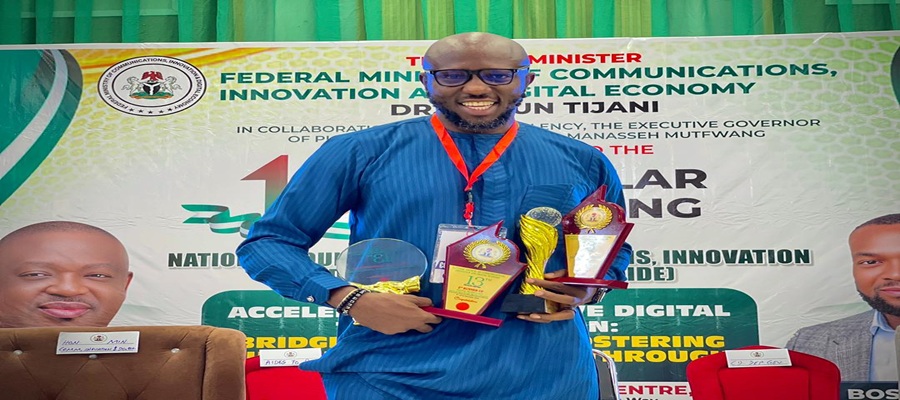
Stanley Muoneke is West Africa Business Development director at Intel responsible for driving Intel Corporation connectivity related engagements and business.
His broad 15 years experience spans business development, sales, management and consulting working in local IT firms Bitcom Systems and Zinox Technologies as well as global multinationals like Hewlett Packard and software giant’s Microsoft.
Muoneke studied at the University of Benin, where he holds a masters degree in engineering and an MBA and has attended numerous advanced courses globally.
He spoke to chike onwuegbuchi on a wide range of issues
Role of Intel in Developing IT in globally
We could easily look at Intel and say Intel is at the forefront of innovations and if you look inside computers, Intel is best known as a company that does silicon. The leading microprocessor company in the world, the very heart of PC itself is driven by Intel’s technology, but beyond your knowledge of our leadership in chips and processors; current Intel innovations spans broad computing platforms in various spheres of life. It is not just what we make but what we make possible, through Intel’s technology. Today, we have innovations in all works of life..From transportation to developments in health, education and all of those things. Our technology makes all of these things possible.
Relationship with Local OEMs
These local OEM’s are valuable partners to Intel and Intel is proud to be associated with them and their growth and obviously through that growth, its contribution to local skills and manpower development as well as developments of the businesses of these companies. These companies because they are system builders work with us and use our technology to put together their products and services, so we work with them as partners.
Of course we also work very well with our multinational MNC partners.
Corporate Social Responsibility
Intel has driven lots of programs in this area, focusing primarily on broad education and especially teacher training. In the last 5 years we have worked with various ministries and agencies to train about 70 thousand teacher. Helping them incorporate technology in their teaching. We have provided software etc worth millions into numerous programs of this nature. We are committed to Nigeria and will continue to increase and support these initiatives.
Intel World Ahead Programme
The whole objective of Intel World Ahead Programme(WAP) is how to connect the next billion people to uncompromised technology around the world. The WAP has four pillars and these four pillars are accessibility, connectivity, education and content. Accessibility addresses strategies and programs to ensure easy and affordable access of computing technology to people worldwide working with national governments, corporate , individuals etc .Examples of this are CANI in Nigeria and IAdvance in Ghana.. You see us getting involved in how to provide affordable computing for employees, for students so we are involved in a whole lot of programmes around that particular space. Under connectivity, you see us having very broad collaboration with Service Providers and Telco’s because it is like two sides of a coin; you can have computing and connectivity driving each other.. In today’s world, you see a lot of convergence between computing and connectivity. Once you have that connectivity, what do you do with it? That brings us to the third pillar which is education. In the last five years we have trained about 70,000 teachers in this country. How do you use the PC, how do you ensure that the content is digitized, how do you ensure that teachers are trained on how to use PCs to teach? Being able to teach with a PC means everything from lessons notes to digital content to methodology are available and arranged in such a way as to allow the teacher to , for instance teach Biology more effectively using the technology and resources to teach in a way students will understand . It is very different from trying to teach a student how to use an application in a computer .In this manner ,the PC then becomes a tool for teaching and we work with partners to do this. We have got the teacher training component and all other components in most of our programs. This naturally brings us to the fourth pillar which is Content. The question here is what content do you then teach students? Is this content aligned with the approved local curriculum? Do you have enough local content etc?We have got lots of partners who we work with around local contents because if you give people content that is local to them, that will make sense, they begin to understand. Content also means digitizing what is currently part of the written and approved curriculum and making it available in digital format. We work with the Ministries of Education and we have been very active in IT in education and PC in education. We have also worked in education at the policy level. We have provided contents for free, if you go to www.skoool.com.ng; you will see content that is available , customized and aligned with the countries curriculum in digital format and is available both online and offline; helping students in various areas including mathematics and science .
Connectivity and collaboration with service providers
Connectivity is crucial for us because like voice today where we are able to talk cheaply and save ourselves the hassle of travelling; connectivity means that we can participate more in the world economy. It means that people can be more educated, it represents a massive leap in a lot of things.
We work with regulators globally help build capacity and access to global best practice. We also have a lot of experience working all over the world with service providers on the technology side so we’ve got a lot of collaborations in trying to deploy all sort of technology. Intel supports Wimax, however this does not mean that it’s the only technology we support .Indeed we support broadband generally. I agree with you regarding the gap in last mile capability however, I believe that following the hugh bandwidths that are landing at Nigeria’s beaches and capacity rises we will probably see more and more investment in the last mile capabilities. We have a role to play in this and we engage at both the policy level, capacity building level in terms of training and we engage on the technology side as well to provide expertise.
Helping Telco’s Grow Data ARPU
We have global expertise in this area. Today voice ARPU (average revenue per user)of Telco’s is dropping as subscriber numbers grow. For Instance, unlike our large voice penetration numbers in Nigeria, our data penetration is less than 10%. So it represents a great area of growth for Telco’s. It’s true that Smartphones with internet connectivity have helped us make strides but if you look at the usage models you notice people mainly do a bit of e-mail and search on their smart phones. When they want to do serious online interaction, they do it on a computing device. As such, today the best platform for consuming data is a connected computing device. Often you will consume about 30 times more data on a connected computing device. This represents at least not less than a five times profitability over voice. That’s the reason you see lots of Telco’s getting interested in connected device bundles . Intel is currently involved in about 170 of these Telco bundles globally providing training, tools , program design and support as well as technology roadmap insight and marketing collaboration. We have provided this support to local Telco’s in the last two years and are open to helping more in this area. We are excited by the cable landings because we hope that it drives more affordability of data services and helps Telco’s provide more value to their customers.
New technology
Technology keeps evolving to ensure that the world (governments, corporate, etc) is able to deliver systems and services that are smarter, and more efficient. You will find that Intel’s new ranges of processors are incredible. The new Corei3, core i5 and Corei7 are phenomenal and have been described as intelligent computing. Try and get more information on them. When you look at the range of performance that our new server technology enables, it is incredible what they are doing. Imagine in a single refresh you are able to get a server performance sometimes delivering 100x and more times performance extra, it blows the indices away. Today Intel’s technology of the Atom processor has spawned a new pc category of netbooks which have made it possible for the consumer to acquire a computing platform at about less the price of a high end Smartphone, making it easy for the consumer to get value.
Development of IT in Nigeria and other African Countries
I think it is rapid. IT is developing; we live in an emerging market where we have in many cases the greatest chance to use IT to increase the lot of our people. Everything from education to health is driven largely by innovations in IT. You will find that our government just like the government of other West African countries is increasingly making more and more investments in IT. If you go across the border to Ghana, you will see that they are executing a national IT policy which is delivering results. You will increasingly see more and more programmes and projects come up. In the last four years, we have seen a good growth in ICT generally across the regions.