Telecom
#DRIF19: Delegates Call for Renewed Action to Protect Digital Rights in Africa

Delegates at the Digital Rights and Inclusion Forum have expressed concern at the spate of violation of human rights online on the African continent, calling for renewed action to protect the digital space from rights violations.
The delegates were speaking at the 3-day Forum which held in Lagos, Nigeria, from April 23-25 and welcomed delegates and speakers from across Africa and beyond.
The Forum provides a platform for conversations on efforts to ensure human rights online are not violated and that more people in Africa are connected to the internet.
Anriette Esterhuysen, the former executive director of the Association for Progressive Communications, in her submission, argued that the internet has to be protected and remain open as “it is the usually the only means of expression for some minority groups to access information on issues that are not openly discussed.”
Grace Githaiga, the co-convener of KICKTANET said, despite the challenges facing the digital rights space on the continent including internet shutdown, harassment of internet users and online journalists, and lack of data protection laws in many countries, “advocates should celebrate the positive- good laws, initiatives, and partners that allow us to meet and remaining optimistic of a better future.”
This came on the backdrop of conversation on internet censorship that has rocked the continent over the last few years.
Africa now leads with the highest number of countries shutting down the internet or restricting service.
In Chad, for example, social media has been shut down by the government for over a year now.
In 2019 alone, Chad, Sudan, Zimbabwe and DR Congo have either shut down the internet or restricted access to services.
Speaking on the challenges facing efforts to improve internet penetration, Funke Opeke, the chief executive of MainOne Cable, emphasised the need for government to partner the private sector instead of constituting itself as a stumbling block to expand internet access.
She said governments in other climes “create the right incentives and structures to facilitate access to the internet, especially in the rural areas.
Dr Ernest Ndukwe, a former chief executive of the Nigerian Communication Commission, also urged civil society and active citizens “to focus more attention on what government can do to ensure people have access.”
The Forum also explored the state of data protection and privacy laws on the continent.
Ephraim Kenyanito of Article 19 and Morisola Alaba of Media Rights Agenda, while speaking on the new 5G technology, said there was an urgent need to have data privacy legislation as the technology made its way to the continent, saying the technical capabilities of 5G could allow for greater surveillance capacities for repressive governments.
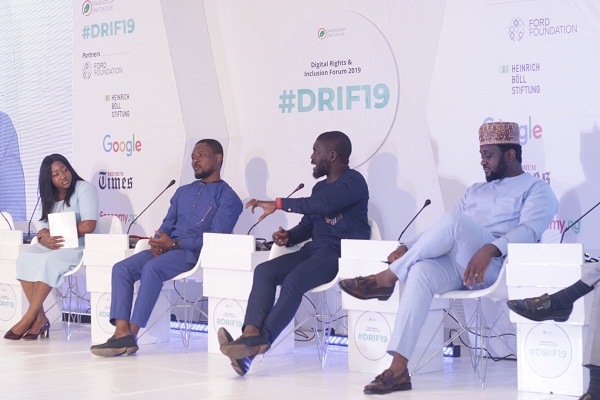
The tone for the Forum was set by the Opening Panel which was moderated by ‘Gbenga Sesan, the Executive Director of Paradigm Initiative and featured Hawa Ba, the Head of Senegal Office of Open Society Initiative for West Africa, Segun Mausi, Head of Africa division at Human Rights Watch, and a Emmanuella Darkwah who was representing Ghana’s National Security Advisor.
The Panel explored the centrality of human rights to modern society and the need to dedicate resources and attention to the protection of human rights.
Hawa Ba highlighted the crucial role the internet has played in public education and mobilisation in Senegal and said it was important to ensure the internet remained an open and safe platform.
Mausi Segun said all internet users have a duty to fight for the protection of digital rights and to make sure their government enables internet access for more citizens.
While according to Ghana’s Emmanuella Darkwah, Ghana was working on a law to make internet shutdown impossible in the country, delegates from Togo, Chad and Cameroon bemoaned the ease with which their governments shut down the internet and specific internet services.
In Chad, a delegate reported, social media platforms have been unavailable for over a year now, making life unnecessarily harder for the people of the country.
In his closing remarks, ‘Gbenga Sesan urged delegates to go back to their countries with a renewed energy to contribute to efforts to keep the internet safe and open to all users, saying “digital rights advocates are in the business of not minding our businesses.
“We have no choice but to be involved in efforts that help protect the internet, and to resist action that endangers human rights online.”
#DRIF19 is the seventh edition of the Forum which is convened annually to provide an “important platform where conversations on digital policy in Africa are shaped, and policy directions forged.”
The Forum, organised by Paradigm Initiative and supported by Google, Ford Foundation, and Heinrich Böll Stiftung, welcomed delegates from 38 countries.

Telecom
Surge in Fibre Cuts Hobbles Service Provisioning

Nigeria’s telecom operators recorded 155, 397 fibre-cut incidents between April and May 2026, and these they blame on why internet or calls suddenly stop working.

Data from the Nigerian Communications Commission (NCC) showed fibre-cut incidents increased from 74 276 in April to a record 79 121 in May, bringing the two-month total to the highest level recorded by the industry.
This represents a 2 428% increase from the 5 934 incidents reported during the first quarter of 2026.
Vandalism remained the leading cause of fibre cuts, accounting for more than 54 000 incidents despite telecom infrastructure being designated as Critical National Information Infrastructure, a classification intended to strengthen protection of key digital assets.
Also road construction constantly damages fiber where iggers and machines tear up buried cables during road repairs or construction.
Even with all these, some state governments make it hard for companies to fix cables quickly across different areas with all manners of fees and levies.
The NCC designation provides for penalties of up to 10 years’ imprisonment for offenders, but operators continue to face widespread infrastructure damage.
Proposed solutions, including Nigeria’s Dig-Once policy and AI-powered fibre sensing technologies, have yet to achieve widespread adoption.
The NCC is developing a cost-based framework for shared underground duct infrastructure, while operators are exploring AI-powered fibre sensing technologies that can detect cable damage in real time and improve network resilience.
Nigeria is pursuing ambitious broadband targets under its National Broadband Plan and has expanded fibre deployment to about 35 000 kilometres.
However, infrastructure protection has not kept pace with network expansion, leaving subscribers vulnerable to unreliable connectivity despite continued operator investment.
Telecom
Helios Towers Secures $29m Facility to Expand Across Africa

Standard Bank has partnered with Helios Towers to provide a $29 million Social Documentary Credit Facility. According to the financial services company, this transaction marks Standard Bank’s first Documentary Credit Facility structured in a Sustainable Finance format.

It notes that the facility will support the procurement and importation of telecommunications infrastructure and related services across Africa.
It will also provide payment certainty to suppliers, while supporting Helios Towers’ working capital requirements and infrastructure expansion programme, the bank adds.
Structured in accordance with the Loan Market Association’s Social Loan Principles, the financing is designed to promote digital connectivity and telecommunications infrastructure development in underserved markets.
This will help Helios Towers further expand its footprint and enhance mobile network coverage and connectivity across the continent.
Helios Towers operates one of Africa’s independent telecommunications tower platforms, enabling mobile network operators to extend coverage across multiple markets.
Standard Bank notes that the facility supports the expansion of tower infrastructure and services, increased network densification and improved connectivity in underserved markets and remote regions across the African continent.
It will also drive digital inclusion and tackle the digital divide while supporting economic growth and socio-economic development.
“This transaction demonstrates the power of innovation in trade finance. By combining a first-to-market Social Documentary Credit Facility with a cross-border funding solution, Standard Bank has supported Helios Towers’ growth ambitions while helping extend digital connectivity to underserved communities across Africa,” says Benoit Samouilhan, global transaction banker at Standard Bank Corporate and Investment Banking.
According to the bank, this facility enables positive social impact by increasing and improving network coverage and connectivity in some of the world’s most remote regions.
“Reliable digital infrastructure is fundamental to Africa’s future growth and development,” says Alex Carter, group finance director at Helios Towers.
“This facility provides us with the flexibility and certainty needed to support our ongoing infrastructure investments while advancing our mission of expanding connectivity across the continent. We value our longstanding relationship with Standard Bank and look forward to building on this partnership.”
Telecom
NCC Begins Stakeholder Consultation on MVNO Business Rules

Nigerian Communications Commission (NCC) will on Thursday convene a stakeholders’ consultative forum to review the draft business rules for Mobile Virtual Network Operators (MVNOs) in Nigeria.

NCC
The forum, scheduled to hold at 10 a.m. at the NCC Annex Office, Mbora, Abuja, is expected to bring together telecommunications operators, industry associations and other stakeholders to provide input on the proposed regulatory framework before its finalisation.
The commission announced the event on its official social media platforms, inviting interested stakeholders to participate in the consultation process.
The engagement is part of the NCC’s efforts to strengthen the regulatory framework for MVNO operations and promote greater competition, innovation and consumer choice in Nigeria’s telecommunications sector.
Mobile Virtual Network Operators are telecommunications service providers that offer mobile services by leasing network capacity from licensed Mobile Network Operators (MNOs), rather than owning spectrum licences or telecommunications infrastructure.
The NCC has identified the MVNO licensing framework as one of its initiatives aimed at deepening competition, expanding access to telecommunications services and driving digital inclusion across the country.
The consultative forum is expected to provide stakeholders with the opportunity to review the draft business rules, make recommendations and contribute to the development of a robust operational framework for the emerging MVNO segment.
The commission is expected to issue further details on the outcome of the consultation after the meeting.
Telecom2 days agoMTN Nigeria Slashes Cost of Broadband Internet Router, Unwraps New Data Bundles for Low-Budget Users
E-Financial2 days agoNigerians Accumulate $59Bn in Cryptocurrency Assets —FDC
General News2 days agoNearpays, Nigerian Fintech Becomes First African Startup to Win UN’s AI for Good Innovation Factory
E-Financial2 days agoFlutterwave Partners Xoom on Transfers into Nigeria
Telecom2 days agoNokia’s 14 Years of Mobile-Phone Supremacy Ended in an Afternoon
News2 days agoDataPro Upgrades Dangote Cement’s Credit Rating to AA+
General News2 days agoLASG Signs PPP Concession Agreements to Advance Digital Services, Others
General News2 days agoFintech Brands Should Communicate Right in a VUCA Economy