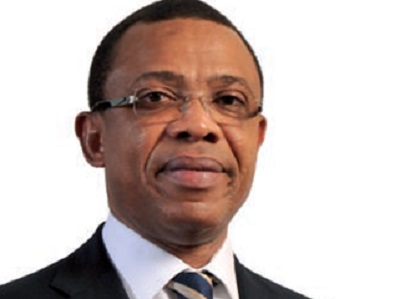
Chuma Ezirim is head, eBusiness group in First Bank Plc that is in charge of developing and managing eChannels and Card business in the bank. He holds a B.Sc in Industrial Chemistry, University of Nigeria, Nsukka and M.Sc. (in the same field), University of Ibadan. He also has a MBA from Nsukka. He is also alumnus of the prestigious Lagos Business School. Ezirim, pioneered the introduction and use of the Smartcard Payment System in Afribank Nigeria Plc as a young banking officer and served in the steering and marketing committees of the Nigeria Smartcard Scheme, where the broad product strategies for the scheme were set. He also has broad experiences from Prudent Bank, where within two years, he took the bank from 27th to the number one position in the Valucard Scheme. Ezirim, was also an assistant general manager at Skye Bank, from where he joined First Bank in November, 2010. He works directly with the group managing director of First Bank to reposition eBusiness as an important source of earnings diversification for the bank. He spoke with miebi senge, excepts:
Overview of Cashless Lagos
I am sure that we all know the objectives behind the cashless policy. We think that the policy is coming at the right time considering all that is happening in the country and I am happy that all the stakeholders have embraced that policy and then of course they are also committed to its success. Last year the Central Bank of Nigeria (CBN) recognized the need to bring all stakeholders in the payment industry together to look at ways of reducing the amount of cash in the country and that concern was based on the risks of carrying cash and of course the cost involved in managing cash. There is also the convenience associated with using electronic payment channels to make payments.
The pilot started in Lagos on January 1 and we have had some hiccups, which are being addressed by the relevant stakeholders. CBN has also recognized the challenges in terms of rolling out the scheme; that is why they have moved implementation of the service fees to April 1, 2012 in Lagos. Between now and the end of March, all stakeholders would have had the opportunity of addressing some of these challenges.
In terms of awareness, the CBN and other stakeholders also are doing very good job in sensitizing the public. There have been several town hall meetings with key stakeholders like traders, artisans, religious groups, etc, where the policy was extensively discussed and demonstrations of the alternative channels like POS terminal were made. The sessions have been largely successful.
We think that it is still too early to start assessing performance of the policy but the good thing we have noticed is that there is a whole lot of awareness. We are getting calls from our corporate and retail customers asking us to come and talk to them about the policy, including organizing awareness sessions with their key distributors and suppliers.
Breaking Tradition of Moving Cash Around
The truth is that we cannot eliminate cash. Even in advanced markets, we still find that cash transactions account for more than 50 per cent of transactions in those markets so we cannot totally eliminate cash. The challenge we have in Nigeria is that we have a situation where we have more than 90 per cent of our transactions done with cash. For us, that is a challenge, with huge implications on key performance indices in our economy. I will like to look at it from the point of view of all key stakeholders – the economy, business, banking industry and then of course, the customers. Three things the policy aims at addressing; one is safety, convenience and cost.
For the economy, for instance the CBN spends so much printing cash. Even the cost of managing the distribution or the circulation is also a major cost.
Studies have shown that if you are able to improve on the efficiency of your payment system, it could lead to savings, which could be as much as one per cent of the GDP of a country. For me that is an achievable goal. This industry spent over 90billion in 2009 managing cash. If we can even reduce that amount by half there would be a saving that translates into investments in infrastructure to improve the quality of services we render to customers. It would also lead to reduction in the cost of funds.
For the business we know that today security is a major concern in this country. Why would a business accept cash in the office or shop, with all the attendant risks. The bad thing about cash is that once it is lost, it is lost. For me, safety is also a major issue for businesses. For those that are into retail businesses like supermarkets, it is a major issue.
For the customers, you are looking at the convenience of carrying and transacting with cash. Why would I want to carry a Ghana must go bag when access to that sum of cash is in my wallet? We know that people attack homes because of cash that is kept at home.
Are we going to make progress with this policy? The answer is yes. This country has also proved with mobile phones that though we might not be numerate but we’re not illiterates. We have over 90 million active mobile phone subscribers now in Nigeria. The truth is that if you are able to use a mobile phone, you should be able to use cards to settle for your transactions at the POS terminal or withdraw money from the ATM. It is easier to use cards than mobile phones.
I think that this country has all it takes to move from paper based transactions to e-based transactions.
Meeting Point Between Banks and Mobile Money Operators
Mobile money is one of the schemes that would support the cashless policy. There are several players in the industry and what the CBN has done is to licence some operators to operate mobile payment schemes. I know that their operations also affect this policy in the sense that instead of just depending on PoS terminals, ATMs, etc for transactions, you use your mobile phone. I think that the scheme would complement what we are doing at least in addressing some of the cash challenges we have and reaching the under-banked and unbanked.
FirstBank and the Cashless Policy
I am sure you are aware that we are the clear leader in the Nigerian payment industry. FirstBank processes about 31 per cent of transactions on the InterSwitch network. One out of every three Verve cards in the market today is a FirstBank First card. We have the highest number of active ATMs in the market. We have the highest number of active PoS terminals in the market. We have the highest number of mobile banking subscribers in the market.
I can go on and on. The truth is that we are well prepared from the acceptance point of view; we have more devices out there than any other player in this market.
In terms of cards, we have issued more cards than any other player in this market. So when we are talking of cashless policy, FirstBank has a major role to play.
The other way to look at it in terms of level of preparedness is that today we are the only bank in Nigeria where you could walk in as a customer and a card would be issued to you and activated within 15 minutes. A customer can walk into a First Bank branch, open an account and be issued a card within 15 minutes, which is also activated on the spot. We have completely eliminated the use of PIN mailers in card issuance. We also have very robust mobile and online banking platforms.
Investment in Cashless Policy
Our investment in e-channels has been on for several years and is still on-going. What we are trying to do now is to look at our processes and increase our presence in some locations by deploying more ATMs, more PoS terminals and enhancing our mobile internet banking platforms. These are basically what we are doing now. I might not be able to tell you how much we have spent in specific terms because these are investments we have made over time.
Job Loss with cashless Policy?
There would not be loss of jobs with the cashless policy. Efficiency enhances productivity. There would be cost savings and more money for people to invest in other productive sectors.
Assurance to customers
All the stakeholders with the support of the CBN have invested a lot in terms of resources and efforts in ensuring that this policy works. Most of the challenges that we have in the industry are being addressed. We are very optimistic and committed to achieving the objectives of the cashless policy.
Nigeria as hub of Cashless in Sub-Sahara Africa
Yes, Nigeria can be a financial service hub in Africa. It is a matter of planning and allocation of the right resources. The CBN is very committed to this, and working closely with banks to ensure that we deploy very efficient and secure electronic payment systems in the country. My Group Managing Director is personally driving all our alternative payment service delivery initiatives in the bank.
Nigeria can Easily Transit to eTransactions – Chuma Ezirim
Comms Week21 Feb 20120 Comments
Chuma Ezirim is head, eBusiness group in First Bank Plc that is in charge of developing and managing eChannels and Card business in the bank. He holds a B.Sc in Industrial Chemistry, University of…
C
Published by
Comms Week
Trained and practicing journalist passionate about telecommunications, fintech, cybersecurity, and digital economy reporting.
You May Like

U. S. Mission Nigeria Celebrates Azih, Nigerian for Fintech Innovation
Autobrake Failure Contributed to Enugu Air’s Benin Runway Overrun - NSIB

NLNG, NCDMB Boost Engineering Research with Innovation Centre
NITDA Seals Strategic Deals with Goose FL and Fireflies AI to Power $1 Trillion Digital Economy Vision
Anambra Seeks Digital Inclusion in Rural Communities