Omnichannel has been a buzzword in retail in recent years, yet providing a seamless shopping experience across all different channels is becoming more and more challenging, according to the International Post Corporation (IPC).
IPC said one reason for this is the huge increase of touch-points the modern consumer has before purchase.
IPC was reacting to according to a Webloyalty & Conlumino research from 2015 which records that in 2000, the average consumer typically used around two touch-points during the purchase process and only 7% of consumers regularly used over four.
Today, an average retail shopper uses just under five different touch-points, including stores, websites, dedicated apps, telephone order lines, catalogues, social media etc.
Seamless shopping experience means that whether a customer is visiting the website from home to research a product, using the mobile app to ‘click and collect’ or walking into a local high street branch to pick something up in person, the customer journey has to run smoothly and in very similar steps.
Should a regular high street shop visitor decides to go to their retailer’s website, he would easily see similarities between the website’s structure and design and those of the physical store, enhancing the user experience and adding to the visitor’s confidence about their shopping.
The purchase path online should also be as similar to the physical store’s as possible so that a purchase can be processed fast and without any issues or hidden costs (in many cases, the delivery costs are only mentioned at the latest stage of placing an order, reducing the sales conversion).
The key, however, is to ensure channels are not completely replicating each other, as online, for instance, can have a different focus and set of business objectives to in-store.
The technologies enabling the omnichannel landscape in retail are capable of turning every touch point, including offline environments and printed materials into online shopping environments and accountable sales vehicles.
Advertising mail has proven to be a powerful physical touch-point that enables online engagement for retail customers using technologies such as Near Field Communication (NFC), BLE (Bluetooth Low Energy), QR-codes and others (view examples in the DM case studies library).
Etihad Deepens Maintenance Agreement with Air France-KLM
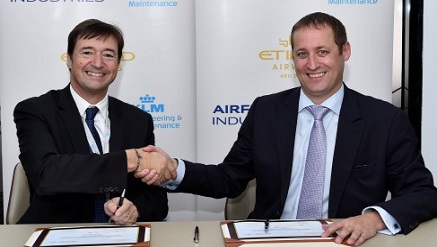
Etihad Airways, the national airline of the United Arab Emirates, has expanded its strategic cooperation with Air France-KLM through a several hundred million US dollar component maintenance agreement for its Boeing 777 fleet.
The 10-year deal, effective February 2016, provides Etihad Airways and its equity partners with access to an extensive global pool of components offered by Air France-KLM’s maintenance arm, Air France Industries KLM Engineering & Maintenance (AFI KLM E&M), for the wide-body aircraft through the 777 Component Services Program (CSP) jointly operated with Boeing. Etihad Airways currently operates a fleet of 33 long-range and extended-range passenger and cargo Boeing 777 variants.
The maintenance agreement is the latest phase of a partnership struck between Etihad Airways and Air France-KLM in October 2012.
The carriers have a commercial alliance involving codesharing on flights across their networks over hubs in Abu Dhabi, Paris and Amsterdam.
The wide-ranging codeshare agreement sees Etihad Airways and Air France-KLM offering joint codes on destinations in Europe, the Middle East, Asia and Australia.
Jeff Wilkinson, senior vice president Technical of Etihad Airways, said: “Through this latest phase in our relationship with Air France-KLM, we are confident Air France Industries KLM Engineering & Maintenance will provide easy, quick, reliable and cost-effective access to components for our triple seven aircraft which are the backbone of our rapidly-growing fleet.
“It builds on an excellent commercial agreement we have enjoyed with Air France-KLM over the past three years helping to provide the high level of efficiencies required in a competitive environment.”
Franck Terner, executive vice president of Air France KLM Engineering & Maintenance, said: “We are very pleased with the trust placed by Etihad Airways in our services. This agreement further demonstrates the competitiveness of our component support offer, and AFI KLM E&M’s ability to tailor maintenance solutions exactly matching its customers’ needs.”
The agreement provides Etihad Airways with access to AFI KLM E&M’s extensive component maintenance network and a significant upgrade of its service offering.
Through its global MRO network, AFI KLM E&M will maintain pool stock in the UAE and around the world to support Etihad Airways’ Boeing 777 fleet.
In addition, the partnership includes a framework for further collaboration with Etihad Airways’ partners and a tie-up with Etihad Airways Engineering for additional maintenance services.
Etihad Airways and Air France-KLM together provide a combined codeshare network of over 40 destinations.
The strategic alliance is aimed at exploring areas of potential cooperation, including joint procurement, maintenance and repair collaboration to identify cost savings and achieve economies of scale.
--
Omnichannel Retail Now Pose Challenge to Online Shoppers- Report
Comms Week12 Nov 20150 Comments
Omnichannel has been a buzzword in retail in recent years, yet providing a seamless shopping experience across all different channels is becoming more and more challenging, according to the…
C
Published by
Comms Week
Trained and practicing journalist passionate about telecommunications, fintech, cybersecurity, and digital economy reporting.
You May Like

U. S. Mission Nigeria Celebrates Azih, Nigerian for Fintech Innovation

Autobrake Failure Contributed to Enugu Air’s Benin Runway Overrun - NSIB

NLNG, NCDMB Boost Engineering Research with Innovation Centre

NITDA Seals Strategic Deals with Goose FL and Fireflies AI to Power $1 Trillion Digital Economy Vision

Anambra Seeks Digital Inclusion in Rural Communities