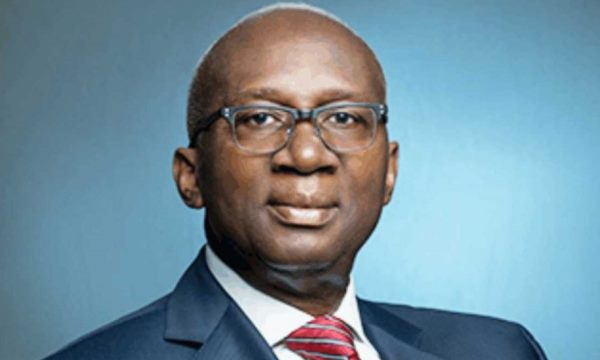
Dr Ernest Ndukwe, former Executive Vice-Chairman of the Nigerian Communications Commission (NCC), will attend the eWorld Forum commemorating 25 years of Nigeria’s Global System for Mobile Communications (GSM) revolution as Special Guest of Honour.
Ndukwe, who currently serves as Chairman of MTN Nigeria, confirmed his participation in the landmark event.
“I will attend by the grace of God,” Ndukwe told the organisers of the eWorld Forum.
Widely regarded as one of the principal architects of Nigeria’s telecommunications transformation, Ndukwe was at the centre of major decisions that laid the foundation for the country’s mobile communications revolution.
He served as Executive Vice-Chairman of the NCC from 2000 to 2010, assuming leadership of the commission at a defining moment in Nigeria’s telecommunications history.
At the time, Nigeria’s telecommunications infrastructure was inadequate, while fixed-line telephone services reached only a small fraction of the population.
Ndukwe and the NCC leadership were, however, presented with an opportunity to change the sector’s trajectory.
The GSM Choice
One of Ndukwe’s defining contributions was his support for GSM technology as the platform for expanding telecommunications access across Nigeria.
At a time when there were arguments in favour of Code Division Multiple Access (CDMA) and other competing technologies, Ndukwe backed GSM.
The decision proved consequential, as Nigeria was not merely choosing a telecommunications technology but a platform on which its communications future would be built.
His vision was straightforward but ambitious: to make telephone services accessible to every Nigerian, irrespective of social or economic status.
The objective was to ensure that access to telecommunications was no longer a privilege reserved for a small elite but an everyday service available to ordinary citizens.
GSM, with its scalability and international ecosystem, provided the platform for achieving that vision.
However, choosing the technology was only the beginning.
Ndukwe also had to help establish the regulatory and investment framework required to attract operators and support the development of a national telecommunications network.
Standing Firm When the Process Was Tested
Among the difficult decisions associated with the historic licensing process was an alleged attempt by influential and well-connected technocrats to disrupt the process while international observers were watching.
The development had the potential to embarrass Nigeria and damage its credibility at a critical point in efforts to attract global investment into the telecommunications sector.
Ndukwe reportedly stood firm, resisting pressure and insisting that the process must continue.
His decision helped protect the integrity of the licensing process and ensured that Nigeria could demonstrate its ability to conduct a credible and transparent telecommunications auction.
The episode remains one of the defining moments of his public service career.
The Licences That Changed Nigeria
Under Ndukwe’s leadership, the NCC pursued a competitive licensing process designed to attract serious investors and establish a sustainable telecommunications industry.
The landmark auction produced a historic outcome.
MTN emerged as the highest bidder, offering $285 million for a GSM licence, while Econet Wireless also emerged as a successful bidder.
The licences paved the way for the operators to undertake the enormous task of building networks and rolling out mobile services across Nigeria.
The process marked the beginning of what would become one of Africa’s most significant infrastructure and economic transformation stories.
The GSM revolution rapidly changed how Nigerians communicated, conducted business, transferred money, accessed information and connected with the rest of the world.
Mobile phones gradually moved from symbols of privilege to essential tools for everyday economic and social activities.
Today, mobile connectivity supports a broad range of services, including digital banking, fintech, e-commerce, social media and broadband-enabled businesses.
Yet, 25 years ago, obtaining a telephone line was a major challenge for many Nigerians, while telecommunications access remained severely limited.
Ndukwe was among the key figures who helped change that reality.
A Friend of the Nigerian IT Press
Another aspect of Ndukwe’s legacy is his support for Nigeria’s technology journalism and specialist IT publications.
At the beginning of the country’s digital transformation, many technology publications faced difficult commercial conditions.
Specialist publications invested heavily in reporting an industry that was still developing, while advertising revenue and other sources of support remained limited.
At that critical period, the NCC, under Ndukwe’s leadership, provided advertising patronage to several Nigerian technology publications.
The support helped specialist media organisations sustain their operations and continue reporting on the rapidly changing information and communications technology landscape.
For many journalists and publishers, the patronage went beyond advertising support.
It helped sustain media platforms documenting the policies, licensing processes, investments, network roll-outs, innovations and personalities shaping Nigeria’s technology transformation.
In that sense, Ndukwe’s contribution extended beyond building the telecommunications industry to supporting the journalism that chronicled its emergence.
A Revolution Still Unfolding
Twenty-five years after the first GSM licences were issued, the impact of the decisions taken at the beginning of the mobile communications revolution can be seen across Nigeria.
From the widespread use of mobile phones to digital banking, fintech, e-commerce, social media, broadband and the wider digital economy, the transformation has reshaped the country’s social and economic landscape.
The GSM revolution did not merely change how Nigerians made telephone calls.
It created new industries, transformed existing ones, opened opportunities for millions of Nigerians and connected communities that had previously been isolated from the national and global economy.
It is against this background that the eWorld Forum will bring together pioneers, policymakers, investors, operators, technology entrepreneurs, journalists and other stakeholders to reflect on 25 years of Nigeria’s GSM revolution.
The event will also celebrate individuals whose decisions and contributions helped lay the foundation for the country’s telecommunications transformation.
Ndukwe will be at the centre of that conversation as one of the regulators who made difficult decisions, championed GSM as a pathway to mass connectivity, opened the telecommunications sector to competition and helped guide the NCC through a decade of extraordinary growth.
For many Nigerians, the GSM revolution began with the issuance of a licence.
But behind that licence were vision, courage, difficult decisions and an enduring belief that every Nigerian — rich or poor — deserved the opportunity to be connected.